Showing posts with label psychology. Show all posts

Thursday, June 5, 2014

Weed for Votes in San Jose, but don't tell Maureen Dowd

On Tuesday in San Jose, California, local marijuana dispensaries gave away weed to anyone who voted in the primary and brought in their "I voted" sticker to prove it:
San Jose voters who brought their “I Voted” sticker – along with their medical marijuana ID card -- to about a dozen participating dispensaries received free or discounted weed on Tuesday, primary Election Day.

Amsterdam's Garden, a San Jose medicinal marijuana dispensary, was busier than most polling places on Tuesday. It’s not a voting precinct, but if you already voted and were a member, you got a reward: a free, pre-rolled marijuana cigarette.

[...]Juan Lopez got his, a little extra product to say “thanks for voting.”

"It's definitely a good idea to get people to vote,” Lopez said, sticking the joint behind his ear. “Offers like this don't happen all the time.”

No doubt Lopez is correct. But, if the so-called “weed for votes” plan works, expect to see it on future election days.

California Medical Marijuana Association Vice President Xak Puckett said says the incentive idea was part brainstorm, part social media campaign.

The San Jose City Council is considering a proposed ordinance to closely oversee medicinal marijuana collectives and cultivation in a city with 78 collectives operating illegally.

The unlawful pot businesses continue to exist since the repeal of a law governing them in 2012. The city did not have enough funds for enforcement to close them down, Mayor Chuck Reed's spokeswoman Michelle McGurk said.

The Silicon Valley Cannabis Coalition posted a list of their recommendations for candidates in San Jose who they believe "will take a reasonable approach to regulating cannabis clubs," founder of the All American Cannabis Club and SVCC member Dave Hodges said in a statement.

A list of clubs participating in the "Weed for Votes" program was posted on SVCannabis.org.
And here I am, in the most conservative county in the USA. (sigh)

If this "weed-for-votes" scheme was at all possible here in South Carolina, I know several people who would have been elected to the Senate by now.

Since that obviously isn't going to happen for awhile, please enjoy the story of Henry, a man who similarly tried to bring happiness to the people.

~*~

Instantly recognizable by the catchy refrain, rolling down the mountain going fast fast fast, this song has also been covered by the Grateful Dead and numerous other jam bands. (It was years before I learned the title was "Henry.")

Delightful steel guitar by Jerry Garcia.

Henry - New Riders of the Purple Sage


~*~

For you young folks who missed that wonderful movie classic REEFER MADNESS (1936) , you can get a modern update from the New York Times' Maureen Dowd, who ate PART (!) of a pot-candy-bar in Colorado and flipped out.

Yes, that's the story, and she's sticking to it.

At least one of my friends believes her column is alarmist, invented bullshit, but I've often heard tales of certain neurotic newbies who were "wound too tight" and their paranoid first-experience with marijuana. (This describes uptight, prim Maureen to a T.) However, her purple prose is amazing, which is why I thought of New Riders of the Purple Sage.

And then, the Guardian got in on the act and Paul Krugman linked it. Maureen is now the subject of much mirth on Twitter and beyond.

Rolling down the mountain going fast fast fast...

Thursday, February 27, 2014

Online provocateurs are the real thing


When I read Glenn Greenwald's latest leak of the Snowden files, titled How Covert Agents Infiltrate the Internet to Manipulate, Deceive, and Destroy Reputations--I found it some pretty sobering stuff. (all graphics here are from the article; you can click to enlarge.) Greenwald wrote:

One of the many pressing stories that remains to be told from the [NSA whistleblower Edward] Snowden archive is how western intelligence agencies are attempting to manipulate and control online discourse with extreme tactics of deception and reputation-destruction. It’s time to tell a chunk of that story, complete with the relevant documents.
And now it's time to tell another chunk of the story, focusing on my little corner of the net.

On the radio, I had been talking about online-provocateurs (and their carefully-targeted disruptions) only a few days prior to reading the Greenwald piece. I suddenly knew I had to write this. Typically, very few over on Tumblr seem to have read the leaked documents. On Social-Justice Tumblr, despite the okey-doke posturing, politics is basically secondary to self, self, self and the self's many facets of wonderfulness. (sigh)

I knew I might have to name names. And naming names has a tiresome and predictable outcome: The named-persons' friends stream forth to defend them and call me evil names. In this case, the provocateur is a successful and much-enjoyed troll, with literally thousands of followers. In December, after this individual "gave the order"--I was basically Tumblr-blacklisted ... which means it is highly unlikely that this person and their legions of fans will ever read this. Thus, I feel a certain freedom in that I don't have to please anyone and I have already been labeled an enemy (although I am not sure why--it was never fully explained to me). I might as well go ahead and speak my mind.

I am talking about THIS AWFUL PERSON (quoted therein), who shall henceforth be known as TAP for short. She is probably the most well-known leader of the trans women faction at Tumblr. In many ways, she directs the posse and calls the shots; if she was not in a leadership-position, I wouldn't take note of her zealousness in destroying others, she'd be just another meanie. But as a leader who draws a lot of attention, it is pertinent than she is divisive and gives advice to others, that they should be as divisive as she is. TAP is an entertaining writer, fairly outrageous and very good at reducing her detractors to tears; she excels at the personal insult, the creative cussing and take-downs. It is useless to attempt to argue "facts" with her. I know this, because she told me.

In the above link, TAP pointedly called herself an ex-troll, and yet, she is obviously trolling more than ever before. I wrote that piece in 2009, and it was only last year that I learned she was considered the biggest, nastiest and most vicious hell-raiser on Tumblr.

So what happened?

Check out the list of stuff I quoted from TAP in the link, the different types and techniques of trolls... and then check out THIS list:


It's the same, only not as colorful. Same. In fact, I am wondering if TAP is the one who wrote it. (Or maybe she just excelled at the correspondence course?) "Divorce behavior from outcome" = pretty much defines emotionally-manipulative trolling.

And here is where we cut to the chase:

We are not talking about a simple troll, folks. We are talking about someone who is masterful at driving people away from social justice movements; someone tremendously skilled in purposely painting social justice activists in the worst possible light. TAP is excellent in creating and exaggerating discord between two or more factions (as G Gordon Liddy said was necessary for the destabilization of a popular movement). In short, TAP may be a paid provocateur or federal agent. She might be working for the government, the NSA, The Dept of Homeland Security (etc etc) or she might be working for right-wing operations like Americans For Prosperity. She may be part of a "dirty tricks campaign" run by a particular sectarian group or politician. She may be getting nickel-and-dimed; regularly slipped some PayPal contributions in exchange for picking a fight with first this activist, then that one... and she may not know WHO she is actually working for.

Since TAP endlessly talks about being mentally ill and having been manipulated by opportunistic people in the past, it is also reasonable to assume this could still be happening. Certainly, she is far worse than she was in 2009, when I wrote that post.

Who is making her so much worse, and who benefits?


Ask yourself: who benefits?

We see that TAP's last attack was on Ellen Page, a likable and popular young actress who just came out as gay. TAP attacked her, claiming that she was transphobic (since all cis lesbians are transphobic). However, in her coming-out speech, Page pointedly mentioned trans actress Laverne Cox as an inspiration, so TAP's statement instantly blew up into a feud within the LGBT community on Tumblr, not surprisingly. TRANSLATION: A great public-relations moment for the movement, gets the immediate take-down from TAP.

This is a seasoned provocateur-move, and this is what made my antenna go up: Take the last morale-building WIN from a movement, and turn it into a morale-killing LOSS. TAP did this admirably. Although I do find it odd she is changing her name so many times; like a half-dozen times in the last few months. She changed her name again, right before this attack on Page.

And now, since the Greenwald leak, I have suddenly become aware of TAP's habits. Mostly, she tears feminists apart. She is devoted to keeping trans and cis women divided and spends hours and hours online exacerbating the divisions, keeping everybody angry and stirred-up. When things start to die down, she gets them stirred up again in short order, by making pronouncements like the one about Ellen Page. For instance, she tells all cis women that we are ugly, stupid and totally inferior to trans women. (She emphatically says "Ewwww!" about the bodies of cis women.) This kind of thing is calculated to get a response. And although she claims she has a job, she appears to spend ALL of her time insulting people on Tumblr. She deliberately tries to upset and hurt people and proudly succeeds. Usually, after one of her bloody verbal attacks, she invariably tries to milk pity, and suddenly reminds her readers that she is suicidal, mentally ill and popping pills. (Apparently, she doesn't realize that being a constantly-vicious, cruel person makes you feel bad about yourself. As you should, of course.) She then throws in some politically-correct stories, reblogs some crowd-pleasers. Next day, she is right back at it without missing a beat. Dedicated and determined. She is single-minded and relentless.

After all, she has a job to do.

~*~

To those of you who follow this person, stop. You are being used and exploited. She is spreading her poisonous hate to you, and you ingest it willingly.

But even more than garden-variety hate: you are being manipulated. It is doubtful she believes most of what she says. SHE IS TROLLING AS A COUNTER-REVOLUTIONARY, deliberately trying to bust up several movements at once. And she does it demolition style: accuse cis feminists of raping thousands of trans women (she has actually claimed that, for example) and then scream like a maniac when anyone asks for evidence of such a thing. There is no "evidence" that will satisfy a provocateur, there is only emotional manipulation and extremism. These are their DESIRED GOALS: to make you mistrust feminists and trans women, to make people more likely to avoid face-to-face collectives and/or group-activism, and in fact, likely to drive you away from all political involvement.

Or maybe more likely to come to the conclusion of the right wing: THESE PEOPLE ARE ALL CRAZY.

That is the real goal, since there is no olive branch offered, no dialogue, no efforts to come together or to understand each other. After all, that would STRENGTHEN our movements, not weaken them.

And that is not what she is being paid for.


When she stops this behavior, I will change my mind. Not before. Until she stops, she is dangerous. She is working for reactionaries and effectively doing the work of the right wing. I regard her as the online equivalent of a grenade.

And so should you.

Thursday, October 17, 2013

The AA ballad of Hugo Schwyzer

My enduring silence on this past summer's Hugo Schwyzer debacle, has been wholly deliberate. For those who need the background, check it out HERE, HERE and HERE. (Warnings out the wazoo, as we say here in the South.)


One of those primary "recovery rules" is that you do not judge another addict, or doubt that they are sober.

Just look at the fallout here when I (correctly) called the cause of Brittany Murphy's death before it was official. I was considered ableist and out of line. (And when I was proven right, none of these people apologized to me either.) I learned from that, and decided I would be more circumspect the next time.

And so initially, I did not plan on saying anything at all about Hugo's now-famous, bizarre meltdown. But since then, folks have pointedly asked me for my opinion, since I mentioned him in my post about my own AA anniversary... and so I have now decided to comment at length.

~*~

At some point, I think after I read the famous jizz piece, I decided feminist-professor Hugo was using and/or drinking again.

The problem was (see Brittany Murphy, Michael Jackson, et al), these were undoubtedly perfectly-legal, professionally-vetted, prescribed meds that he had started abusing again... and this is one reason hard-core Alcoholics Anonymous people like my sponsor were so categorically anti-drug. Prescription drugs are still drugs. Of course there are always "good reasons" for them; I got a million Rxs in my life, with no trouble. Had good reasons for them all. Primary among these reasons: I was an addict, I wanted them, and I knew how to get them.

The onslaught of anti-depressants, sleeping aids and anti-anxiety meds for recovering addicts/alcoholics, has been an unmitigated disaster. Its also an old feud within AA and NA (Narcotics Anonymous), as well as within other recovery circles. The concept is that people were "self-medicating" with alcohol (and so what else is new) and so they just needed the "correct" meds and ... then they somehow magically won't want those naughty "bad" drugs anymore. This is self-serving, narcissistic, addict-apologist bullshit. Always has been. Thing is, those of us who clung to this uncool, supposedly-outmoded view (that it's bullshit), invariably lost the war. Drugs flooded into recovery circles like the proverbial tidal wave. (NOTE: I have been alcohol-free for 32 years, and I refer to the advent of Prozac and similar drugs in the early 90s.)

At one point, I refused to sponsor people who were using prescription drugs to 'cushion their fall' into reality. And I learned (to my alarm) that I could spot them fairly easily. They didn't LEARN anything. They retained many/most of their negative personality-issues and character defects. They didn't "work on themselves"--and I think it's because, frankly, they didn't feel enough pain to find it necessary to change. Pain is instructional. Depression is instructional. Guilt and shame are instructional. When you do not allow yourself to FEEL these emotions/states of mind (self-medicating, the reason you drank in the first place), you do not learn the REASONS for them, which are usually: personality disorders, erroneous views of reality, childhood traumas left to fester and infect the psyche, self-esteem in the toilet, PTSD run amok, a puritanical/punitive world-view, etc. Drugs are a band-aid solution. As soon as I would get close to any of these issues in a sponsoree, they would have a meltdown (much like Hugo's!) and then go robotic; that particular, tell-tale type of robotic-reaction that is made possible by the psychological BUFFER OF CHEMICALS that is DRUGS.

No work could get done.

"I think I have PTSD," says the recovering person.

"Let's work on it," I'd say.

(((HYSTERIA))) followed by the robotic, predictably drugged-up countenance.

Like clockwork.

I would finally cut them loose, and I'd say, get another sponsor or come back to me when you cut out the drugs. I don't care if Sigmund fucking Freud himself gave them to you, NO. I will not work with people who are buffering the world with drugs. WON'T DO IT. And most of these people would hang around awhile, then leave. This has become known as the "revolving door of recovery"--because it just happens over and over and these people never learn to DO WITHOUT SUBSTANCES. TOTALLY.

At this point, readers are thinking/saying, "You are not a professional! Danger, Will Robinson, danger!" And they are right. I am not. That is how AA works, and how it worked for me. I do not go to professionals, I do not BELIEVE in bullshit elitist, over-educated professionals, who have over-prescribed drugs to the point that we now have multiple-epidemics of junkies on the level we have never before had in history. PROFESSIONALS ARE PART OF THE FUCKING PROBLEM. I believe in peers, I believe in equality, I believe in people who have been through what I have been through, I believe in the power of regular human beings connecting with each other. That is what worked for me, and I still believe in it. Professionals pretty much destroyed AA, as did the courts forcing people to attend meetings after being arrested for drunken driving or drug possession (in direct violation of the 11th Tradition, which originally stated that AA membership should be based on "attraction rather than promotion"). The overarching resentment of these court-ordered maybe-alcoholics just smoldered, and their anger was palpable in many meetings, destroying the cozy family-atmosphere we once enjoyed. Meanwhile, the professionals brought in all kinds of psychobabble and Dr Feelgood jargon, correcting the scruffy street-people and (ever so politely!) reinterpreting their experience for them with big words and medical concepts, alienating them even further.

As I said, unmitigated disaster.

In short, old style AA might have helped Hugo. The moment I learned he was still "on meds" (which I'm sure were duly prescribed by one of the all-holy and infallible professionals) --I knew the implosion was just a matter of time. I just waited for it, wincing, because I figured it would be a flame-out of Biblical proportions. (I have also been waiting for something like this from Glenn Beck, and he has disappointed me so far, unless he has been able to keep it out of the media.) I have seen countless of these in AA. It usually manifests in these kinds of people (Hugo and Glenn Beck), who make "recovery" part of their identity. It's okay to do this for awhile, even necessary at first. (e.g. I once saw myself as party animal, so it was necessary at first to see myself as recovery animal; I had to put something IN ITS PLACE as a substitution.) But eventually, the idea should be that we MOVE ON. (I have not been to an AA meeting in about a dozen years now.) After a decent length of time has passed, we should even be able to figure out if indeed a certain drug might be helpful and/or good for us. I am old, and my joints are falling apart; there ARE good drugs, and I fully understand that now. Similarly, a toke at the bluegrass concert, did not hurt me. I have learned the MIDDLE PATH at long last, but only because I made learning that a priority. I did not want to be dependent on AA (or drugs) my whole life. I know the important thing: my drug of choice, alcohol, and highly addictive drugs (Valium, sleeping pills, Oxys, opiates, meth, questionable "appetite suppressants" such as the now-disgraced Preludin, which I ate like candy) are totally off limits for me. I avoid them like the plague. I do not take any psych meds daily, since I believe they interfere with my judgement and make it more likely that I will forget this personal boundary and break this rule. I have managed to maintain my sobriety, although sometimes tenuous, through remembering my triggers: bad temper, familial stress (and attendant co-dependency; trying to run other people's lives to my specifications), feelings of inadequacy, hypochondria... and more importantly, I know where all of these traits came from and how they originated in my life (meaning: I no longer hate myself for them).

I DID THE WORK, SO I KNOW THESE THINGS.

Hugo didn't. So he doesn't.

One of his triggers: WOMEN. He should have been forbidden from any and all relationships for a period of time, until his sponsor told him it was safe, and then the sponsor should have properly vetted the relationship. No sex; celibacy until you figure out what sex is doing to your life and why you compulsively seek it out. (This is true for MEN AND WOMEN regarding what is called "sex addiction" --which often goes hand-in-hand with other addictions, just as co-dependency and eating disorders do.) I know, this sounds cultish, but THAT IS WHAT I MEAN: Hugo went to the new, improved (snark), Rxs-for-everybody AA, not the cold-showers-and-root-canal version I went to in 1982. When I entered AA, NOT cooperating was really not an option if you wanted to hang around for an extended length of time. The Alcoholics Anonymous I went to was categorical: No serious decisions for a year. This rule includes jobs (if you are employed, do not change jobs or quit your job; if unemployed, try to stretch this out as long as you can), relationships (no changing them, no divorces, no "falling in love", no fucking around), and living arrangements, unless you are in an emergency situation (and many addicts are). Every stress-making decision was talked over carefully first, in meetings or with your sponsor. Everything you did and thought was thoroughly interrogated and examined, first by yourself, and if you still weren't sure, you brought it to "group conscience." [When I was faced with attending my grandmother's wake in Indiana, after only six slim months of sobriety, I fully realized this would be a rowdy and hyper-emotional occasion in MY hard-drinking family. The group counseled me, en masse, do not stay with a family member, stay in a motel instead. Wow, I said, isn't that RUDE? Someone replied, "Is getting howling drunk and fucking everything up rude?" Hmm, good point. I stayed in the motel. I managed. It was okay. I got through it, and the group's collective wisdom was the reason why.]

It was a hard-ass approach, but it is the one I think is necessary, because ADDICTS LIE TO THEMSELVES EVEN MORE THAN THEY DO TO EVERYONE ELSE.

And that way of life now seems extinct. I mourn its loss. It might have saved Hugo.

This is why I did not initially comment on Hugo's flame-out, because I knew I would have to say all of this. I think recovery itself FAILED HUGO, because it got soft.

In fact, let me be clear: the new and improved (snark again) recovery was TAILOR MADE for attention-whores like him. He then could use the fact of recovery to become a star and pump up his self-importance and toxic ego even more. For some of us, particularly down here in the working classes, addiction and alcoholism are still stigmatized; even admitting it is in your past, is still stigmatized. I often do not tell people, unless they finally ask me if there is a reason I never drink.

We don't have "stars" in the working classes (who do not eventually become recovery professionals themselves)... you have to be an academic or writer or media-figure to be a "recovery star"--and Hugo was. He used this fact about himself to boost his star-appeal, which tells me that he still hadn't worked on one of his major personality defects: attention-whoredom.

This has been difficult to write. In AA circles, what I have just done is called "taking Hugo's inventory" and is considered really bad form. I apologize, but felt it was necessary after I was asked the 6th or 7th time, and by people I deeply respect. I "defended" Hugo the last time (actually I just said he needed to be able to write honestly about what had happened--although interestingly, I don't). After his most recent flip-out, a couple of people got nasty with me and asked me if I had rescinded that post. No, I haven't--but then, I was writing it about someone I thought was actually recovering. (Notably: I had not seen the infamous jizz piece at that time.)

I would issue a warning, just in general: If you see people leave AA and then take up with some hard-core religion? Warning. DANGER. This person needs rules and boundaries, and they feel they are not getting them. So, they/we go where there are rules, lots and lots of rules. I did, my sponsor did, Glenn Beck did, and I notice, Hugo did. It is NEVER a good sign. It can work for some of us, as a sort of "transition out" of AA, a halfway-house into the regular world. But for others, it just means CARTE BLANCHE and gives them a whole new playground to play in. Aha, they think, I just needed GOD! I was never an alcoholic, I just needed JEEZUS! (And since we know that now, why not have a drink to celebrate?)

Watch out. As the Grateful Dead song said, trouble ahead, trouble behind. Hugo easily found the trouble, and took a nice long bath in it.

If AA had stayed true to itself, the revolving door of recovery would not exist, and the revolving door into the Church/Synagogue/Mosque/Ashram wouldn't either. As it is, we have all been betrayed, and Big Pharm bears a lot of the blame. But we have also lost our way, we have also declined the rougher, more unpleasant aspects of recovery, such as taking a big, bold look at ourselves as we really and truly are, putting all those pesky psychic-dramas under the microscope for close inspection. We have not wanted to look at the damage we have done--at least I never did. This means people like Hugo can write dramatic accounts of almost-murder/suicides and make them sound like Movies-of-the-Week, instead of the horrific, desperate acts they actually are (if his dramatic tale is true at all, of course. I have come to doubt it, or at least, wonder what parts of the story were edited/left out/trumped up, etc.)

I hope this is a satisfactory reply to the people who have asked me to comment on Hugo. I did not mean it to be so long... but then again, that is why I didn't want to write about him in the first place. I do see Hugo as a casualty of his own hubris... but the difference is, in the old days, he couldn't have used recovery as an excuse to GET WORSE. And now, it seems to be a rather common phenomenon.

I weep for those of us who will never recover. I hope Hugo can. But first, he needs to shut up, and for a good long time, too. Attention is his enemy. Although for some, it is a balm, since they were often totally ignored and relegated to the back of the room. That's the thing: One size does not fit all.

And once upon a time, AA knew that and counseled us accordingly.

I miss those days.

Tuesday, October 15, 2013

Tuesday links with Crazy Horse

At left: Mac Arnold and Plate Full O Blues at Fall for Greenville... he totally burned the place down! AWESOMENESS! I got more photos on my Flickr page, so be sure to check out my photos of Mac and his famous gas-can guitar.

INCENDIARY BLOOZ!

~*~


:: My favorite reading of the week is Thomas Frank's TED TALKS ARE LYING TO YOU, which is just so right-on. An excerpt:
Those who urge us to “think different,” in other words, almost never do so themselves. Year after year, new installments in this unchanging genre are produced and consumed. Creativity, they all tell us, is too important to be left to the creative. Our prosperity depends on it. And by dint of careful study and the hardest science — by, say, sliding a jazz pianist’s head into an MRI machine — we can crack the code of creativity and unleash its moneymaking power.

That was the ultimate lesson. That’s where the music, the theology, the physics and the ethereal water lilies were meant to direct us. Our correspondent could think of no books that tried to work the equation the other way around — holding up the invention of air conditioning or Velcro as a model for a jazz trumpeter trying to work out his solo.

And why was this worth noticing? Well, for one thing, because we’re talking about the literature of creativity, for Pete’s sake. If there is a non-fiction genre from which you have a right to expect clever prose and uncanny insight, it should be this one. So why is it so utterly consumed by formula and repetition?
Read it all! The next time you hear the word "creativity" spoken from a calm NPR-sounding voice (and my radio consigliere, Gregg Jocoy, can do a bang-up NPR-announcer impersonation!) --you should keep this essay in mind.

In fact, I may never watch a TED talk again! (Jimi Hendrix reference: "You'll never hear surf music again")

~*~

:: A nasty Georgia Tech frat-boy email has recently gone viral, since it's title--"Luring Your Rapebait"--was guaranteed to get attention. It's offensive, and appears to be one of those GAME things (more about which in due course) that plague the internet like winter head-colds.

Danny, who is no feminist, politely takes it on in his ever-graceful fashion. His post is titled Open Letter to a Frat Brother on the view of masculinity:
I can understand that sex is a desirable thing but I worry that you, just like many others, place too much priority on having sex with women as being a necessary part of masculinity.

Have you considered what affects this pressure can have on guys, namely guys who are in a position where they need to gain the approval of others? Don't you think that pressure can lead to them doing things that range from immoral to illegal in order to gain favor and approval?

Yes, you can say that "They choose to do that stuff." That would be true. But why do you exert such pressure in the first place? Why expect those pledges to be on such a vigilant lookout for sex partners? Why not just let nature take care itself and just throw a party and if people want to get together they get together on their own rather because they might get tossed out of the party and shamed for not looking for women?
Why, indeed?

Maybe because "looking for women" is the very DEFINITION of manhood, for these sorts of guys. The idea of NOT looking for women?!? Well, what ELSE would they do?

These men are conditioned from an early age, that this is "what men do." They don't know how to have a good time and just BE. The female equivalent are the Sex and The City gals who spend most of their evenings fussing over their appearance, and won't dance or get rowdy because they might sweat or mess up their hair.

Quite possibly, they deserve each other. I just wish they wouldn't clutter up the parties and fun spaces for everyone else.

~*~

:: If you need something to explain the government shutdown to you, have a look on my Tumblr, where I quoted from a great article on No More Mister Nice Blog, titled The Punishers Want To Run The Country or We Are All Tipped Waitstaff Now.

Check it out, it's a gem. It explains so much. (And if you are now/ever were a restaurant server, required reading.)

~*~

:: There has been LOTS of arguing in cyberspace over the "Pick Up Artist" (PUA) movement, men who claim to know all the evo-psych rules of just exactly what makes those stubborn, mysterious sexy ladies put out. It's called GAME, and they endlessly talk about it on their many forums and blogs (warning: those link are gross, but fairly typical). Like most evo-psych fans, they make everything that happens fit into their concept of GAME, which is damned annoying. (It's exactly the same way very religious people will inevitably see everything that happens as being an answer to a prayer.) This is why you can't argue with them using facts; they will simply claim that your facts prove --GAME is CORRECT!--right after they tweak them a few times, or twenty.

It gets old, so I stopped bothering some time ago... or even reading. If I see a male blogger refer to GAME, I reach for my mouse, clickety-click, gone, GONE WITH THE WIND.

But Echidne recently found an intrinsic contradiction in the statement of Roosh, one of the BIGGEST of the BIG GAME THEORISTS. Roosh went to Denmark (he writes books about how to apply GAME in every country; getting-laid travel guides for men), where apparently, he says GAME doesn't work:
Roosh calls [his book about Denmark] the “most angry book” he’s ever written. “This book is a warning of how bad things can get for a single man looking for beautiful, feminine, sexy women.”

What’s blocking the pussy flow in Denmark? The country’s excellent social welfare services. Really.

...

Danish women “won’t defer to your masculinity,” he writes. “They can fuck you, but no more. What they do have are pussies and opinions you don’t really care about hearing. That’s it.” Advocates of Nordic social democracy should be thrilled to discover a perk of gender-equalizing work-family reconciliation policies: they combat skeeviness.

Roosh comes to the conclusion that women who aren’t as dependent on men for financial support are not susceptible to the narcissistic salesmanship that constitutes phase one: “attraction.” That’s why Roosh fails to advance to the second level—”trust”—without being creepy. Thus “seduction” is almost always out of the question.
Wow, during this awful government shutdown, we see STILL ANOTHER great reason for the welfare state! Then again, haven't anti-feminist conservatives like George Gilder always argued that welfare services for women and children would inexorably lead to women becoming far more picky about who they, um, spend their time with?

The reality of WELFARE means women won't experience the material desperation men have always depended on, to make their case.

Echidne is all over it:
But that refutes his evo-psycho theories about what women want! If women were hard-wired to go for the dominant growling alpha monkey, then women would do that even in Denmark. That they do not suggests that dating rules and what appeals to people is also culture-dependent and affected by economic realities.
Whatever happened to Neil Young's "Welfare Mothers make better lovers?"

I guess the official PUA verdict is in: No they don't.

~*~

Speaking of which, I used to wonder if that was a sexist song or not. During the time *I* was a welfare mother, I remember feeling like persona non grata, not like I was considered a better lover or any kind of bargain. In fact, it seemed to me that this one fact about me would easily scare people away in droves, potential lovers and friends alike. (Maybe they were afraid I would ask them for money?)

I used to listen to the song ruefully and wonder JUST WHO he was talking about, hoping that maybe I was getting some good press in the bargain. But I was pretty sure I wasn't... hard to believe that love is free, now.

But whatever else, it sure does ROCK.

Welfare Mothers - Neil Young and Crazy Horse

Tuesday, September 3, 2013

Sunday, December 30, 2012

Yearly round-up: books, movies, etc

At left, DVD cover, George Harrison: Living in the Material World


I just loooooved Martin Scorsese's documentary about George Harrison, my favorite Beatle, incredible talent and just plain awesome individual. George introduced that old-time religion to the West, and for that, he got more karma points than you and I put together. The mind boggles.

I appreciated the film's emphasis on George's spiritual journey, which was given all proper and due respect; possibly for the first time I can recall. In most accounts, it's always been some variation of "ohhhhh there's goes dreamy George off with his Indian gurus again..."

What does it mean when someone has more money, fame, attention, sex, etc than most of us can contemplate in our wildest fantasies... and yet, still feels that something is missing? George's life is an enduring testament to spirituality-as-direct-experience, that I have always found very moving and intense.

"GEORGE!!!!!!!" -- screams, squeals; Daisy momentarily reverts to childhood.

~*~

After viewing the somewhat-interesting Another Earth, I watched the second movie from screenwriter-actress Brit Marling, titled The Sound of My Voice. Great premise, as with Another Earth... but my grandmother's phrase, too clever by half, comes to mind. The movie tries to have its cake and eat it too... the ending is something of a cheat, in my humble opinion... although very clever (too clever by half). Describing the movie further, is to jeopardize the story and the ending, although lots of people have.

Both of these indie movies are similar in that they are 1) weird, and 2) ponderous and thoughtful. But more than that, one gets the impression that everybody sat around brainstorming, figured out the boffo endings first and then WORKED BACKWARD. Both movies seem to work up to the 'surprise' endings, stacking the deck in ways that seem overly obvious in retrospect.

One of the strengths of truly surprising, beloved and inventive film-endings, is NOT stacking the deck, and hitting you upside the head all at once: BAM. Think: The Sixth Sense, Fight Club. You DID NOT see it coming, or only glimmers of it, and those delicious glimmers made you sufficiently curious to continue watching. In addition, these movies were not ALL ABOUT the endings, and in fact, people continue to talk about both movies without even referencing the endings. In short, you do not have to love the endings to enjoy both films, and plenty of people disliked the endings who nonetheless greatly enjoyed the movies as a whole.

I don't think that is possible for either Another Earth or The Sound of My Voice, in which one continues watching just to see their respective endings. The actual content of these movies tends to disappear into some kind of cinematic vortex, and the END is the whole thing. The tension is ratcheted up so high, one is watching just to get to the resolution of the grand puzzle; this viewer-disposition is likely due to the fact that they imagined the ending first, and worked backwards, filling in the blanks.

To briefly summarize, The Sound of My Voice is about a cult leader who claims to be from the future. Is she? Well? And you keep watching to find out. Do you actually find out? That is the pertinent question: I think it cheats and you don't, or do, or sorta-kinda both. Huh?

If this plot-line interests you, check it out. Apparently, this was originally planned as the first film in a trilogy, and I'd be lying to you if I said I wouldn't watch the sequels. In fact, the film makes sense as one of a trilogy, in the sense that it might not (in that case) be a total cheat, but I was still a little pissed. Excuse me, but that's 85 minutes I'd like to have back, if you are not going to answer the fucking question. Hmph! (And at this point, it is not clear that they will even be able to make the sequels.)

Hello, lovely Ms Marling and company, this is what SERIAL TELEVISION is for. Maybe you should go to HBO or somebody like that next time, instead of seeking all that attention at Sundance.

~*~

I was sufficiently blown away by Damien Echols' amazing prison memoir, "Life After Death", that I did most of a podcast about it. I certainly cannot do it justice. If I had to recommend one book for the year, this would be it.

How does one keep from losing one's mind and/or being eaten up with fury, while spending 18 years (half his life) on Arkansas's Death Row, for something you didn't do? Another deeply spiritual testimony. His repeated use of the word "magickal" (for those things that transcend everyday-life and take us elsewhere), is just perfect, and aptly conjures up that momentary experience for us. If not for the magickal, some of us would shrivel up and die... and Damien was forced to cultivate the magickal in small, seemingly-inconsequential things (correspondence and pencil-sketches) and almost-forgotten memories, such as old mud puddles and songs he hadn't heard in decades.

A lesser-soul would have been completely destroyed. Many men (and yes, they are men) are completely destroyed, and he tells us all about that, too.

An uncompromising, poetic, breathtaking account. Go read it. Now.

~*~

Ayn Rand and the World She Made was some great reading, providing us with a detailed year-by-year account of Rand's life. Biographer Anne Heller obviously admired Rand, and that gives us the kind of intensity an Objectivist would deliver. The sexual abuse of starry-eyed-young-acolyte turned self-esteem-theorist Nathaniel Branden, is offered here in bright primary colors, so all you fellow scandal-mongers take note. (PS: And who knew that the former Nathan Blumenthal changed his name to one that had Rand's name embedded within? The book is full of GREAT GOSSIPY DETAILS like that.)

I came away convinced that Rand was a lifelong amphetamine-addict, which explained many of the awful extremes in her personality, particularly her ongoing personal paranoia. The fact that she surrounded herself with idolizing sycophants means that nobody challenged this facet of her character; to challenge her was to be consigned to the outer darkness, and few of her Objectivist cult/crew dared to go there.

And therefore, like so many other famous people we can name, she just got worse.

The book succeeded in making me compassionate for Rand, both as an intelligent woman who was often not taken seriously and/or understood, and as a drug addict who did not realize what was happening to her.

This doesn't mean she wasn't a horrific and selfish person; she was. But now I understand why.

And speaking of karma, Rand has plenty to answer for. Her influence on our government and economy has been widespread and damaging, starting with her acolyte Alan Greenspan getting his bullshit ideas taken seriously (while Rand herself could not) and getting himself repeatedly hired and promoted as some kind of economic genius. You can easily clock the deep influence of Rand on the Republican Party, including the fact that one of her fanboys recently ran for Vice President.

If you are interested in a thoroughly fascinating individual, a cultural touchstone and influential life--check out the Heller biography. Of all the books I have read about Ayn Rand (several), this one is the most comprehensive, descriptive and fair.

~*~

Sybil Exposed: The Extraordinary Story Behind the Famous Multiple Personality Case by Debbie Nathan, is indeed extraordinary. If you are a baby-boomer who read the popular SYBIL by Flora Rheta Schreiber in the 70s (and it seems that everyone did) and/or watched the TV-movie starring Sally Field (ditto), THIS IS FOR YOU.

Nathan's investigative account is about the genesis of the book; the psychiatric fraud/fakery and therapeutic-abuse propagated for the sake of money (and goodness, it poured in like water!). One fascinating subplot includes the details of how various psychological 'syndromes' are popularized and then streak through the population like wildfire. (Remember how "multiple personality disorder" became all the rage, with respectable stories on "60 Minutes" and so on?) Hey, when there is big profit to be made, people always materialize to make it. When the student is ready, the teacher will appear... and we might add, when the disease is invented, the doctor/cure will likewise appear, right on cue. For a fee, of course.

I am often reticent to talk about my ongoing skepticism concerning various hip diagnoses going around: bipolar disorder, ADHD, ADD, Aspergers, and so forth and so on. Everybody is depressed all of a sudden. And I see commercials for drugs, drugs, drugs, and dollar-signs are all over them.

This book renewed my skepticism, and made me feel okay about it. Psychobabble and hip mental-states/Dx go through recognizable phases and turn into fads (especially if there is profit at stake)... and somehow (just like religion) psychology always manages to renew itself and stay above the fray it creates. These charlatans never have to answer for themselves, and thus, they never do.

This is one such amazing tale. Highly recommended.

~*~

Other good books I enjoyed this year--

[] We Are Anonymous: Inside the Hacker World of LulzSec, Anonymous, and the Global Cyber Insurgency by Parmy Olsen, was really wonderful. I picked it up and did not put it down; all deep-internet (as in DEEP SPACE) junkies will enjoy it immensely.

[] As Consciousness Is Harnessed to Flesh: Diaries 1964-1980 by Susan Sontag (which I first mentioned here) has continued to shape my thoughts, months later.

One incisive quote concerning the change-in-consciousness wrought by television (and of course, even more accurate in the internet-era), which I scribbled down:

As the images multiply, the capacity to respond diminishes.
Yes.

[] Inside Scientology by Janet Reitman, is well worth your time. Short version: it's even worse than you think it is.

[] Millennium People, one of the last books by my favorite author, JG Ballard, which has only recently been published in the USA. WE MISS YOU, JAMES GRAHAM BALLARD!. Another excellent, related volume is JG Ballard: Conversations edited by V Vale, which has also been quoted here on DEAD AIR, at some length.

I return to it at regular intervals, to keep my sanity.

~*~

I am currently reading Teachings from the Medicine Buddha Retreat by Kyabje Lama Zopa Rinpoche, which is some rather dense and heavy reading... the kind of density that makes you read and re-read the same few pages, until you are sure you get it. And even then, you probably won't get it.

This encyclical contains lots of what the Baptists would call vain repetitions. The litany-reading, rosary-reciting ex-Catholic in me grimaces at still more verbiage that I must repeat. (sigh) Seriously, is there NO END to it?

Then again, it got George Harrison through. He faced his death on his own terms, unafraid. And it got Damien Echols through 18 years in solitary confinement.

And who could ask for more?

Friday, June 29, 2012

Happy Bloggiversary to me!

At left: The Bottom Line Band entertained us a couple of weeks ago, and I apologize for not posting their photo until now. I am nothing if not prompt!


The heat index in upstate South Carolina is a whopping 105 degrees... which I knew even before they told me.

~*~

Announcement: As of this month, I have been blogging FIVE YEARS!

It is unbelievable. I never thought it would last this long. I remember wondering if I would even make it a whole year, and then, could I make it to the second? How on earth did that turn into FIVE years?

I am not the same person I was when I started.

We change and evolve constantly. I have a new understanding and appreciation for people who delete blogs and start new ones, as well as those who stop blogging altogether. It feels as if the old posts no longer represent us, and they can actually embarrass us. Our personal evolution, for good or ill, is there for everyone to see and judge. For example, all of my Christian posts are intact and continue to be linked by Christians, some of whom still contact me. All sorts of opinions and political views I no longer hold are presented here, and I have even made total reversals on some issues. (Is this proof I am indecisive and wishy-washy, or open-minded and continuing to learn?)

Changing our minds is something we all do, but I have a detailed record of my various mind-changes, and most people don't.

We always want our narrative to fit who we think we are at any given time. This is why Orwell's account of revisionist history in 1984 (i.e.: "Oceania has always been at war with Eastasia") makes such an emotional impact on us: We do exactly that type of reality-rewrite, often. If we decide someone or something is bad, we like to say we knew it all along. We search our pasts and come up with evidence that we should have paid attention to; we tell ourselves we never DID trust that person/cause/brand/job/car/town/public figure in the first place, and next time, we will follow our instincts. But this isn't true at all. We are trying to minimize the pain of disappointment, as well as our feelings of embarrassment for our faulty judgment. We try to cover up our gullible natures or our desire to think the best of people, all because we want them to like us too. When it all backfires, we feverishly look for the reasons, the various just-so stories that make us feel better.

But alas, blogging makes us tell the truth. The past is right here, in technicolor, and I can't lie about it.

In some ways, this can become unbearable... which is why I think so many people delete their blogs. It is as if you have no control over your own autobiography and how it will be interpreted. In other ways, it can be very freeing: here I am, no pretense and no phony baloney (as my grandmother, namesake of this blog, would say).

In 2010, I posted very sparingly and had a spiritual crisis. I didn't really know what I should say about that, so I haven't said too much. If I had to name the major difference between Christianity and Buddhism, I think it would be how Christianity exhorts us to share the "Good News" (Gospel), whereas Buddhism mostly counsels us to shut up.

But that would be the major transformation over the past few years. Although I defended Christianity vociferously when I first started blogging, I ended up jumping ship myself.

If you don't think that isn't embarrassing, think again.

But that's me, and that's how it happened. To start a new blog acting like I was always in possession of spiritual truths that I only recently discovered, would simply be false. That isn't who I am.

~*~

I have wondered if blogging is becoming extinct, and perhaps it is. I plow onward out of habit, and because there are facts posted here that haven't been posted anywhere else. I am a great believer in keeping careful records, and I am always amazed by how so much was left unrecorded back in the day. I look up various events from the past and can find no accounts of them, or maybe only one lone photo or abbreviated news account. My advice to all baby-boomers is to start posting your photos and history, especially pre-internet history.

The glut of camera-phones now is basically the OPPOSITE of what so many of us remember: no photos at ALL of so many important days in our lives. So much lost.

Our memories count, too, so tell your stories. Write them down. In reading over my own blog, I am so often struck by the passing details, as well as vivid ones. I remember the storm in this photo; I remember Social Distortion's version of "Ring of Fire"; I remember my granddaughter's week-long visit with me. My blog is like a mental photo album, an emotional and spiritual map of where I have been.

I would blog even if nobody read it. As small blogs dwindle in importance, it may likely come to that. But I would still post the updates.

After all, something really important might happen. :)

Friday, June 8, 2012

A Buddhist Story about People and Cats

My cat Cyril, who has never bitten me.


About a dozen years ago, give or take, I was feeding a cat behind our apartment building. He was a very cute, squat kitty, white/tabby patterned with sweet golden eyes. He was dirty and bedraggled--a feral cat, to be sure; he would not approach humans. I fed him for months, and occasionally sat out on the terrace while he ate. As a stray, he was far too hungry to wait for me to go inside to commence chowing down. He ignored me, and I took advantage of this situation, to get closer. And closer.

And eventually, one day, I touched him. He instantly purred, rubbed against me, meowed happily. I wondered if he had always been feral ... or maybe he had simply concluded I must be okay, as his faithful food-dispenser. I pet him every day after that. It was about two or three weeks after I first touched him, that he suddenly lunged and grabbed my arm with both paws, full-on, and... crunch. He bit me. Hard.

Ouch. It was DEEP. (I still have the scar from it, a singular spot on my thumb-joint.) There was blood, and the pain did not readily subside.

Two seconds after he did this, he was purring again, rubbing against me happily. What gives?--I thought. I realized that he probably had an ear infection (or an infestation of ear mites, as most strays have) and while petting him, I had gotten too close to his ears. I could see that he wasn't mad at me, because he didn't run off. My mistake, I thought, this is what I get for petting strays. I cleaned myself with peroxide and bandages, and went to work as usual.

Within two days, I had a fever, and my arm was red... the redness appearing to climb up my arm. I was working at the dreaded call-center then, and even typing had become painful. I called my mother, and she basically shrieked at me to go to the doctor, that being bitten by a feral animal was a serious matter. Denial, I guess. I knew this intellectually, but didn't seem to think it applied to ME. Because I am a cat person!

It was serious... I already had an infection that was in danger of becoming systemic. I needed a huge dose of Rocephin and was running a significant fever. I was embarrassed by the whole thing. As a cat person, I was embarrassed a CAT had attacked me, feral or not.

But even more than that, it then became a government matter. DHEC has rules about feral animal-attacks. (Who knew?) They have to fill out government paperwork and call the Health Dept and everything. Was this an unprovoked attack?--asked the nurse. I couldn't readily answer. Was it? "Well, I was petting the cat and I think I got too close to his ears," I said, "so that is MY fault." She shook her head at me and disagreed; that is still unprovoked, in fact, that is exactly the instantly-unpredictable, random bad behavior they are looking for.

I certainly didn't think it was unprovoked, but officially, it was. They would have to trap the cat and see if it was rabid.

And get this: to check the cat for rabies, they have to cut off its head.

So, even if the poor stray feline in question doesn't have rabies, the poor cat has still lost its head. :(

I was reminded of those tests for witchcraft in the Middle Ages, in which some poor accused girl would have a boulder tied to her waist and was then thrown into a lake. If she was guilty of witchcraft, of course, she would float. There really is no way to win that one.

And it was the same for the poor kitty. I was horrified and felt terribly guilty. If I had never fed the damn cat in the first place, none of this would have happened. (I also thought of Star Trek's prime directive, and remembered that I had always believed it was a fine idea. Thus, I regarded this as the penalty for my direct interference in Feral Cat Civilization.) Mr Daisy said he hoped this was the end of "Dances with Cats"--for awhile, at least.

The DHEC guy brought the cage-trap and set it on my terrace. When the stray kitty came to eat lunch, as he always did, he was caught in the trap. The guy returned the next day (the cat sat out there in the trap, yowling the whole time, making me feel like a sadist and killer) and took him away. My then-teenaged daughter alternately sobbed and glared at me. I made a mental note to leave the feral animals alone forever after, and I have kept my promise to myself, regardless of how winsome and wonderful they appear. (As they all do, to me.)

The verdict? The stray kitty didn't have rabies, as I knew he did not.

~*~

I recently wondered why I felt so deeply about the cat, and experienced such guilt over his death, when I do not feel this way about humans who bite me. Literally or figuratively. I usually believe they get what they deserve.

Not only did I totally overlook the damage the cat inflicted on me, I somehow believed I had caused it. I was the catalyst for his actions, after all. I immediately sought the reason for his behavior, and in doing so, quickly figured out his ears were sensitive. I took all responsibility on myself. I only went to the doctor and reported it when I realized I was sick. I was ready to forgive and forget, and give him more food besides.

Some of the people I worked with thought I was crazy: "An animal bites me, I'll kill it!" Or at least kick it or do something. The self-defined cat people were more sympathetic, but not uniformly so. Feral cats are dangerous, they said. Many said they would have no sympathy for a cat that harmed them; good riddance.

~*~

Today, I realized... some people are as over-sensitive in various spots and at various junctures, as my stray kitty was about his ears. Get too close, and CRUNCH, they will bite you, big time. I'm sure you know what I mean; it has happened to you, too. And yet, for some reason, I don't excuse the people who bite me, the way I excused the cat. I do not take total responsibility for being the catalyst; I certainly don't fret that they are suffering on my account. I do not instantly search for the possible reason for their sudden attack, and as a result, feel more compassion.

Why do you suppose that is?

Because we cast ourselves in the role of caretakers of the animals? Custodians of the earth, etc? But doesn't that role extend to other humans? Why doesn't it?

Do we assume humans "know better"? And why (chuckle) would we assume such a thing? On one hand, we know humans are completely capable of acting like animals, and yet, on the other, we are always shocked when they do.

I thought of this story while asking myself if I am capable of compassion on a deep level. I doubted it, and then, remembered the feral kitty. I look at the scar on my thumb and remember the surprise of his sudden attack. And yet, in seconds, I forgave him. I was crushed when DHEC took him away.

I have resolved to attempt to replicate this consciousness the next time humans disappoint me, and bite.

I will look for the ear mites; I will attempt to figure out if I got too close, and if this person jumped in pure animal reflex as a result. I will try to perceive in what ways I was the catalyst for the bite. I will forgive and try to remain forgiving.

It's a tall order for someone with such a bad temper as I often have. And yet, if I can suspend my temper for an animal, it seems that I should be able to suspend it for a human being.

Perhaps I can even nurture the opposite emotion, compassion.

Although of course, it really is hard to compare people to cats. But for me, its a good place to start.

Of all God's creatures there is only one that cannot be made the slave of the lash. That one is the cat. If man could be crossed with the cat it would improve man, but it would deteriorate the cat.

Mark Twain

Monday, April 23, 2012

Roger gets his space ticket

MAD MEN gets it right again.

As I have written here before, LSD was originally the (legal) property of the drawing room and the elite types who visited psychiatrists, such as Henry and Claire Booth Luce, Cary Grant, RD Laing... and Roger Sterling and his wife Jane. Hippies did not widely partake until the Merry Pranksters decided to go cross-country, playing Johnny Appleseed and distributing it throughout the heartland. And THEN it was made illegal (in 1966), in response to their nefarious scheme to Enlighten the Masses.

In fact, where do you think the first hippies came from? Guys like Roger, transformed. I am curious what will happen to Roger now; the show closed with Roger informing the ever-beleaguered Don Draper, "It's a beautiful day!"

At this point in the show, it is likely Roger will tell Don about his acid-experience and 1) try to get Don to take it, or 2) Don will be sufficiently curious (after hearing Roger's description) to try it himself. And all of that childhood-trauma of Don's? Wow, that will be hairy. Because yes, those traumas really do come back in technicolor, they weren't joking about that. I would compare it to one of those 180-degree photographs, everything momentarily frozen so that you can go back and have a full-look at it, maybe start a conversation with someone else in the frame.

From Entertainment Weekly:

I could write 3,000 words just about what happened after Roger let a sugar cube of psychedelic chemicals dissolve on his tongue. So many of Roger's hallucinations fed right back into his horn-dog Peter Pan syndrome: The half-grey-half-black hair dye ad; the Beach Boys' "I Just Wasn't Made For These Times" playing overtop a far older song I couldn't quite place; Roger cackling in the bathtub as the 1919 World Series unfolded in his head. It was a telling detail that Roger imagined Don to be his spiritual guide, but I ad0red so many of the small, silly details, too: The bombastic (possibly Russian?) opera that played after Roger uncorked a bottle of vodka; the cigarette that collapsed like an accordion the moment Roger began smoking it; the five dollar bill with Bert Cooper's face on it...
Although it never happened to me personally, paper-dollars with various faces on them was a pretty common LSD-hallucination. Also, the faces on the bills suddenly talking to you. George Washington talks! (I once got out a dollar-bill, hoping George would say something to me, but I guess money only talks to some people.)

And Roger and Jane finally get real:
Really, though, the long, strange trip was all about stripping away Roger's defenses -- his glib charm, his fragile ego -- and building up Jane's self-assurance and confidence so they could both admit to each other that their marriage was over. As Roger and Jane stared at the ceiling, the truth came gently tumbling out of them: "It's over." Their hostess wasn't Jane's friend, she was her therapist, who thinks Jane has been waiting for Roger to tell her their marriage is over so she won't have to. And although Jane's thought about having an affair, her love for Roger was real. But, Jane added, "I just know for a fact that you did not fall in love."

"So what was wrong again?" asked Roger.

"You don't like me."

"I did. I really did."
And their marriage is done.

~*~

As a lone six-year-old who had somehow blundered into the wrong place and time, I was once cornered in the doorway of an empty house by a cluster of (white female) teenage bullies. They had backed me into the proverbial corner and were slapping me, grabbing hair, kicking... all while laughing and laughing. I knew it was just the warm-up, because they were having too much fun. I was sick with fear.

I tried to say something cute, be charming or polite, all the things that had ever worked in the past; like a dog that rolls over and suddenly shows its underbelly in a fight, I was hollering uncle in a hundred ways. They correctly read my body-language of surrender and were emboldened and maliciously overjoyed by it, like a pack of wolves, circling. Exactly like that.

I turned, cupped my hand and peered through the small window on the door. "There's nobody in there," one said, threateningly. The words echoed and echoed through my psyche, and I could never remember what happened directly after. My mother said they had beaten me, but I could not remember it. Approaching that moment in my memory had always frightened me, more than the threat of nuclear weapons, more than drowning, more than snakes. I shut it down, pushed it back, thought of something else.

We all do this, and so do you.

But LSD goes straight for the house that has nobody inside (when it should have), straight for that thing you have repressed. And it can go several ways, from what I am told. But for me?

I was transported back to the sidewalk in front of the house (which I had passed many times) and saw the girls on the porch, who suddenly seemed so young. My goodness, I thought, they are only 14 or 15, aren't they? They aren't giants. They aren't adults. And as I ascended the porch stairs, one by one, they disappeared. I could never remember their faces anyway, but this made it official: they really did not exist any more. They were phantoms that had chased me. I realized, these girls had since grown up. I turned to one, just as she vanished, and asked her if she remembered. "Do you remember this?" I asked her.

She wrinkled her brow and shook her head, no. She was the blonde one, and she was the last to vanish.

I then saw my little six-year-old self, who had been beaten. I was wearing the same clothes I always remembered wearing. They had ripped my favorite shirt, with multicolored pockets on the front. I knew my grandmother (who had bought it for me) would be mad. I hoped she wouldn't be mad at me for straying too far from home, but of course, beaten or not, I thought she would be.

And then, the adult me embraced the six-year-old me. The little-me wept, while I soothed and comforted this little girl (me and not-me, all at once) and told her how strong she was for enduring this. I told her it would make her tough from this point onward, and as I said this, I realized: it had.

I told her everything would be okay, and she would grow up and the girls would vanish. Look, I said, they are gone already. I gestured, and showed her/me, that they were gone.

"They ARE gone!" the six-year-old me said, smiling through tears. Yes, they are.

And they were.

They never came back.

Here's hoping Roger fares as well. And Don, with his ghosts. They might vanish or they might return and kick his ass. It's all up to him.

Be nice to your old self; be charitable and kind to the younger-you. After all, you did the best you could.

Wednesday, March 14, 2012

Asperger's Quiz

Aspie-Quiz: The goal of this test is to give a reliable indication of autism spectrum traits in adults.

My results are below. You can click to enlarge. (Are they accusing me of HUNTING?!)


Logged in as DaisyDeadhead

Thank you for filling out this questionnaire.
Your Aspie score: 33 of 200
Your neurotypical (non-autistic) score: 175 of 200
You are very likely neurotypical

Tuesday, February 21, 2012

Fat Tuesday reflections: When will we fall down?

I can't remember the last time I did not go to Ash Wednesday Mass. Can't remember. Must have been the 80s. Really.

The photo is from last year, when I already didn't believe in what I was doing. Why was I there? Habit. The sublime order of the liturgical year, which is encoded in my DNA somewhere. My body even seems attuned to it. I have often complained (like in comments on this endless thread from 2009) that I find it impossible to leave the Church.

And of course it isn't impossible, but on some other level, of course it is. This is what I have trouble explaining to people.

Someone suggested that I replace the Christian rituals with Buddhist rituals. Alas, one of the things I am trying to expunge is clinging to ritual itself, which is exactly what I am trying to avoid. I have clung to rituals of some kind my whole life; rituals help me make sense of the passage of time, they help mark these passages in an introspective, moral fashion, examining my conscience. What, I would ask, have I done since last year? And the passage of time, these careful yearly markings, would cloak me in feelings of safety.

As one leaves the Church, this feeling evaporates. It is like you are exposed and naked; I get the unwelcome mental image of a naked woman (me) descending the steps of a huge and beautiful cathedral, completely defenseless and at the mercy of the elements. That is how it feels NOT to go to Ash Wednesday Mass, NOT to go to today's Fat Tuesday pancake suppers.

But I have a movie-series to tend to, I have other places I must be tomorrow. It is a lot like an old Twilight Zone episode--I know if I can go the entire 24 hours, I will have it in the bag. But this day, Ash Wednesday, is somehow even more compelling (to me) than Christmas or Easter, since it is about doing penance. Who will forgive me? And why am I so focused on forgiveness to the exclusion of other aspects of Christianity? These are questions it will take me years to answer... and I know the answers are not where I thought they were.

It is my task to answer them.

But first, must resist the hypnotic draw of the ashes.

Ashes, ashes, we all fall down.

~*~

And speaking of falling down, that made me think of Toad the Wet Sprocket, a band name that I immediately spotted as having been named after a Monty Python routine. At the time the song came out (1993), I was riveted by it. Years later, as it became something of an alt-rock staple, I decided it was about my daughter. Now, I realize that it was actually about me, stranded within Christianity (in what I now call my pseudo-Opus Dei period), trying so hard to conform and fit in with secular Carmelites and people like that. Who was I kidding?

And so, it is a perfect song for today, as well as today's blog title.

Toad the Wet Sprocket - Fall Down

Monday, July 11, 2011

Betty Ford 1918-2011

I was 24 years old when I walked into my first AA meeting. Too young?

Certainly, I already looked like I belonged there, swathed in discarded old scarves like some pitiful hippie-ragamuffin. Although it was dark, icy and cold--January in Ohio--I had walked to the meeting at St Aloysius on West Broad Street. That fact seemed to impress the people at the meeting more than anything I had actually said, which was likely a jumble of drug-addled gibberish that made no sense.

I held onto the one hope I had: too young? Am I too young?

And then, she just sort of settled into my mind. Her presence. It was like she was with me.

The president's wife, you nitwit. It could be anyone. Anyone.
A-N-Y-O-N-E. Any age, any sex, anywhere; there is no membership requirement except the desire to stop drinking.

But... but...

Shut UP, said my conscience, eager to win one for a change. Shut UP. The president's fucking wife.

Anyone.

And she remained there, a presence in my consciousness, a presence occupying my head without my full realization... until now. And she is gone.

Betty Ford was crucial to me, to us. She was so important, possibly the most important person in the American recovery movement save for the founders of Alcoholics Anonymous. Because she was Anyone. She was the respectable person who passed out at a dinner given in her honor. She was a rich man's wife who started to drink to deal with social pressures. And she wasn't Dick Van Dyke or Robert Downey Jr, either, she was a WOMAN. A lady. She had been, after all, the First Lady.

If it could happen to her, it could happen to you. (And do you know how many times I have heard that phrase, in meetings, in monologues, in phone conversations? I have said it myself, and it has been said to me.) Why do you think it couldn't? Who do you think you are? Of course it could. Luck, goodness, intelligence, class, decency, none of that means squat: you can't handle it, leave it alone. Even she had to. It could be anyone.

Anyone.

And how many lives were saved, all because we could point to her and confidently announce, ANYONE? Her presence, her life, became an object lesson for millions... certainly, it was very important to me, to know that she was in our ranks. See? I'm not the only girl! (In 1982, it often felt like I was.)

My deep affection and love for this woman is hard to convey. Her simple honesty and her life lessons, helped so many of us. Just her presence, in our minds, meant so much.

Her legacy overshadows her husband's easily.

Rest in peace.

Tuesday, February 8, 2011

Scientology Examined by the New Yorker

"When we need somebody haunted we investigate. When we investigate we do so noisily always." - L. Ron Hubbard, MANUAL OF JUSTICE, 1959


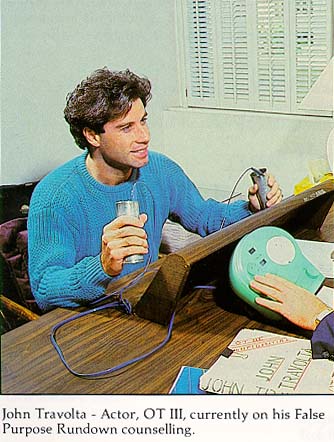
I first met Scientologists when they showed up (uninvited) at various and sundry Yippie events, particularly Smoke-Ins, throughout the 70s. They seemed to think they could convert pot-smokers. This is possibly because the only time their theology makes any real sense is when you are stoned out of your mind. We regarded them as just another kooky 70s cult, like the Moonies, who would usually show up wherever and whenever the Church of Scientology did. It's like they were competing for the same members.

The Scientologists used to set up shop in a little booth (always smiling smiling smiling in a spooky, eager-beaver fashion), with those little tin-can things for "auditing"--called an E-meter. You see the E-meter, you know who it is.

A band of Yippies trooped up to them at one such local event, rudely pawing the sacred E-meter and peppering them with dumb questions. Finally, one Yippie put one tin can to his ear as the second Yippie started bellowing into it: "What?! What?! Play some BLACK SABBATH!"... causing onlookers to guffaw appreciatively. Rather than becoming merely grim and humorless (as Christians might) or rolling their eyes and telling us all to GROW UP (as right-wingers would), the Scientologists suddenly appeared completely furious and could barely contain their anger. One became red-faced and livid: "Back off!" he hissed at the Black Sabbath fan, who seemed shocked and put the tin can down, appropriately backing off. "Those people are crazy," he whispered to me later. "You can feel the insanity vibe, just radiating off them," he said. Wow, really?

Some years later, I would walk by the same E-meter audit-set-up in downtown Columbus, Ohio (in front of the State House, no less), accompanied by some bright yellow balloons. My daughter, about three years old at the time, pointed at the gaily-colored balloons and wanted one. Pointing at the auditing cans (flanked by numerous copies of the tell-tale book Dianetics), I replied, "You don't want those balloons, hon, those are Scientologist Balloons!" --chortling at my own wit. Then I saw a business-suited-woman standing near the booth, and felt embarrassed she had heard me. I felt sheepish and giggled (exactly as I might act in front of a nun), but the Scientologist (auditing-Thetan, in this case) wasn't amused. She gave me the most hateful, evil look I have ever witnessed--and this includes nasty looks from right-wing maniacs and Reaganoids I have protested against over the decades. It was a glowering, focused, scary look. Damn, these people mean business, I thought. And from that point onward, I was very interested in the Church of Scientology. Rather like The Visitors who come in peace... well, sure they do.

Scientology-founder L. Ron Hubbard once wrote an amazing horror novel titled FEAR, which can scare the beJesus right out of you. After reading it and having a few nightmares, I realized that a man who could write like this could easily get to the bottom of an unruly or confused psyche and turn it upside down in record time. (I could not even bear to put the novel down, and I knew it was by L. Ron Hubbard.) FEAR's level of restrained paranoia/freak-out is incredible; the dramatic tension is not fully resolved until the last pages. Any religion started by this guy is going to be BLOODY HEAVY indeed, I thought.

And now, we have a famous Scientology-defector they can't eliminate, drive crazy or simply ignore: movie director Paul Haggis, who has gone public. He reached the second-highest level in the Church, Operating Thetan VII.

I have seen the New Yorker article titled The Apostate: Paul Haggis vs. the Church of Scientology posted in about a half-dozen places already, so let me add my link.

It's long, but contains some real doozies. Brother and sister scandalmongers, you must read it:

Many Hollywood actors were drawn into the church by a friend or by reading “Dianetics”; a surprising number of them, though, came through the Beverly Hills Playhouse. For decades, the resident acting coach there was Milton Katselas, and he taught hundreds of future stars, including Ted Danson, Michelle Pfeiffer, and George Clooney. “Most of Hollywood went through that class,” Anne Archer told me.
...
Jim Gordon, a veteran police officer in Los Angeles, and also an aspiring actor, spent ten years at the Playhouse, starting in 1990. He told me that Scientology “recruited a ton of kids out of that school.” Like Scientology, the Playhouse presented a strict hierarchy of study; under Katselas’s tutelage, students graduated from one level to the next. As Gordon advanced within the Playhouse, he began recognizing many students from the roles they were getting in Hollywood. “You see a lot of people you know from TV,” Gordon says. He began feeling the pull of the church. “When you started off, they weren’t really pushing it, but as you progressed through the Playhouse’s levels Scientology became more of a focus,” he told me. After a few years, he joined. Like the courses at the Playhouse, Scientology offered actors a method that they could apply to both their lives and their careers.
Finally, an explanation for why so many actors are Scientologists; they actually targeted the industry from the inside. I had mistakenly believed they zeroed in on celebrities from the outside, you know, like they did the pot-smokers. Nope, they get them while they are studying for something else entirely. Interesting.
Katselas received a ten-per-cent commission from the church on the money contributed by his students.

Katselas died in 2008, and Scientology no longer has a connection with the Beverly Hills Playhouse. Anne Archer told me that the reputation of Katselas’s class as, in Gordon’s words, a “Scientology clearinghouse” is overblown. “His classes averaged about fifty or sixty people, and there would be maybe seven to ten people in it who would be Scientologists,” she says. But the list of Scientologists who have studied at the Playhouse is long—it includes Jenna Elfman, Giovanni Ribisi, and Jason Lee—and the many protégés Katselas left behind helped cement the relationship between Hollywood and the church.
More goodies from the article, which you should read and pass around:
David S. Touretzky, a computer-science professor at Carnegie Mellon University, has done extensive research on Scientology. (He is not a defector.) He estimates that the coursework alone now costs nearly three hundred thousand dollars, and, with the additional auditing and contributions expected of upper-level members, the cumulative cost of the coursework may exceed half a million dollars. (The church says that there are no fixed fees, adding, “Donations requested for ‘courses’ at Church of Scientology begin at $50 and could never possibly reach the amount suggested.”)
That pesky inflation!

And by the way, although the church doesn't like it when you refer to the E-meter as "tin cans"--according to this article, it STARTED as mere SOUP CANS, seriously:
During auditing, Haggis grasped a cylindrical electrode in each hand; when he first joined Scientology, the electrodes were empty soup cans. An imperceptible electrical charge ran from the meter through his body. The auditor asked systematic questions aimed at detecting sources of “spiritual distress.” Whenever Haggis gave an answer that prompted the E-Meter’s needle to jump, that subject became an area of concentration until the auditor was satisfied that Haggis was free of the emotional consequences of the troubling experience.
And finally... yes, at long last, we're getting to Xenu! You knew he was coming!

Only a really great horror/sci-fi mind could have hatched Xenu:
The church, which considers it sacrilegious for the uninitiated to read its confidential scriptures, got a restraining order, but the Los Angeles Times obtained a copy of the [Thetan] material and printed a summary. Suddenly, the secrets that had stunned Paul Haggis in a locked room were public knowledge.

“A major cause of mankind’s problems began 75 million years ago,” the Times wrote, when the planet Earth, then called Teegeeack, was part of a confederation of ninety planets under the leadership of a despotic ruler named Xenu. “Then, as now, the materials state, the chief problem was overpopulation.” Xenu decided “to take radical measures.” The documents explained that surplus beings were transported to volcanoes on Earth. “The documents state that H-bombs far more powerful than any in existence today were dropped on these volcanoes, destroying the people but freeing their spirits—called thetans—which attached themselves to one another in clusters.” Those spirits were “trapped in a compound of frozen alcohol and glycol,” then “implanted” with “the seed of aberrant behavior.” The Times account concluded, “When people die, these clusters attach to other humans and keep perpetuating themselves.”
As that wise old shopkeeper on the old Friday the 13th TV show was always saying: It all makes a terrible sense.

And you wondered when Tom would show up.
In 2004, Cruise received a special Scientology award: the Freedom Medal of Valor. In a ceremony held in England, Miscavige called Cruise “the most dedicated Scientologist I know.” The ceremony was accompanied by a video interview with the star. Wearing a black turtleneck, and with the theme music from “Mission: Impossible” playing in the background, Cruise said, “Being a Scientologist, you look at someone and you know absolutely that you can help them. So, for me, it really is K.S.W.”—initials that stand for “Keeping Scientology Working.” He went on, “That policy to me has really gone—phist!” He made a vigorous gesture with his hand. “Boy! There’s a time I went through and I said, ‘You know what? When I read it, you know, I just went poo! This is it!’ ” Later, when the video was posted on YouTube and viewed by millions who had no idea what he was talking about, Cruise came across as unhinged.
Ya think?

(More fun with Tom below. Could not resist!)

As the father of two gay daughters, Haggis finally broke with the church over their funding of anti-gay Proposition 8, which banned gay marriage in California. And then he studied and found out more...

As they say, read it all.

~*~


[NOTE: The only other time I have written about Scientology at DEAD AIR, was about the death of Jett Travolta, which was predictably covered up.]

Edit: The last few seconds of the video cautions that all copies are quickly removed by the church of Scientology, so you should download it yourself and upload it to YouTube after this copy is removed. Create a different account for this purpose, since they go after that, too.