Thursday, July 11, 2013
Owl mythology
He flew from tree to tree about 100 yards in front of me, which is when I first noticed him. He had an enormous wing span. I was walking in his direction, so when I arrived below the tree where he was, I spoke to him. He looked right at me and seemed to be listening. I suddenly understood all the stories about owls being "wise"--they do seem to be smart and attentive, with their immense, intense eyes.
Watching him for a few minutes, I realized he was carefully watching me too, looking me up and down. Very large black eyes; a creepy feeling, as if sizing me up to determine if I could be eaten.
I stood there awhile, sort of communing with the owl. I asked him a couple of spiritually-oriented questions that I won't repeat here. As I said, he seemed to be listening, so why not? The swamp is so, so hushed and quiet. It seemed appropriate to break the silence and say hello.
I then pointed him out to the next couple of cyclists as they whizzed by; these two expensively-sports-attired young fellows ignored me as if I was a crazy old woman (uh-oh). But the next two middle-aged women cyclists stopped and cooed appreciatively at him, taking photos also. A nice Baptist-looking family of cyclists also stopped, their teenage son especially impressed, exclaiming he had never been so close to an owl that was not caged.
On my way home, I idly considered the Lakota legend concerning the sighting of owls in the daytime (portent of death) and wondered if Lakota legends 1) applied to non-Lakota, and 2) applied in Carolina. (Wouldn't Cherokee or Catawba legends apply here instead?) And then I promptly forgot about the owl... until I dreamed about him.
He was answering my questions. He answered them very clearly, but not in "language." They were answers that formed in my mind, and when I woke up, I knew what I should do and what was going to happen.
So, I realize now that the owls are magic.
I posted the owl's photo on Facebook and received a couple of warnings about bad luck. And so I looked up some of the mythology and omens connected with owls. I discovered that throughout the world, they are regarded as signs of both good and bad luck. Also, I learned that the concept of owls being "sisters" originally comes from the indigenous people of Australia (see list below), which I hadn't known. There is a national women's organization called OWL (Older Women's League), which (as far as I know) has mostly regrouped into smaller, local chapters. I always wondered why they chose that particular name; I assumed it was a reference to the wisdom of age. I realize now that the connection of owls/women is part of the world's mythology.
The Owl Pages offers everything you ever wanted to know about owls. I discovered his species: Barred Owl, although many southerners call them Rain Owls, which is certainly an interesting (and appropriate!) name, since we have had so much rain lately.
From the Owl Pages, I found a list of fascinating world-legends and mythology about owls.
Here are some of my favorites:
Africa, Central: the Owl is the familiar of wizards to the Bantu.
Africa, Southern: Zulus know the Owl as the sorcerers' bird.
Africa, West: the messenger of wizards and witches, the Owl's cry presages evil.
Algeria: place the right eye of an Eagle Owl in the hand of a sleeping woman and she will tell all.
Arabia: the Owl is a bird of ill omen, the embodiment of evil spirits that carries off children at night. According to an ancient Arabic treatise, from each female Owl supposedly came two eggs, one held the power to cause hair to fall out and one held the power to restore it. Arabs once believed that the spirit of a murdered man continues to wail and weep until his death is avenged. They believed that a bird that they called "al Sada" (or the death-owl) would continue to hoot over the grave of a slain man whose death had not been avenged. The bird would continue to hoot endlessly until the slain man's death was avenged.
Arctic Circle: a little girl was turned into a bird with a long beak by magic, but was so frightened she flapped about madly and flew into a wall, flattening her face and beak. So the Owl was created.
Australia: Aborigines believe bats represent the souls of men and Owls the souls of women. Owls are therefore sacred, because your sister is an Owl - and the Owl is your sister.
Borneo: the Supreme Being turned his wife into an Owl after she told secrets to mortals.
Brittany: an Owl seen on the way to the harvest is the sign of a good yield.
Burma: during a quarrel among the birds, the Owl was jumped upon and so his face was flattened.
Cameroon: too evil to name, the Owl is known only as "the bird that makes you afraid".
Carthage: the city was captured by Agathocles of Syracuse (Southern Italy) in 310 BC. Afterward, he released Owls over his troops and they settled on their shields and helmets, signifying victory in battle.
Celtic: the Owl was a sign of the underworld.
China: the Owl is associated with lightning (because it brightens the night) and with the drum (because it breaks the silence). Placing Owl effigies in each corner of the home protect it against lightning. The Owl is regarded as a symbol of too much Yang (positive, masculine, bright, active energy).
France: when a pregnant woman hears an Owl it is an omen that her child will be a girl.
Germany: if an Owl hoots as a child is born, the infant will have an unhappy life.
India: The Barn owl is the "vahana" (transport/vehicle/mount) of the Hindu goddess of wisdom, Lakshmi. As such, the owl is held as a symbol of wisdom and learning. The eagle owls, especially the rock eagle owl [Bubo bengalensis] and the brown fish owl [Bubo zeylonensis] are called " ullu" in Hindi and the word is also used as a synonym for "idiot" or "imbecile". The most chilling sound during the quiet and cold winter nights in the plains of Bengal is perhaps the call of the " kaal penchaa", the Brown Hawk Owl. The rhythmic "kuk - kuk - kuk" is believed to be a foreboding of impending death.
Indonesia: Around Manado, on the isle of Sulawesi, People consider Owls very wise. They call them Burung Manguni. Every time someone wants to travel, they listen to the owls. The owls make two different sounds; the first means it is safe to go, and the second means it's better to stay at home. The Minahasa, people around Manado, take those warnings very seriously.
Iran: In Farsi the Little Owl (Athene Noctua) is called "Joghde-kochek". It is said that this bird brings bad luck. In Islam, it's forbidden (Haram) to eat.
Ireland: An Owl that enters the house must be killed at once, for if it flies away it will take the luck of the house with it.
Israel: in Hebrew lore the Owl represents blindness and desolation and is unclean.
At left: the swamp itself, which is much more ominous after heavy rains. I love love love it, except for the mosquitoes, which are humongous and always-starving. It is also home to the largest snake I have EVER seen that wasn't under glass in a zoo.
~*~
Japan: Among the Ainu people the Eagle Owl is revered as a messenger of the gods or a divine ancestor. They would drink a toast to the Eagle Owl before a hunting expedition. The Screech Owl warns against danger, although they believe the Barn Owl and Horned Owl are demonic. They would nail wooden images of owls to their houses in times of famine or pestilence.
Latvia: when Christian soldiers entered his temple, the local pagan god flew away as an Owl.
Lorraine: spinsters go to the woods and call to the Owl to help them find a husband.
Madagascar: Owls join witches to dance on the graves of the dead.
Malawi: the Owl carries messages for witches.
Mexico: the Owl makes the cold North wind (the gentle South wind is made by the butterfly). The Little Owl was called "messenger of the lord of the land of the dead", and flew between the land of the living and the dead.
Newfoundland: the hoot of the Horned Owl signals the approach of bad weather.
Poland: Polish folklore links Owls with death. Girls who die unmarried turn into doves; girls who are married when they die turn into Owls. An owl cry heard in or near a home usually meant impending death, sickness, or other misfortune. An old story tells how the Owl does not come out at during the day because it is too beautiful, and would be mobbed by other, jealous birds.
Puerto Rico: The Owl is called "Mucaro". Back in the 1800s, the people from the mountain coffee plantations used to blame the little mucaro for the loss of coffee grains. The belief was that the coffee was part of the owls' diet, and many owls were killed. There are old folklore songs on the subject, one goes like this:
Poor Mucaro, you're a gentleman
you just want to eat a rat
then the rat
set up a trap
he eats the coffee grains
and people blame you.
Romania: the souls of repentant sinners flew to heaven in the guise of a Snowy Owl.
Russia: hunters carry Owl claws so that, if they are killed, their souls can use them to climb up to Heaven. It is said that Tartar shaman of Central Russia could assume Owl shapes. Kalmyks hold the Owl to be sacred because one once saved the life of Genghis Khan.
Samoa: the people are descended from an Owl.
Siberia: the Owl is a helpful spirit.
Spain: legend has it that the Owl was once the sweetest of singers, until it saw Jesus crucified. Ever since it has shunned daylight and only repeats the words 'cruz, cruz' ('cross, cross').
Sri Lanka: the Owl is married to the bat.
Sumeria: The goddess of death, Lilith, was attended by Owls.
Sweden: the Owl is associated with witches.
~*~
And so we see, Owls are often connected with women, and with spirituality... or both.
Since my dream, I choose to see my owl as a good omen. But I also realize that life IS impermanence, and what is regarded as "good" right now, may well be considered "bad" in the future.
Perhaps that is the lesson of the owl. Live completely in the present.
Posted by
Daisy Deadhead
at
3:00 PM
Labels: Africa, animals, Australia, birds, Buddhism, China, goddesses, history, India, Indigenous peoples, Japan, Mexico, New Age, Owls, Puerto Rico, recreation, Russia, South Carolina, spirituality, Swamp Rabbit Trail
Wednesday, August 17, 2011
Wordless Wednesday: Ducks, etc
They seemed real glad to see me, until they realized I had no food. Then they turned around and waddled back into the water. Fickle, opportunistic animals!
These photos are of the Reedy River, downtown under the bridge. Also, got Crape (not Crepe) Myrtle trees! Purty!
The price of living in such a beautiful tropical paradise is... well... ((faints from heat))
~*~
Posted by
Daisy Deadhead
at
12:11 PM
Labels: animals, birds, green spaces, Greenville, hiking, Reedy River, Swamp Rabbit Trail, Wordless Wednesdays
Sunday, September 13, 2009
Foothills Animal Rescue
Foothills Animal Rescue folks during their benefit yesterday on Pelham Road. Below: Holly Compton Harvell with Lala the cockatoo, and Frances Wilsher with DJ the Nanday Conure. (Yes, DJ poses for the camera!)
And Lightning, the really big turtle.
~*~
Posted by
Daisy Deadhead
at
9:55 AM
Labels: animals, birds, Dead Air Church, Foothills Animal Rescue, Frances Wilsher, Holly Compton Harvell, reptiles
Thursday, May 14, 2009
Your redneck-hippie guide to the PGA Tour!
Welcome to the tournament! These trailers are all over the place. Only Budweiser is more ubiquitous.
~*~
Yes, we provide only the very best guides to American culture here at DEAD AIR!
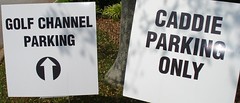
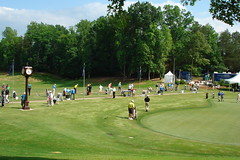
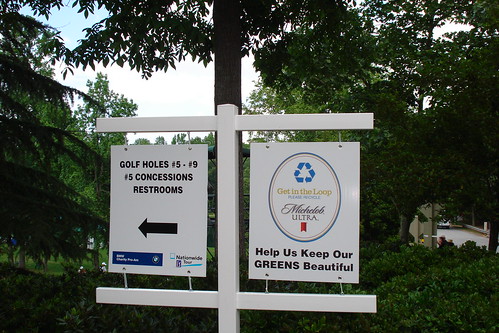
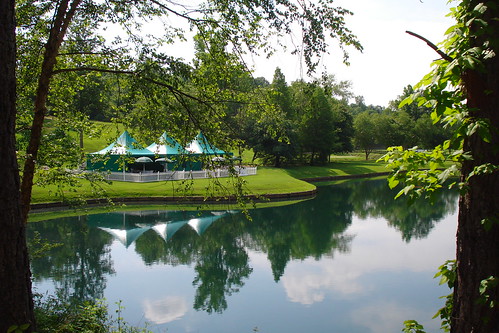
My apartment complex is about 20 feet from Thornblade, one of the premier golf courses in the south. As stated in this space last year, it is time for the annual invasion of the golfers. Of course, I speak of the BMW Charity Pro-Am Golf Tournament. It's some major hoopla, and people flock here from all 50 states and abroad. The celebrities in this year's tournament include Terry O'Quinn, Dennis Quaid and Greg Kinnear. Since the Golf Channel is parked at one of my apartment complex exit-gates, I was able to stroll right through, unnoticed and undisturbed... until one over-eager security guy sternly reminded me not to walk on the green. (Dude, I wouldn't dream of it.) The golf clubs, cars (BMW provides all the shiny new "courtesy vehicles" for the event) and assorted sports accoutrements simply reek with money... in fact, the whole place radiates cash, even more than it usually does. Ordinarily, someone like me could not afford to be anywhere near the premises, except as a caddy. But Mr Daisy and I walk through this neighborhood all the time, and know the intricate twisty-turns far better than the yearly visitors. (Not to mention the fact that their golf balls hit my spare-room window every day during golf season.)
Unfortunately, I don't know from golf, so I can't explain any of these photos on a sportsman's level. But I can certainly explain them on a redneck-hippie level!
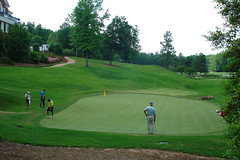
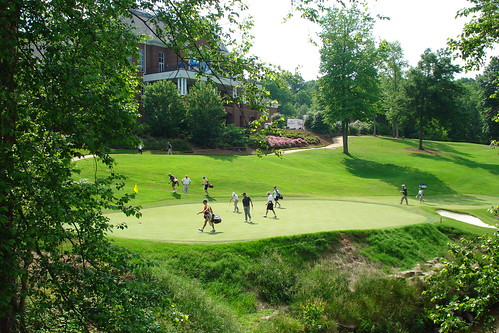
~*~ The people lined up on Thornblade Boulevard to watch this shot, were whispering intently and staying very still. I figured this meant something important was happening, so I took a photo of it.
You can't see the golf ball, but it's real close!
~*~Practice range at Thornblade... our apartment complex is right beyond the line of trees, mere feet away. We live at the very edge. The trees are very nice, and we can usually pretend it's a park when the golfing population is low. ;)
~*~
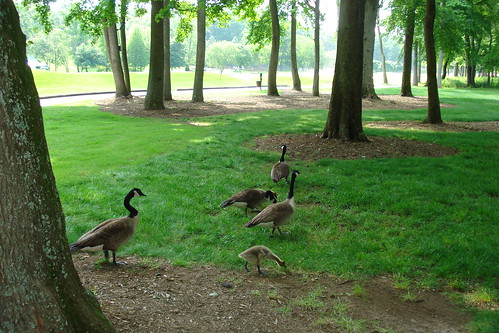
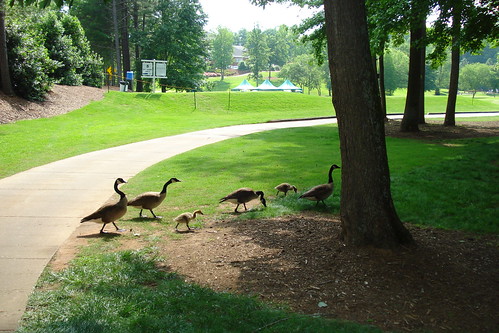
An unsuspecting geese family flees, confused and wondering what all these mega-rich people are doing in their habitat.
I know exactly how they feel.
~*~
And more photos below...
Posted by
Daisy Deadhead
at
4:42 PM
Labels: animals, birds, BMW Charity Pro-Am Golf Tournament, celebrities, Dennis Quaid, golf, Greg Kinnear, neighborhoods, South Carolina, sports, suburbs, Terry O'Quinn, Thornblade
Tuesday, February 10, 2009
SC Bill would increase premiums on obese workers
At left: In case you needed any more proof that R. Crumb could predict the future. (from Zap Comix, several eons ago.)
In our sordid state news today:
SC Bill would increase premiums on obese workers
The Associated Press • February 10, 2009
COLUMBIA — Obese public employees would have to pay an extra $25 monthly for their state health insurance under a bill up for debate in South Carolina.As always, South Carolina loves to be first in all things. You've undoubtedly noticed by now!
The measure sponsored by GOP Sen. Greg Ryberg of Aiken is on the agenda Tuesday in a Senate subcommittee. It would tie the surcharge to employees' body-mass index, a weight and height measurement.
The proposal follows a vote last August to increase health insurance premiums of public workers who smoke. The smoking surcharge is set to take effect Jan. 1, 2010. It was approved by a five-member board that oversees the state budget.
Smokers called it an unfair increase, since smoking isn't the only bad habit that increases health care costs.
South Carolina has among the nation's highest rates of obesity and diabetes.
~*~
More from recent Blogdonia excursions:
Lauren's post on class and feminism, titled Context.
Our state bird is disappearing. From TreeHugger: Is It Still a Carolina Wren If It No Longer Calls Carolina Home?
Attention local folks! (Upstate SC and Western NC) Please help save the Burton Street neighborhood, currently in the corporate cross-hairs as bureaucrats haggle over how best to expand I-26 in Asheville. Mountain Xpress has been doing a bang-up job of covering the proposed "Downtown Master Plan" for Asheville. (((applause for excellent work))) Please, please, please do not ruin Asheville!
And finally...
Antiprincess's precious littlest patriarch, Wolfgang! Beware adorable baby picture!!! YOU COULD DIE FROM THE CUTE! (((makes gurgly grandma noises)))
Posted by
Daisy Deadhead
at
6:06 PM
Labels: art, Asheville, birds, comics, cute, environment, fat, Greg Ryberg, health, motherhood, Mountain Xpress, neighborhoods, North Carolina, R. Crumb, South Carolina
Friday, January 11, 2008
It should be obvious, but it's not...
In Isaac Asimov's story NIGHTFALL, enlightened scientists try to figure out why chaos breaks out on their planet (called Lagash in the short story, Kalgash in the novel) every 2000 years or so. (Interesting timespan that he chose, I always thought!) Archaeologists have determined that several civilizations have been lost this way; in fact, all history, learning, and science is totally destroyed during these mysterious periods of planetary chaos. Why? And so, scientists, astronomers, smart big shots of all kinds, descend on the problem. They discover that a planetary alignment occurs every 2049 years. Could this be it?
Asimov, diehard atheist, was attending Columbia University at the time he authored this amazing tale, an ode to our human and uniquely self-centered ignorance. He perfectly describes the arrogance of scientists and imitates their voices, which are often just so jolly pleased with themselves. The scientists discover an ancient holy book by a group called the Apostles of Flame, counseling them to GO INSIDE and STAY THERE during the period of said alignment, in which the world will be destroyed by darkness and an accompanying torrent of fire. The scientists snort derisively. Right! And miss the big celestial event? Ha! The scientists study the alignment from every which-way, they calculate and re-calculate. They think they know what will happen, perhaps a deviation in Kalgash's moon. What else could it POSSIBLY be? They can't imagine what they don't know, what they haven't seen.
It's right there, in the title of the story. And yet, as you read, and you read what hour of the day it is and which star is visible--orange, pink, yellow... you take note of it like the people who live on the planet, who have fond feelings for each of their planet's six stars. It doesn't occur to you, on first reading... wait? There is always a star. It is always light. Of course they don't understand what will happen; they've never seen it.
We can't know, what we can't know.
And then, it happens:
(From Wikipedia.)
[On Kalgash] eclipse on one-sun days (Dovim) occurs every 2049 years. Therefore, "nightfall" occurs once every 2,049 years, when the sole sun on one side of the planet is eclipsed for half a day.
Since the population of Kalgash has never experienced universal darkness, the event would be devastating and the population, with even short exposure (15 minutes), can be susceptible to major trauma and possibly death from shock. When nightfall occurs and the stars appear for the first time in millennia on Kalgash, most people became mentally damaged in the process (at least temporarily) and civil disorder breaks out. Cities are destroyed in massive fires and civilization - as previously known - collapses.
The stars come out, the torrent of fire. They have never seen them. They seem to be falling on them. They go insane with terror.
The last line of the short story was simply: Nightfall.
~*~
Black swan theory
(from Wikipedia)
In Nassim Nicholas Taleb's definition, a black swan is a large-impact, hard-to-predict, and rare event beyond the realm of normal expectations. Taleb regards many scientific discoveries as black swans—"undirected" and unpredicted. He gives the September 11, 2001 attacks as an example of a Black Swan event.
The term black swan comes from the ancient Western conception that all swans were white. In that context, a black swan was a metaphor for something that could not exist. The 17th Century discovery of black swans in Australia metamorphosed the term to connote that the perceived impossibility actually came to pass.
Taleb notes that John Stuart Mill first used the black swan narrative to discuss falsification.
The high impact of the unexpected
Before Taleb, those who dealt with the notion of improbable, like Hume, Mill and Popper, focused on a problem in logic, specifically that of drawing general conclusions from specific observations. Taleb's Black Swan has a central and unique attribute: the high impact. His claim is that almost all consequential events in history come from the unexpected—while humans convince themselves that these events are explainable in hindsight.
~*~
NSFW, unless you work some cool place on the coasts. (Lyrics include F-word. Video artsy and nonoffensive.)
Black Swan - Thom Yorke
Posted by
Daisy Deadhead
at
5:59 PM
Labels: atheism, birds, Black Swan, books, culture, fantasy, Isaac Asimov, John Stuart Mill, music, Nassim Nicholas Taleb, Nightfall, religion, SciFi, spirituality, Thom Yorke
Wednesday, November 21, 2007
Yearly Thanksgiving Harangue
You knew it was coming, dincha? ;)
None of my friends and family IRL escape this, and dear reader, neither will you.
Excerpted from Turkeys: Factory-Farmed Torture on the Holiday Table:
More than 40 million turkeys are killed each year at Thanksgiving, more than 20 million are slaughtered at Christmas, and another 19 million die for Easter dinners. Before ending up as holiday centerpieces, these gentle birds spend five to six months on factory farms where thousands of them are packed into dark sheds with no more than 3.5 square feet of space per bird. To keep the overcrowded birds from scratching and pecking each other to death, workers cut off portions of the birds’ toes and upper beaks with hot blades and de-snood the males (the snood is the flap of skin that runs from the beak to the chest). No pain relievers are used during any of these procedures.Okay, I'm done.
Genetic manipulation and antibiotics enable farmers to produce heavily muscled birds who can weigh 35 pounds in as little as five months, and “their internal organs are noticeably crammed together in the little bit of space remaining for the body cavity,” according to The Washington Post. An industry magazine said, “[T]urkey breeders have created birds with huge, unnatural, outsized breasts, since white breast meat is where the money is.” Another turkey breeder complained that birds “are bred to grow fast just to live to 16 weeks [and then] they die,” usually from organ failure, and some suffer from broken legs because their bones are not able to support their weight. A 12-year study of turkey farmers in Iowa (one of the nation’s top turkey-producing states) revealed that leg problems and aneurysms were among the top three health problems in turkey flocks. Factory-farmed turkeys are so large that they cannot even perform normal reproductive behaviors, so all turkeys raised for food are the products of artificial insemination.
Millions of turkeys don’t even make it past the first few weeks before succumbing to “starve-out,” a stress-induced condition that causes young birds to simply stop eating. Catching and transportation are particularly stressful processes for birds, and yet they are repeatedly moved during their short lives—from hatchery to the brooding area to the growing area and finally to the slaughterhouse.
At the slaughterhouse, turkeys are hung upside-down by their weak and twisted legs before their heads are dragged through an electrified “stunning tank,” which immobilizes them but does not kill them. Many birds dodge the tank and, therefore, are fully conscious when their throats are slit. If the knife fails to properly slit the birds’ throats, they are scalded alive in the tank of hot water used for feather removal.
Consider a nice tofurky, or some mashed potatoes?
More:
Butterball Cruelty
United Poultry Concerns
Animals Voice
Vegan Outreach
Go Veg.com
----------------
Listening to: Dead Kennedys - Holiday in Cambodia
via FoxyTunes
Posted by
Daisy Deadhead
at
1:41 PM
Labels: animal rights, animals, birds, factory farming, food, holidays, Thanksgiving, turkeys, veganism, vegetarianism