Showing posts with label menopause. Show all posts

Sunday, November 6, 2011

If Men Had Hot Flashes

Of course, we know that hot flashes are caused by menopause. But what causes them? Why do they continue in some women and not in others? Why do some foods seem to precipitate them? Why do they occur in the dead of night?

As you may or may not know, if you look up "causes of hot flashes"--HOW they happen, the physiological mechanism--you repeatedly read the following:

The exact cause of hot flashes isn't known, but the signs and symptoms point to factors affecting the function of your body's thermostat — the hypothalamus. This area at the base of your brain regulates body temperature and other basic processes. The estrogen reduction you experience during menopause may disrupt hypothalamic function, leading to hot flashes.
Well, duh!

I could have written that. I know what the hypothalamus does. Most of us who wake up soaking wet, have figured out that it's something like that.

But what CAUSES the hypothalamus to go wacky? What is the exact way lowered-estrogen affects the hypothalamus? How and why does hormone-level impact it?

(((crickets)))

Wait, they can figure out how to make hard-on drugs for old guys, but they still don't know what causes hot flashes?????

Now, let me guess. Why do you suppose that is?

Are women, specifically OLDER women, just not that important? Why has some high-end study not been conducted? THIS IS 2011!

Wait, let me guess again. Someone tried to fund a study, and couldn't get funded. The pharmaceutical industry specialized in giving women cancer for decades, and that was judged good enough. It was only when various medical studies came out, definitively condemning Hormone Replacement Therapy as a medical risk, that many women started studying the issue for ourselves. After all, our mothers and grandmothers had used HRT, and we assumed we might also.

But my mother had breast cancer (when she was exactly my age) and my grandmother had fibrocystic breast disease (to such an extent that she had several large, but benign, breast cysts surgically removed). Hm, thought the baby-boomer women. Maybe they're right, and we shouldn't use astronomical levels of hormones? (And why didn't they study the safety of hormones, before dosing millions of women with them? Well, why would they?)

Okay, we thought, let's study the condition, and figure out what might help; first, the cause of hot flashes. If we can isolate the cause, we can figure out what natural or alternative treatments might be. At the very least, we can figure out catalysts and try to minimize their occurrence.

(((crickets)))

They. Don't. Know.

They put a man on the moon (man on the moooooon) -- so yes, it is reasonable to assume they might care about their moms' discomfort. Isn't it?

Ha!

I started menopause in 2006, and as regular readers know, I celebrated my postmenopausal self (defined as one year of not menstruating) by starting this blog in June of 2007. I still have hot flashes, although not the wretched slow-boil kind (known as "ember flashes"), which are mercifully behind me. Some women continue to have those, too, though. Why? And why are they notably less common in Asian women? Is this cultural, and possibly diet-related? A good way to determine this would be to study hot flashes in Asian women still living in Asian countries and eating Asian diets, vs Asian women who live in the USA and eat the usual American diet of processed foods, salty snacks and Taco Bell. Is there a difference in number of hot flashes? Or perhaps there is a genetic component.

And have they done this? I have no college degree, and yet, I can figure out this much.

(((crickets)))

Last night--BANG, in the middle of the night, I woke up and wiped off the sweat. I wondered if it was something I ate at a wedding reception, and then... was instantly peeved: I SHOULD KNOW THIS! I SHOULD KNOW WHAT FOODS TO AVOID, DAMMIT! WHERE IS MY GUIDE FOR THE MENOPAUSAL SWEATY WOMAN, WRITTEN BY SOME ASSOCIATION???!!! As the diabetic associations and the gluten-intolerance associations and the salt-free associations offer guides for their people.

No, they can't provide this, since they are clueless.

Women have lived on this planet as long as men, and yet--? Hot flashes are still described as a "mystery."

And so, in a nod to Gloria Steinem's witty piece titled "If Men Could Menstruate"--here is what occurred to me in the dead of night.

~*~

If Men Had Hot Flashes, there would be a Hot Flashes Association (HFA) with foods marked "HFA" (logo inside a macho male symbol), the way Cheerios have a little heart on them, for "heart healthy." Needless to say, they would KNOW which foods to eat and which not to eat, since extensive research and causality studies would exist.

If Men Had Hot Flashes, the Weather Channel would feature a daily Hot Flash Report, instructing men with maps of Hot Flash Regions for the day (since extensive research will show that weather is a factor). Men at work will ask each other (not in whispers, either), what the Hot Flash Report said that morning: "Did anyone catch the Hot Flash report? Whew, is it hot in here?" Raucous laughter and high-fives.

If Men Had Hot Flashes, there would be hot-flash drugs tomorrow morning. And they would be advertised in pricey, cutesy TV ads, just like Viagra, Cialis, etc. (Drugs with NO female equivalent, BTW, since older women's sexual enjoyment is as low-priority in this culture as the dilemma of hot flashes is.)

If Men Had Hot Flashes, when it's time to toast at the wedding and they flush unexpectedly, they will stand up boldly and proudly announce, "I AM HAVING A HOT FLASH!"--and all men in the room will applaud, laugh and cheer. It will be like announcing which team is going to the Orange Bowl. No shame, no apologies. No giggling by anybody when they turn beet-red. What is to apologize for? It's a sign of MANHOOD, isn't it? And therefore, it would be roundly celebrated.

If Men Had Hot Flashes, women would hear how we really don't understand the mysteries of the human body, the stages of life, the natural progression of age. We would hear jokes about "women menopause"--how women suddenly have to acquire sports cars and young hottie-boys in old age. Or is that just too funny to think about? Yes, you're right, never mind. (Let's skip this one, too sci-fi to be believable.)

If Men Had Hot Flashes, they would brag about how hot it was, how long it lasted, and who had the biggest. They would institute suitable competitions and a Champion thus installed: Hot Flash Champion. And everyone would know this man's name.

If Men Had Hot Flashes, they would probably wake up their wives at night and demand to be taken to the ER. Some Nice Guys(tm) would quietly and politely not wake the Missus, take a cold shower, and go back to sleep... only to be called MANGINA, WIMP, WUSS, PUSSY-WHIPPED and such, by his fellow males. Suitably chastened, Nice Guy(tm) will attempt to make a big fuss next time, like a proper man should.

If Men Had Hot Flashes, there would be literary works throughout history about Hot Flashes. Shakespeare's Henry V would have given a rousing speech, "We happy Few! We who burn on the pyre manhood!" (Males thrust weapons into the air and shout in response: AGGGHHH!!!!) TS Eliot would write great poems about his hot flashes, while Hemingway would turn it into an existential drama about hunting. And we would have to study all of this in school, and it would be nothing to take lightly or laugh about. THIS IS MANHOOD WE ARE TALKING ABOUT, people!

If Men Had Hot Flashes, John Wayne would have said: "I gotta hot flash, pilgrim, whats it to ya?" This famous manly comment, shrugging off the tortures of the damned, will make it into Bartlett's Quotations.

If Men Had Hot Flashes, well, I wouldn't even have to write this. ;)

Wednesday, January 2, 2008

Where are the old women bloggers?

We know everything that has ever happened, and there is no end to derision.--Friedrich Nietzsche, Thus Spake Zarathustra

~*~

After turning 50 in September, I became somewhat obsessed with the age of bloggers. I discovered I could find a lot of male bloggers in the 50-and-older category. But where are the women?

I know, there are a few. And I am not talking about Arianna Huffington, who is 57 and a billionaire (and therefore looks 25), but about us ordinary bloggers, such as Raven, Jackie, Risa, JJ, Marion, Maitri and Shadocat. I try to find them and link them on my blog... they are like precious jewels.

I have wondered if the hyperventilating over WOMEN'S AGE might be the cause of this phenomenon; we might call it The Botox Effect. We cover up the "lines" in our writing, as we try to cover the lines in our face. We minimize that which makes us seem old. If there is something new we don't understand, such as contemporary slang, we don't dare ask for clarification and thereby give ourselves away. Perhaps, then, there are more of us than I realize? Many women pointedly do not provide their ages on their blogs, while men usually do; a silly, sexist and archaic cultural habit.

At times when I write about nostalgia, as I enjoy doing, I get replies from isolated people (who will not comment publicly, it is worth noting) thanking me for publicly remembering something that they agree needs recounting. But they say it in hushed, secretive emails, as if I have said something dirty out loud. THE PAST IS OLD, and therefore, not a good thing. NEW is good, new is revolutionary, new is a product that has been improved, reformulated, with all kinds of good shit added to it to make it a rockem-sockem, highly-evolved and BETTER thing... better car, better house, better suburb, better dishwashing liquid.

Various cultures throughout the world once prized the old, as those who had knowledge and wisdom. As American imperialism runs roughshod all over the world and into every nook and cranny of the globe, we see all that is old is shunned and shunted aside. Hatred of what is old is now invading hearts and minds and cultures everywhere. Universally, the belief that old age equals wisdom is fast disintegrating. NEW NEW NEW shall reign. The old is hidden or eliminated, and that includes old people.

On certain progressive blogs, when I try to comment about what we expected or thought in the past, it's a sure way to get beat up and left for dead. Yes, I am told, that just proves how fucked up everything was back then. Nietzsche's Last Man of History knows everything that has ever happened, and there is no end to derision.

The very idea that we may know something is laughed at. And yet writing "teh" is not considered laughable, for some reason. I guess because it's a "young" thing to do.

~*~

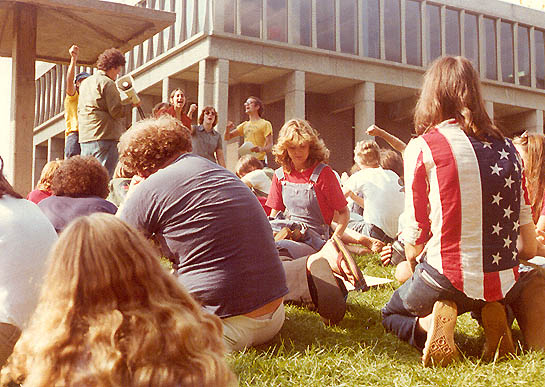
Left: A photograph of the back of my head, taken at a political rally 30 years ago. I was lying down with my head propped on my elbows--that's my blond hair, which looks virtually the same now as it did then. (Hey, it could be worse, I could look like the girl with the Farrah Fawcett hair!) Kent State, 1977.

When you get old enough, you find photos of yourself (and your head, and your feet, and your husbands, and your kids) all over the net, which is a scary thing.


~*~

When old women aren't laughed at, we are completely ignored.

I have tried very hard not to be petty about this. I have concentrated HARD on my new tattoo, and asked my various saints whether I am being self-centered or petty when I am ignored and patronized. I look around, though, and I see a DEARTH of women bloggers my age. Of course we are ignored, we do not even exist. We are not a DEMOGRAPHIC BLOCK and they don't have to deal with us as a GROUP, or maybe they would notice how shitty they talk (or don't talk) to us.

I am pretty tired of this, and I have nearly given up blogging twice over it. Being ignored or talked down to, hurts. How much of this is also sexism and elitism/classism is hard to say... perhaps taken altogether: an older, working-class woman in South Carolina is simply unimportant. Possibly, if I were from New York, London or someplace cool, that would be sufficient to allow me to be taken seriously. But I keep coming back to age: Menopausal gals ain't hawt, and subsequently, we don't say very hawt things. And on the internets, hawtness is a crucial selling point.

My rant was brought on by a particular blogger, who of course is oblivious to my existence. Thus, it makes no sense to link him here, it won't matter to him one way or the other. He may find it peripherally amusing. But I am curious as to how many people might read this, and wonder if I am talking about them?

~*~

I think about right-wing conservatives, and their continuous political appeals to old people. I wonder if much of their success is their promise not to forget about us, to honor our lives and experience? By contrast, the left (where I have spent my life), sends us off to the glue factory.

One last thing: Unless you die, you will all age. If you'd like that to be a pleasant experience, rather than an unpleasant one, it may behoove you to change the culture NOW. Otherwise, I daresay, you'll someday understand exactly what I mean by this post.

Yall come back now, ya hear?

----------------
Listening to: Etta James - Don't Lose Your Good Thing
via FoxyTunes

Sunday, December 16, 2007

My Christmas Present

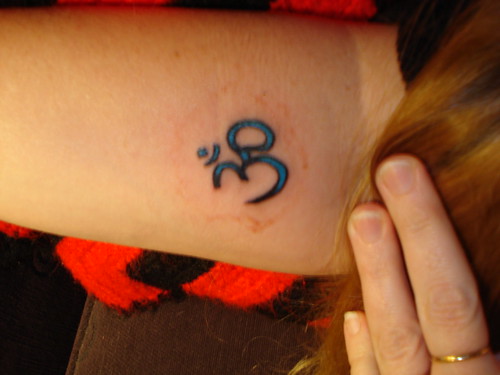
How do you like it? I just got it about an hour ago, so pardon the raw appearance!

~*~

My Christmas present is a tattoo, my fourth. It is an Om (also called Aum) symbol, as popularly written in Devanāgarī. An Om/Aum means many things. It is recognized in Hinduism (as well as the Eastern religions that branched off from it), as the all-encompassing, the All-One. It is a sign of the Infinite, of all that is.

Of which I am a very small part, and that's a good thing to keep in mind.

My purpose in getting this tattoo is to have an actual physical reminder of that fact, so that I won't forget the nature of the Infinite and instead place myself at the center of the universe. Which is one of those things I like to do.

As Bob Dylan said, it's life and life only.

----------------
Listening to: The Pretenders - Tattooed Love Boys
via FoxyTunes

Monday, November 26, 2007

Elizabeth Kucinich...

...looks like a movie star. Yeah, I was surprised, too. Dennis, dude, you've been holding out on us.

The official Dennis Kucinich 4 President website links to an article sweetly titled How Kucinich Found Love:

Elizabeth's mother [Julia Massey] was a bit concerned about her daughter's plan. An American politician? In England, people mostly hear about America's conservative political figures. She couldn't imagine Elizabeth with such a man.

"But then I went to Dennis's Web site and I realized he was so much like Elizabeth," Massey says. "It just seemed heaven-sent."

She, too, found the age difference - Elizabeth's 27 years to Dennis's 58 - insignificant. "This is about a meeting of souls."

Of course, the age difference has garnered them attention.

"People who see us together understand - they see our connection," Elizabeth says. "And it's not like I'm some ditsy young thing and he's an old fogey. He has the wisdom of an ancient and the energy of youth."

Dennis says, "I've never seen myself as time-bound. When you make a connection on a soul level, age is not important."

As for having a family - Elizabeth says she would like children some day - Dennis says, "There's no problem there."
Maybe it's my age, but I seem to remember that as a young women, I similarly hooted when people would justify their attractions to young, beautiful, famous and/or affluent people with stuff like "We're on the same wavelength," or "We're soul-mates," or some other nonsense. Yes, of course you are, and this person just happens to be half your age, rich and/or drop-dead gorgeous.

My question: Why aren't the old, unattractive and/or poor people ever soul-mate material?

I admit, I was shocked that Dennis, regarded as the mousy nebbish of the Democrats, has gotten himself a trophy wife. I know, I'm way behind the curve; this has been under discussion for some time now. For instance, CNN Political Ticker humorously reported back in August, that Dennis managed to bring up the wife's age while discussing veganism, of all things:
Cedar Rapids, IOWA (CNN) – At the Livestrong Forum Monday, Democratic presidential hopeful Dennis Kucinich, D-Ohio, hit home the message of proper health education and personally shared the benefits he’s experienced since adopting a vegan lifestyle.

“I didn't need as much sleep. I had a lot more energy. I had a lot more clarity. I didn't have the health problems that I had previous to that,” the Ohio congressman said. “And as a result, I had a better quality of life.”

Kucinich added: “People want a president who is healthy because if you’re healthy you can think right.”

The White House hopeful emphasized his commitment to a “full disclosure” health education policy, where Americans are made aware of the nutrition value and health risks of the food they eat.

Referencing the epidemic of American obesity owing to such lack of information, Kucinich pushed for overall “health consciousness” that includes physical fitness, proper nutrition and access to health care.

“There is a direct connection not only between diet and health, but diet and the environment, diet and the economy. And so as president I'm going to be singularly positioned to be able to lead that discussion because I take in my own journey toward health based on my dietary choices,” he said.

While describing a diet free of animal products and an improved quality of life, MSNBC Hardball Host, Chris Matthews, ignited laughter when playfully remarking “And you married a young woman.”

Kucinich joked, “And I did. And my – hello. I mean, I'm 60 years old, I have a – my wife's 29. You draw your own conclusions. Diet helps.”
Draw your own conclusions? Dennis, please.

Karen Heller, in the Philadephia Inquirer, gets to the point:
There are two ways of looking at the field of presidential contenders. On the one hand, there's the novelty of a woman, an African American and a Latino pursuing the White House.

On the other, presumably the left with a sizable rock involved, there are so many trophy wives.

Many candidates traded in their original models for younger, leaner and leggier partners, often producing a second family
of adorable tykes so ideal for photo ops.

I know, a shocking turn of events in Washington.

This does mark progress of some sort.

In the old days, pols rarely married their daughter-aged girlfriends.

That was because they were still wed to their wives, divorce being a greater political liability than adultery.

Fred Thompson's wife, Jeri, is 40, almost a quarter century his junior. Given to plunging necklines and soaring hems, she will never be mistaken for Laura Bush. The couple have two toddlers, making him one of several AARP diaper dads seeking the White House.

Sen. Chris Dodd, 63, who engaged in a 1985 "waitress sandwich" with Ted Kennedy while their dates were in the ladies room, is another. His second wife, Jackie, is a mere 18 years younger.

As is Cindy McCain, the Arizona Republican's second wife of 27 years. Not being one to endure a marital vacancy, McCain began courting his second wife while married to his first.

Dennis Kucinich's third wife, Elizabeth, has late-night pundits, You Tubists and, well, most males salivating. The former "boy mayor" of Cleveland, now 61, has a babe wife less than half his age.

She is car-crackup gorgeous and - for a change from the requisite blondage - a redhead, resembling Julianne Moore, only better and taller.

Should the Ohio Congressman be elected president, Elizabeth Kucinich would become the first first lady with a pierced tongue.
Of course, most political observers think there is no chance Dennis will be elected, especially after admitting that he had seen a UFO (this in reply to a direct question from Tim Russert during the Democratic debate in October). That seemed to finish him off. Nonetheless, the trophy wife issue lingers. Sad to say: I expect a Hollywood actor like Fred Thompson to have a younger wife, but I expect a lot MORE from a progressive candidate like Kucinich. How will menopausal, baby-boomer-aged women (of which I am one) feel about this glut of guys with babe-wives? Are we supposed to ignore what Tom Wolfe memorably dubbed "wife-shucking"? Can we trust a man who ditches his older wife for a younger model?

Does he value older women enough to fight for our rights?

Well, it's time to remind everyone, that one politician never ditched his wife, and right now, his wife is running for president. Let's all just vote for her, as a menopausal-pride thing. :)


----------------

Listening to: Howlin' Wolf - I Ain't Superstitious
via FoxyTunes

Monday, September 17, 2007

You say it's your birthday

It's my half-century mark! Whoever thought I would live so long? I'm just as surprised as everyone else!


“Your task is not to seek for love, but merely to seek--and find all the barriers within yourself that you have built against it.”-- Jalal ad-Din Rumi

Tuesday, September 11, 2007

Herbs now, herbs forever

At left, Echinacea


For two days, I have been defending my occupation against mostly-anonymous shills for the drug companies over at Alas, a blog. If they aren't actual shills for BigPharm (which are in fact all over the net and get paid very well for it), they can come over here and say so, and this time, they will answer my direct questions (helpfully placed in bold) or git the hell out.

It started with a derail, of course. Mandolin wrote that she is experiencing heavy bleeding, and I recommended Chaste Berry (Vitex) and all hell broke loose. Never mind that other questionably-effective remedies are discussed, including artificial cancer-causing hormones of varying strengths, invasive surgery, expensive fertility specialists (!) and that's all understood to be fine and dandy. I just mentioned a fucking PLANT! OUT OUT DAMNED SPOT! I said there were no side effects--when I admit that I should have said FEW. (Or maybe I should have just been honest and said, I have never had anyone report any side effects to ME; in fact, I was comparing the weak side effects of herbs, to the serious side effects of the therapies being discussed.)

Anyway, with that, we were off to the races. First from some drug-company shill (I have no idea if she is or not, merely judging from her RAH RAH WESTERN MEDICINE! posts, and her refusal to answer the question of whether she is) named Dianne:

No. Any drug that is strong enough to have a clinical effect is strong enough to have side effects. It doesn’t matter if it comes from a tree or a lab or was given to you directly by hyperintelligent aliens who designed it just to help you. It may be perfectly fine and helpful and do wonderful things for you, but it is a drug and should be treated with the same caution that you would treat Merck’s latest product. More: nature doesn’t care about being sued and most medicinal compounds that plants make are actually made in an attempt to keep the plant from being eaten–poisons, in other words.
I dislike being patronized and assumed to be stupid by someone who hauls out the profanity MERCK when preaching to me, and I replied:
I will amend my statement: the side effects are negligible compared to either pharmaceutical or over-the-counter remedies.

...Someone seems a bit hypersensitive (hostile) towards herbal medicine. Drug company rep? Doctor?
Maia:
daisydeadhead - to imply that anyone who has a problem with the marketing of alternative medicine is doing so because they’re bought off is offensive and completely unfounded.

I think a sizeable proportation of alternative medical practitioners are thieves and charlatans. I think the vast majority of pharmaceutical companies, or companies that sell ‘alternate medicine’ are pretty much the epitome of evil.

I don’t think the battle is between two groups of people who want to sell us different health products. I think it’s about whether health is a commodity to be bought and sold or a right.
I replied:
Maia, I detected some hostility in Dianne’s comment, when all I did was suggest an herb, which has shown very few (any?) documented side effects. I got two rather hostile paragraphs, and I don’t think my suggestion deserved that. And now, you seem hostile also. (?)

And I didn’t see any discussion of “marketing” of alternative medicine; I saw a bizarre reference to aliens. Why the sarcasm and patronizing? Was that necessary? Yes, I replied in kind.

And BTW, I was not recommending anything I didn’t learn from my grandmother, and she from her grandmother. I am not foisting some evil nefarious industry on anyone.
Brossa, another commenter, wrote:
From one of the research articles in DaisyDeadhead’s initial Chaste Berry link: “The most frequent adverse events are nausea, headache, gastrointestinal disturbances, menstrual disorders, acne, pruritus and erythematous rash.”
Me:
Same as for birth control pills, but even less occurrence of these.

Why do you all ignore the same negatives for prescription drugs? It’s like you have a blind spot for those–and I could dig up countless malpractice suits and trash-talking blogs dedicated to every single one.
Ignoring my question, Brossa continues:
Dianne’s point is a legitimate one. The active ingredients in chaste berry have real physiological effects, which may benefit or worsen a given medical condition. If it had absolutely no physiological effect, like a homeopathic tincture, then there would be less reason to be wary of ‘just giving it a try’.
Me:
I will amend my statement: the side effects are negligible compared to either pharmaceutical or over-the-counter remedies.
Dianne:
I know very little about chaste berry in particular, but if this statement refers to herbal medications in general, it is nonsense. Herbal medications can have side effects just like any other medication.

Specific examples: There have been deaths due to kava and ephedra. Other herbs can alter the metabolism of other drugs with potentially lethal side effects. Then there’s the PC Spes story. PC Spes was once touted as an example of successful use of CAM in cancer. It appeared to work periodically–not always, not particularly better than “allopathic” medicine, but sometimes–on prostate cancer. Then people taking it started getting clotting and/or bleeding problems. It turns out that the company that makes PC Spes was adding a synthetic estrogen to the mixture to make it effective. But estrogens can cause clotting. So they added coumadin. And a benzodiazapiem to make people happy about taking it. Unmonitored coumadin is a disaster waiting to happen and benzos are addictive. It was withdrawn from the market once this was discovered.
Regarding my remark that "I detected some hostility in Dianne’s comment," Dianne replies:
Well, yes, but it wasn’t directed towards you, but rather at the “herbal supplement” industry. Which is totally unregulated and has caused a number of deaths, both directly and indirectly. Perhaps you are obtaining your herbs by gardening or searching the woods for appropriate plants (please be careful if so), but most people buy them. The makers of these medications are not wise men and women working deep in the Amazon rain forest with nothing but knowledge hoarded from generation to generation, but large companies that make them for the same reason that drug companies make drugs–to make a profit. Often they are branches of “big pharma” houses. Some herbal supplements are contaminated with heavy metals. Others do not contain the ingredient listed as “active”. If you must buy herbal supplements, buy them from Germany. Germany does regulate its supplement industry and so you’ll at least be reasonably sure that what is listed on the package insert is what is in the bottle.
Dianne also claims:
My mother used to give me aspirin when I was sick as a child. She learned that from her mother. It turns out that we were both simply lucky in that we did not die from Reye’s syndrome. On the other hand, she also learned that breast feeding is a good idea and I benefited from that. Traditional wisdom is a crapshoot: might help, might kill.
DaisyDeadhead (me on ALAS) writes:
Quoting Dianne: I know very little about chaste berry in particular, but if this statement refers to herbal medications in general, it is nonsense. Herbal medications can have side effects just like any other medication.

First, I didn’t say this about all herbal meds. You are extrapolating. But if you wanna go there, fine.

Specific examples: There have been deaths due to kava and ephedra.

The death of the baseball player, supposedly due to ephedra was due to an overdose. There have been far more overdoses due to regular diet pills–and I grew up when diet pills like Dexedrine were given to any overweight teenager who asked for them, myself included . Ma Huang, the herb ephedra is extracted from, has been used for thousands of years in China, and is very safe if used properly. It’s historic use was for ASTHMA, not weight loss, which is how it was marketed in the West.

Deaths from kava? Details? I know of some concurrent liver issues with people ON OTHER DRUGS who took kava also (and if you have pre-existing liver problems, DO NOT TAKE KAVA–this is why you go to a proper herbalist who knows this stuff). But I know of no deaths solely from kava. Also, these deaths were in Germany, if memory serves, where local supplement companies did not know the correct part of plant that was historically used in Tahiti. Perhaps they should have asked the locals? Western arrogance strikes again.

Like Ma Huang, Kava-kava has been safely and successfully used as a cocktail (actually sold in cocktail bars in Tahiti as the cocktail “Nakamal”) for millenia. Didn’t you have any when you went to Tahiti? If so, that’s what you drank, just as ROOT BEER was once historically Sarsaparilla.

Drug companies have been very aggressive in marketing these few scare-stories, though, even though Vioxx, Celebrex, Fen-Phen and even garden-variety Ibuprofen have caused far more damage. Yet, people are terrified of herbs, which as I said, have been historically used for MILLENIA, not for the few scant decades that prescription drugs have been used (and idolized).

At this point, Dianne hauls out something arcane that I never heard of, as if it is a mainstream example:
Then there’s the PC Spes story. PC Spes was once touted as an example of successful use of CAM in cancer.
Me:
Well, I’ve been in herbal medicine for decades, and I have never heard of this. Guess it ain’t much of a story, huh? Which herb is this?
Dianne ignores the question, and plows onward:
It appeared to work periodically–not always, not particularly better than “allopathic” medicine, but sometimes–on prostate cancer. Then people taking it started getting clotting and/or bleeding problems. It turns out that the company that makes PC Spes was adding a synthetic estrogen to the mixture to make it effective.
Me:
So, it was the company’s meddling with the herb, not the herb itself. Figures.

Um, where did they get this estrogen? They had a doctor, with prescribing capabilities, working for them? Sounds hinky.
Dianne is unimpeded:
But estrogens can cause clotting. So they added coumadin. And a benzodiazapiem to make people happy about taking it. Unmonitored coumadin is a disaster waiting to happen and benzos are addictive. It was withdrawn from the market once this was discovered.
Me:
You are saying an herbal company added TWO EXPENSIVE PRESCRIPTION DRUGS to their formula? Forgive me for my skepticism, but do you have a link? How were these obtained without prescription? Are you saying they had the power of prescribing?

Which company was this?

I fully admit, that one must be conscious and aware before using herbs, as one would when using anything else, including food. But certainly, no herbs can cause the harm prescription drugs can, WHEN TAKEN PROPERLY and advised by someone knowledgable.
DaisyDeadhead (me) replies:
Do you believe even external use, as in Arnica gel (or essential oil) for joint pain, is ineffective?

Aloe vera for burns? Lavender essential oil for relaxing people during massage? Peppermint has NO effect on migraines? I guess those migraine-sufferers who claim different are all full of shit, then, yes? Eucalyptus is bullshit and does NOT open sinuses? (Do the cough-drop and cough-medicine makers know this, because they use LARGE AMOUNTS of Eucalyptus, Thymol and Menthol in their products.)

And White willow bark is crap, too? Then, we should stop taking aspirin to prevent heart attacks? You realize, that is where aspirin comes from, no?

I could go on, of course, but those are the best-selling herbs.

Dianne:
The makers of these medications are not wise men and women working deep in the Amazon rain forest with nothing but knowledge hoarded from generation to generation, but large companies that make them for the same reason that drug companies make drugs–to make a profit.
Me:
My favorite herbal company is Gaia Herbs, a local company from Brevard, NC. I have been there myself, several times, and I have seen how they farm herbs, and prepare their formulas. I have eaten their stuff raw, out of the ground. And they sell a great kava formula that I have taken many times.

Many companies do not get my seal of approval, and some do. It’s like ANYTHING ELSE. One must learn to discern and judge–not throw out the baby with the bathwater.

Germany, huh? Like where the kava fiasco occurred? Regulation doesn’t mean shit, and needs to be AVOIDED. (Sorry, now you are tapping into my anarchism, sorry about that.)

Dr Andrew Weil has an excellent rule of thumb: Western medicine is for crisis, Eastern medicine is for chronic. Cancer, broken bones, acute pancreatitis, etc=Western medicine. Acid reflux, sinuses, insomnia, arthritis, etc=Eastern medicine.

Western medicine is great for crisis situations. That’s its strength, that’s how it was forged. The problem is, western medicine treats EVERYTHING like a crisis–ruining people’s digestion with Prevacid, getting them hooked on Ambien (I talk to at least 2 Ambien addicts a week, some by telephone, so it isn’t just a local problem) and garbage like that. (The best sleep and arthritis aid, marijuana, is not legal for medical use in my state, another outrage.) Herbs and other supplements such as digestive enzymes would be preferable for acid reflex, and in this matter I speak from personal experience also.

Eastern medicine understands the relationship of mind and body, and can ferret out dietary causes of illness in a shot. However, they are likely to prescribe herbs for broken bones and cancer, and NO, you can’t do that. I have actually pleaded with my customers to go to doctors before–the medical profession has scared so many people and repeatedly lied to them, patronized them, etc– people avoid them even when doctors are obviously necessary.

I’ve heard about 3 iatragenic illnesses in just the past week; people who went to the hospital for one thing and came out with something else. Conventional Western medicine has PLENTY to answer for.

The problem with the Weil thesis is that at some point, chronic can become crisis, or crisis can revert to chronic. In a civilized society (not this one), an herbalist and doctor might work together for the betterment of the patient, not continually be at odds, as you seem to prefer.
Brossa replies:
“Why do you all ignore the same negatives for prescription drugs? It’s like you have a blind spot for those–and I could dig up countless malpractice suits and trash-talking blogs dedicated to every single one.”

I don’t ignore the negatives for prescription drugs; I just want to point out that herbs have indications and contraindications, effects and side effects, and favorable and unfavorable interactions, just like prescription medications do. Just because you can eat them out of the ground does not mean that they are all inherently safe, or even that they do what it is claimed that they can do.

I believe that homeopathic tinctures, where any possible active ingredient has been diluted to the point of nonexistence, are no more effective than placebo. One last time: I do not dispute that herbs have physiological effects under the proper conditions. Deadly nightshade got that name for a reason. My own experience with aloe vera for a burn resulted in a pretty unpleasant skin reaction, akin to a poison ivy rash. Western medicine has derived a huge number of highly effective drugs from plant/fungal/animal sources. But citing the historicity of a given herbal treatment does nothing to establish its efficacy or side effect profile.

I encounter more people who think that herbs are perfectly safe than I do people that are terrified of them.
Me:
My remark about “eating them out of the ground” was in reply to any doubts about Gaia’s process and purity, which I feel very confident about. This is not some huge evil conglomerate, it is a local business I approve of, have thoroughly checked out, and therefore do business with. I don’t think anyone added any estrogen, etc (!) (still waiting to hear which company did this?) to any of their products.

Umm, I wouldn’t be much of an herbalist if I thought “all herbs are safe”–why does it jump from my stated opinion that “herbs can be better than Rx drugs for certain conditions” to the straw-herbalist argument “you think all herbs are safe”? No, that is not my opinion. Stop putting words in my mouth and read what I said: I think Eastern and Western medicine can work together. You are the one proposing the superiority of Western medicine to all else.

Some herbs are safe if used in extract and not externally; some you can smoke and some will kill you that way. Some can heal and the VERY SAME HERB, USED WRONGLY, can hurt. I realize this; it’s my job.

As we say about abortion, it’s better to be legal and safe, than illegal, driven underground, with information and resources scarce and/or nonexistent. (PS: some abortions are dangerous and some are safe–that doesn’t mean all abortion is unsafe.) Wouldn’t you agree?
Brossa:
When I propose “the superiority of Western medicine to all else”, feel free to quote me.

When you trash herbs, you trash Ayurveda and all traditional medicine. YES, YOU DO.
Perhaps I misunderstood your earlier statement:

But certainly, no herbs can cause the harm prescription drugs can, WHEN TAKEN PROPERLY and advised by someone knowledgable.

Is this not a claim that, unlike prescription drugs, no herb can cause harm when taken properly and under supervision? Or that the side effects or interactions of herbs are always more benign than those of prescription medications? Because that claim is patently false.

A Google search on PC SPES will provide a large number of references about the testing and withdrawal of the product. I will address one point: prescription medications are only expensive and hard to get if you produce them legally and are subject to the expense of testing and product liability. Coumadin is a brand name for warfarin, which is itself a synthetic derivative of coumarin, which was isolated from moldy sweet clover. Warfarin was produced as a rat poison, and is dirt cheap in bulk, especially if purity is not much of a concern.
Dianne Writes:
But I know of no deaths solely from kava.

I guess you didn’t read the link, then, since it mentioned four deaths from the use of kava and no other drugs or herbal supplements, in people who had no prior history of liver problems.
And Dianne sees fit to tell me, after I have told her several times that I've been an herbalist for years:
Actually, willow bark is not aspirin. It is salicylic acid, not acetylsalicylic acid. The difference is quite important if you want your stomach lining to remain intact.

Oh for chrissake: I said it COMES FROM White willow bark. Can you read? Didn't Merck train you to READ before letting you loose on the web? Stop patronizing me, please.

My stomach lining is barely intact, after barfing over this thread. :P

Dianne continues the arrogant condescension, teaching me Herbology 101:
Of course many medications are derived from plants. Besides aspirin, you could have mentioned digitoxin, taxol, vincristine, opiates, and many others. Yet people take taxol for their breast cancer, not yew bark extract. Why? Several reasons. First, yew bark is not standardized (the plant makes a variable amount depending on any number of changes in its environmnent) and so simply taking a given amount of it doesn’t guarantee a given dose of active ingredient. Second, it is far more effective, with far fewer side effects (i.e. more a drug and less a poison) if taken IV instead of by mouth. I’ll leave the question of what would happen if you injected bark to the readers’ imaginations. Finally, taxol, the drug, can be synthesized. This is critical: before the synthesization was worked out, there was fear that demand for taxol would drive the yew tree into extinction. After, there was no problem. Much like viagra–an effective drug for impotence–is helping save the rhinocerous by driving down the demand for rhino horn, a traditional, but entirely ineffective, treatment for impotence.
I was then asked:
Are we talking about FDA approved substances?
Dianne raps on:
Ah, that’s the beauty of the thing for Big Naturpathy: the FDA doesn’t regulate “herbal supplements”. They aren’t allowed to because of a bill pushed through by the oh-so innocent companies that sell these supplements. All they have to do is label them in such a way that they don’t make an overt claim to cure any disease and they are “nutritional supplements” and not subject to regulation, not “medicines” which, plant derived or not, are.

More on the dangers of taking herbal medications listed, for example, here. The long list of references to cases of non-permanent injury, permanent injury, and death related to the injestion of various herbal and ostensibly herbal medications is particularly interesting.
Ah, we get to the heart of it. Dianne, spokesdoctor for BigMotherGov/BigPharm wants "regulation." And when I hear the words "regulation"--I reach for my gun.

And Mandolin adds the big indictment:
My sister-in-law used to sell herbal medications.
Well, there you go.

And I used to work in traditional western health care, too... so? My brother-in-law used to mow lawns at Six Flags Over Georgia, but this doesn't mean I know anything about roller coasters.

Dianne:
Because, after all, plants are never addicting. (Opium, tobacco, marijuana, alcohol…nope, no addiction problems there.)
Me:
First rule of herbology: Two of these are not like the other two–opium and alcohol require a lot of preparation (fermentation, in the case of alcohol) to use, and are transformed into food-like (processed) products, while marijuana and tobacco require no processing. Opium and alcohol are therefore distilled, extracted and much stronger. They have passed out of the herbalist category. Marijuana and tobacco remain in their natural state.


Mandolin:
I have no problem believing some alternative medicines work. But if they work, why not prove they work? The scientific method is not an impassable barrier.

If the problem is funding the tests, then that’s a reasonable concern. Or maybe you feel the FDA has been biased about this drug, in the way they’ve been biased about things like plan B. That’s fine. But I still generally prefer scientifically gathered evidence to anecdote-based evidence. I prefer evidence that controls for factors like patient’s other treatment and placebo effects, and that monitors for unexpected side effects.

For instance, take your recommendation (which I totally appreciate the spirit of, by the way). You are telling me you know it’s safe because your grandmother took it. I am glad that it’s been beneficial for you and yoru family. But if we aren’t very similar physiologically, it could have very weird effects on my health. I’m allergic to a lot of stuff that most western Europeans aren’t, for instance. And also, I’m very susceptible to mood effects from plants or drugs.

I tend to have extreme reactions to medications, anyway. If there’s a nasty (non-fatal, non-permanent) side effect, I’ll usually get it. I like to have warning.
Dianne:
The idea that we have already discovered every plant that has any potentially useful medicinal qualities and every potential medicinal quality of all known plants is extremely implausible. Proving which ones work and which don’t is one important issue. But I’d still be in favor of isolating the active ingredient*, synthesizing it, and giving it as a “western”-style medication (”western” is in quotes because not all allopathic medications are discovered or developed in places we’d think of as the “west”) for several reasons. First, increased ability to standardize dosing. Second, decrease the chances of side effects due to other toxic components of the plant. Third, ease of transport and administration. Finally, decrease the likelihood that demand for the medication will endanger the plant’s survival.

*Whenever possible. I can, at least in theory, imagine a situation in which the plant is producing a large number of ingredients, all of which have a low level of activity in different ways such that no one can be isolated and used separately because no single component is responsible for the effect. However, I know of no such situations in real life, though I have some suspicion that the anti-nausea effect of cannibus may be more than just THC.
First of all, it's spelled CANNABIS, which I am surprised that you don't know, as patronizing and arrogant as you are.

Me:
The FDA can ban anything, as it did L-trytophan. OTOH, it does not “approve” herbs, but if any supplement is judged a “food” for some unfathomable bureaucratic reason (some amino acids, kombucha, etc) it does have power to approve or not.

Certain vitamins and other herbs are now claiming to be “whole food”–which to me is playing gotcha with the FDA, but hey, their choice, and they claim they can stand up to any analysis, so I say go for it.

Interestingly, these particular companies are rarely challenged, so maybe it’s all how you go about it?

Is this not a claim that, unlike prescription drugs, no herb can cause harm when taken properly and under supervision? Or that the side effects or interactions of herbs are always more benign than those of prescription medications? Because that claim is patently false.

No, that is not my claim. (Sorry for unclear writing.) My position is that any possible harm would not equal the possible harm of an RX drug. They simply are not as strong.

Why does everyone see this matter in black and white?

A Google search on PC SPES will provide a large number of references about the testing and withdrawal of the product.

Oh, dear God.

You brought it up and I am not going to do your searching for you. I searched enough to see that 1) no participating company is mentioned that is currently in operation and 2) you can’t name any herb that is in this remedy. I’ll ask again: WHAT HERB DOES THIS MYTHICAL CONCOCTION CONTAIN? Because if this is your example of evil herbal medicine, and you can’t name a single herb that it supposedly contains, I’d say it’s a pretty shitty example, wouldn’t you say?

Your kava example, again, is mistaken. All of the people were taking concurrent ibuprofen, according to the German monograph accounts I have read. Why are you concentrating on some Germans who used (as I said, please read carefully) the wrong part of the plant, rather than the Tahitians who have used it for millenia? Do the Tahitians not exist?

Are you therefore against all Eastern medicine modalities, including acupuncture, Ayurveda, etc? Because if it’s like that, that is a simple cultural bias that you have not examined or studied.


I also provided the link to CONSUMER LAB, which tests herbs to insure other excipient ingredients have not been added, as in the mythical PCES example given above.

And I ended with:
Since you are all WESTERN MEDICINE UBER ALLES, with highly ethnocentric arguments… I am ending this discussing before I accuse someone of cultural ignorance and xenophobia, as well as a belief in the superiority of the West–which I thought died out with Claude-Levi Strauss. Shows what I know!

If you want to continue this conversation, I will be posting on this thread at my blog, where I can’t get banned for accusing people of ethnocentrism, colonialism, and all that lefty stuff.

It’s been real! :)

Before continuing, Dianne needs to come clean regarding what she does for a living, as I have. If she doesn't, I will assume she works for BigPharm or the medical establishment, and is a lackey for the Western-ethnocentric status quo. I am ready to defend herbalism from all over the world, not just exhibit some garden-variety, predictable, spoon-fed-by-drug-commercials, June-Cleaver-on-Kaopectate USA bias.

Anyone else wants to jump in, remember, this isn't ALAS, and all assumptions that "The West is the best/get here and we'll do the rest" will be challenged as the racist, evil, ethnocentric arrogance it is, and when you trash the traditions, history and disciplines of another culture, you will be expected to answer for the entire tradition you are defending, including the medical experimentation done on slaves and Jews during the Holocaust. You are expecting me to answer for all of herbalism, and accusing me of defending all abuses of herbology, and I will therefore hold you to the exact same standard. Yes, I will haul out the entire sordid history of the American profit-driven medical medicine. If you are ready to go there, bring it on.

Brought to you by your local hippie herbalist. Toasting with a kava cocktail!

Saturday, July 28, 2007

The girls want to be with the girls

Renegade Evolution has posted that she is "walking away from feminism"--something I hate to hear women say. Kim has expressed similar sentiments on her blog, too. But that brings up another subject, endlessly discussed in the women's movement's earliest days.

Can women be friends?

We used to talk about this openly, at least for awhile. No more.

Renegade Evolution is a beautiful woman, and I think some feminist dislike of her and other highly sexual women (most especially sex workers who show a high level of independence), is based on jealousy and rivalry. (At her blog, certain anonymous comments make this rather obvious.) In the early days of feminism, this was a given. We talked about female rivalry as the predictable fall-out of patriarchy, but now, everyone is in major denial.

Well, not everyone. Here are some descriptive excerpts from Tripping the Prom Queen: the Truth About Women and Rivalry by Susan Shapiro Barash. All italics are mine.

Reluctantly I began to admit that I, too, had felt competitive, envious, even jealous of my fellow females. I, too, had walked into a dinner party and done a quick tally of how I stacked up. Was I as talented as the other women? As pretty? As prestigiously employed? During my divorce, before I met my second husband, I, too, had looked longingly at the few women I knew who seemed truly in love, thinking, "Oh, to have what they have." I, too, had caught myself viewing my daughters with something close to envy for their youth and self-confidence, for the advantages their generation would have that were so far beyond my own. I had even wandered through my local bookstore while I was working on my first book, checking out the other women writers, envious of their apparently secure place on the bookshelves when I wasn't even sure whether I could find a publisher.
[...]
So I designed a study whereby I could interview five hundred women -- again, from a wide range of ages, classes, ethnicities, and religions -- asking them directly about their experiences with these feelings. I wanted to know the role that women's rivalry had played in their lives, their experiences as both targets and perpetrators of female envy.
[...]
What I found astonished me. I heard from women whose colleagues, best friends, and sisters had stolen their boyfriends and husbands. I talked with women whose fear of female rivalry was so strong that they chose to live in small towns, "so there would be less competition"; women who avoided certain parties "because I don't want my husband to meet too many single, beautiful women." I heard about girlfriends dropping a woman when she snagged a promotion at work, or finally found a great guy, or even when she became pregnant. Women described the wear and tear of constant competition, of continually comparing themselves to friends, coworkers, sisters, even to their daughters. Many women confessed that they had spent their lives trying to steer between two painful courses: reaching for the advantages that other women seemed to have and struggling to defend themselves from other women's envy. Although I had known that female rivalry was a theme in many women's lives, I emerged from my research feeling as though it must be a theme in every woman's life. We're just not allowed to talk about it.
[...]
In fact, when I recovered from my first wave of shock at the extraordinary stories I was hearing, I was able to boil down my findings to three conclusions:

1. Despite all the efforts of the women's movement to change this troubling pattern, we're still willing to cut each other's throats over what we value most -- jobs, men, and social approval. Although we've moved into the workplace and the public arena as never before, we tend to ignore men when it comes to competing, focusing our rivalry almost entirely upon each other.

2. We'll do anything rather than face up to female envy and jealousy -- especially our own. Between traditional social pressures to be the "good girl," and feminist expectations of female solidarity, we sweep all evidence of a bleaker picture under the rug. Indeed, in these postfeminist times, women are often rewarded for romanticizing female friendship and punished for telling the truth about female rivalry.

3. Even though my focus is on female rivalry, I have also found some wonderful examples of female bonding -- within families, between friends, among colleagues. In these positive instances, I found that the key was for women to have realistic expectations, of themselves and each other. When we stop demanding total, unconditional support; when we accept our loved ones' differences as well as similarities; when we own up to our own rivalrous natures; and when we confront problems rather than ignore them, we can create extraordinary bonds that nourish us throughout our lives.
[...]
We can't understand female rivalry without understanding the pressure to conceal it. Although the women I interviewed spoke readily of competing with mothers, sisters, coworkers, and friends, many of them also seemed to buy into the myth of female solidarity, lamenting their own isolation from what they saw as a world of camaraderie and support.
[...]
For virtually every woman in this society, our definition of ourselves is bound up in our perception of other women. We see ourselves through comparisons with our mother, our sisters, our friends, and our colleagues. For a whole host of reasons -- some psychodynamic, some social -- we have a hard time seeing ourselves as separate individuals with destinies of our own. Instead, we view our identities as a kind of zero-sum game: we succeed where our mothers fail; we gain what other women lose. We can't envision succeeding or failing on our own terms; we can only measure ourselves against other females. So first we envy the powerful women we see in the media, and then we symbolically triumph over them as they crash and burn. After all, we can never compete against them. Who can be as beautiful as a movie star or as powerful as a princess, a president's wife, or the head of a business empire? If we can't beat them ourselves, at least we can enjoy the sight of them competing with one another, and we enjoy even more seeing them fail.

What does everyone here think? Do you have close female friends, IRL? How have you nurtured that friendship, or was it an instantaneous identification with another woman that blossomed? Are you colleagues? Are you "alike"? What is your friendship based on, if that is quantifiable?

As with the trans issue(s), feminism won't go anywhere without confronting the issue of female rivalry and jealousy, the fact that we all compete ruthlessly with each other (and NOT with men) for what has been allotted to us. We have to stop playing games about it, and confront it, head on.

And to do that, we need to talk.

Thursday, June 7, 2007

Postmenopausal Day!

I am starting this blog because it is now precisely ONE year since I have menstruated, making me officially an old woman.

It is now time for me to share my wisdom, look out upon the world and say hmmm. Yes. "Well, I remember back in the day..."

Thing is, I DO remember back in the day. And history repeats itself, like the man said, the first time as tragedy and the second time as farce. And so, I will try to remind everyone of what has happened before. Those who do not remember the past are condemned to repeat it.

We see that now. The anti-war movement of my youth was large, dramatic, exhilarating...but we should always remember that it's strength was due to the DRAFT. It was not due to any moral or political superiority on our part, not by a long shot. Much of the anti-war movement was about the unbridled self-interest of the affluent classes. Once that fear (conscription) passed, and the draft abolished (by Nixon, that shrewd operator), the anti-war/peace movement virtually collapsed. And stayed that way.

What are the so-called "lessons of Vietnam"? Make sure the people fighting your war are people with absolutely no power.