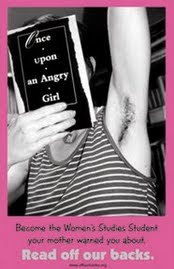
Off Our Backs (known colloquially as OOB), the longest-running feminist periodical in the USA, began publishing in 1970. I began reading it around 1975-76. Confession: I used to fantasize about being in the Off Our Backs collective. I mean, in-depth fantasies. I imagined it as a feminist heaven, a woman-identified nirvana.
My OOB-collective fantasy first came to flower in the late 70s, during the time I attended lots of political meetings. Meetings, meetings, more meetings than anyone should be forced to attend. I became fascinated with the inner-workings of all of these meetings; the vast number of subjects spoken and unspoken. The multiple ancient hostilities and differences submerged for political expedience; the comrades sleeping together who pretended they weren't; the various types of flirting disguised as political curiosity; the engagement in constant verbal foreplay, using lefty phrases and slogans almost as caresses. And above all, the congenitally bossy people who were sublimating, using the left as their new place to terrorize, cajole, and occasionally force others into doing their will. All personality types were present and accounted for. And all sins. I found myself wondering if an all-woman environment would contain the same constant jockeying for power and position.
One of the things we had at the Columbus Free Press, was an "exchange list" of alternative newspapers from across the country. I don't know when the exchange list began, but every alternative newspaper I worked for (about a half-dozen total), had an exchange list of publications; they would send theirs to us and in exchange, we'd send a copy of our proud, plucky Free Press to them. It was then someone's job to go through the large stack of monthly exchange newspapers and scout for interesting news clippings to reprint. I gladly volunteered, since I was totally enamored with the collection of funky, radical publications, which made me feel like there really was a national movement. This was how I originally discovered Off Our Backs, Big Mama Rag, and What She Wants, as well as three newspapers I later worked for myself: Womansong, Majority Report and Plexus.
Off Our Backs was easily the most intense and comprehensive of all of these feminist newspapers. They covered an inexhaustible number of subjects, and took radical positions quickly, without a lot of dithering. (For example, for good or ill, they were the first to take the sides of both Aileen Wuornos and Mary Beth Whitehead, thoroughly unpopular positions.) They interviewed powerhouse feminists like Catharine MacKinnon, Nikki Craft and Mary E. Hunt. Fabulous women like Susanna Sturgis and Irena Klepfisz regularly wrote for them. I was enthralled. They seemed to have a lot of what we now call process, and they would write articles about how they had come to their political positions, including various arguments within the collective.
I became somewhat obsessed with the Catholic member of the collective, Carol Anne Douglas. I loved everything she wrote, although she scared me in how uncompromising and separatist she was. I could see Catholicism in her separatism, an unwavering brand of dogma that I wondered if she could even see herself. [1] But I loved her writing, and her careful reporting on events like conferences and workshops. I would go so far as to say that because I read her monthly for many years, my own writing style has been greatly influenced by hers. Douglas had the knack of fairly covering all sides of a debate while always letting you know where she stood, which I have always found intellectually impressive in the extreme.
At this juncture of the wild and woolly 70s, your humble narrator was hanging with the Yippies, whom I knew the OOB women wouldn't approve of. I knew this because I had written a (fairly good, I thought) piece on some of the Yippie women who had organized the Rock Against Racism concerts in Columbus, Chicago and New York City. Not only did OOB not publish it, they didn't even reply to me. (It was later run in a small Midwestern feminist newsletter, the name of which escapes me now.) I assumed this was due to my lack of education and/or poor writing (although my column in the Free Press had a small following by this time, so I figured my writing couldn't be too awful bad). Although I had carefully included the women-rockers who had helped launch the event in the USA (RAR was originally a British movement), I thought maybe OOB didn't like rock music or thought too many men were involved to make it an overtly "feminist" event. It never once occurred to me that they did not consider Rock Against Racism, or anything against racism, to be "unfeminist" or unpolitical. It is pertinent that I just assumed that politically, they were "ahead" of me; it never crossed my mind that I might be politically "ahead" of them.
The OOB-Collective fantasy began, full-fledged, at this time. I would imagine the perfect harmony of an all-woman collective; the woman-identified purity that I could never hope to achieve, with all my backward husband-acquiring, punk-rock ways. I knew many of the OOB women were full-on separatists, so I imagined what I would say to them when confronted about those pesky males that I kept marrying. What would I say? Many of the answers I came up with, in imagined radical-separatist meetings, are answers I continue to use. (Fantasy has its uses!) I also found myself imagining long conversations with Douglas, about St Elizabeth of Hungary and holy women like that.
Around this time, I was also involved in another political group called TUFF. (No, I didn't give it the goofy name, okay?)
TUFF (which the Yippies called "not so tough") stood for Those United to Fight Fascism, and some of this group later morphed into Klanwatch. The (mostly white) people in TUFF were accused of ignoring the agenda of the Columbus black community and took these charges very seriously--deciding (of course) to have a big meeting over it. Interestingly enough, it was at this time that OOB was also having major issues with accusations of racism. I remember that the OOB collective didn't seem all that convinced that they needed to examine themselves, in comparison to TUFF, whose white members were busily rending their garments, doing penance and applying copious ashes and sackcloth. By contrast, it seemed to me, OOB acted as if they were doing Women of Color a favor by entertaining their perspective.
And so, TUFF (dumb name) had a racial inquisition, around the same time that Off Our Backs had one. (I remember wondering if this was some kind of weird political synchronicity.) Thus, I read about OOB's "race problems" at virtually the same time the white Columbus left was dealing with our "race problems"--and I was startled to read of the similarities in interpersonal dynamics. WOW, I thought, it all sounds the same!
OOB's official "Women of Color issue"--which was the result of a protest from WOC feminists who demanded that OOB turn over an issue to them exclusively--was the first place I ever read the term "pearl-clutching." There was also a very critical article by a black woman named Hope, who wrote about how white feminists did not take her seriously. She gave several real-life examples and I wondered which of these involved OOB collective members, or if any of them did?
 I started thinking about the fact that OOB (and, to be fair, the white left in general) used images of Women of Color to gain credibility and to appear more serious. For instance, the OOB cover at left was fairly typical. Looking at the cover, you might think an Asian woman wrote the article, or that it was particularly knowledgeable from a Vietnamese woman's point-of-view. Nope. The image was just cool to use; the article was by an American, about American peace activists in Hanoi. (I did not know the term "cultural imperialism" then, or I might have used it.)
When Carol Anne Douglas' novel, To the Cleveland Station, was published, I grabbed it immediately. The novel was about a thinly-disguised Douglas (a lesbian-feminist writing for a radical newspaper, working on her Ph.D.) involved with an African-American woman who had been subjected to electroshock therapy as aversive conditioning. I read it a few times and was greatly disconcerted by it, but could not readily explain why. [2]
My first major problem with OOB (besides the separatism, which I enjoyed mentally jousting with) came in the early 80s. The aforementioned Carol Anne Douglas wrote, "Why aren't there any radical feminists in welfare offices?"--a line I read, as luck would have it, as I was sitting in the welfare office.
I read the line again. What?
And again.
I can still remember the feeling, my cheeks growing hot, the embarrassment I felt as I was erased by the same person I couldn't wait to read each month.
I was stunned. Why did she assume none of us are poor? That none of us have children AND are poor? It hurt me, but I didn't have the words. It just seemed like some bizarre assumption to me; welfare mothers can be some of the most radical women you will ever meet.
Doesn't she know that?
Apparently not.
And so, my OOB-universe was seriously rocked to the foundations by this classist statement by Douglas, whom I had so much admired. My OOB-fantasies consequently ebbed for awhile. But at the end of the 80s, when I moved south, they resumed, as I found myself pining for a lefty political collective again, realizing that the whole alternative-media era had now passed. OOB and Kerista were the only people left who had maintained collectives, and took center stage in my mind as people who had made collectives somehow continue to work in real life, not just in theory.
When the Keristans broke up in 1991, that left OOB.
~*~
 I can't remember when I stopped reading OOB. Probably the mid-90s.
At some point, their views seemed antiquated and disjointed. I changed my mind about several key issues, such as sex-work and transgenderism, and found myself on the opposite side of the feminist divide. Nonetheless, I always wanted the publication to survive, although I didn't see how that could happen without an infusion of new ideas and new blood.
And as time went on, the welfare-office remark stuck in my craw. As I grew older, I realized what a completely clueless statement it had been. I wondered how I had ever idolized people who believed such a thing. The statement was obviously the result of a very sheltered life, from one who had never been inside a real live welfare office. And I wasn't thrilled about the direction OOB was taking in the 90s, which seemed even more middle-class, highly-educated and sheltered than it had been in the past.
Which brings me to the present.
Off Our Backs has been rumored to be in the process of breaking up for quite some time now. While I remember regular monthly OOBs, never late and always bulging to the seams with content, OOB has been quarterly (or less) and rather slim for the last decade or so. But last year, Heart (YES! That Heart!), aka Cheryl Lindsey Seelhoff, was supposed to be riding in on her white mare to save the day and edit the summer issue. (Oh boy, I thought.)
Apparently, Heart messed up her save-OOB gig. In fact, no one seems to know why Heart did not do as she promised she would do, but that's getting ahead of the story. (She claims a "family emergency"--although the women who were on her email list know of no such emergency.)
A black woman who was a collective member of OOB, has just written a scathing critique of OOB's race politics, or lack of them. She has catalogued her OOB involvement on a blog named Celie's Revenge. Thus, I will call her Celie, since I have not been given direct permission to use her name (although Karla Mantilla used it in her response).
It's a long post, but several passages jump right out at the reader, especially an old OOB junkie like your humble narrator:
Their last question to me during the interview process I went through to join the collective was if I had any ulterior motives? Let’s put aside, just for the time being, the inherent racism in any POC being asked such a question by anyone who is white, especially when the interviewer is in the more powerful position not just due to race. At the time I took this to just mean they were concerned that, in fact, I was just a closet sex pozi. But now looking back realizing that I had already made my radical feminist opposition to the sex industry very clear from the start I see the question as a reflection more of their suspicion of my possible ulterior motives as a Black person not as a sex-positive (pro-liberal, pro-porn, pro-prostitution) person. Would I as a Black woman whose identity was muddied by the reality of race threaten the collective’s value system in which the interconnectedness of oppression is dismissed in favor of a narrow focus on gender identity and male supremacy? Was that what they meant by “ulterior motives”?Their last question to me during the interview process I went through to join the collective was if I had any ulterior motives? Let’s put aside, just for the time being, the inherent racism in any POC being asked such a question by anyone who is white, especially when the interviewer is in the more powerful position not just due to race. At the time I took this to just mean they were concerned that, in fact, I was just a closet sex pozi. But now looking back realizing that I had already made my radical feminist opposition to the sex industry very clear from the start I see the question as a reflection more of their suspicion of my possible ulterior motives as a Black person not as a sex-positive (pro-liberal, pro-porn, pro-prostitution) person. Would I as a Black woman whose identity was muddied by the reality of race threaten the collective’s value system in which the interconnectedness of oppression is dismissed in favor of a narrow focus on gender identity and male supremacy? Was that what they meant by “ulterior motives”?
Indeed, this lets us know the agenda was not entirely on the up and up. Why would someone's "ulterior motives" be questioned?
Why is a black woman thought to be more "sex pozi" than any other feminist who applied for the position? (Is there
any serious feminist who doesn't already know OOB's position?)
That was my experience of their question: I felt like I was in a probationary period in which I was supposed to prove my loyalty which really meant my ability to be silent on matters of race and white supremacy.
Although I was previously declaring and saying that I was the first Black female member of oob’s collective I’d discovered that this actually is not true. But I shouldn’t be faulted for assuming that! Why? Because after my experience with oob’s collective, production team, and volunteers the vast majority of whom were white, I couldn’t have imagined that another Black woman could have existed and survived with her radicalism and dignity intact for long in such an oppressive space [...]There’s no way for me to know how many other Black women and other women of color have been on the collective of off our backs. And I’m sure oob is not to about to say because I doubt the numbers are impressive.
Good Lord, they
never discussed this with her???!!!
Oh wow. Ohh...wow.
I had
no idea they were this backward regarding race. The fact that my Rock Against Racism article was patently ignored, is suddenly viewed
in a whole nother light, now isn't it? Maybe they thought the subject simply wasn't important, if they thought the fact of WOC collective members wasn't important enough to discuss with Celie. [3]
I urge you to read it all. Some other excerpts that seem especially damning:
Oob is overwhelmingly white in a city known for its anti-establishment organizing and community-building by POC. This includes a bookstore called SisterSpace and Books on U Street NW, the operators, a black lesbian couple were evicted from that space due to the gentrification of the neighborhood. What is the history of oob’s solidarity with SisterSpace and Books and other WOC-run organizations in DC? This is an open question to the oob collective for whom sisterhood is so valued in statement. The question is, is this value also evidenced in their forty years of presence in a Black-majority city where Black women outnumber white women? Is it reasonable to assume that over forty years some significant sisterly bonds would be made by the white women of oob to their Black DC sisters?
I had actually asked Karla Mantilla directly that question related SisterSpace and she seemed uncomfortably dismissive of them stating that she had tried to reach out but they never seemed interested.
In the collective, currently, there is only one woman of color and the white women who comprise the majority are just fine to put her out there as “the representative” of the collective...
[...]
we see an example in which some white women strengthen their sisterly supremacist bond by freezing out “the other,” the lone Black woman, the ‘guerilla in their midst.’ Or, as white supremacist “radical” feminist Kate Guntermann phrased it, “Blackzilla” in an exchange I had with her on Facebook. She used this term, seriously, to me, to refer to Black women who she believes choose race over gender by siding with sexist Black men rather than bonding with racist white women.
It should be noted here that my exchange with Kate Guntermann was what compelled me to set the record straight with my “radical” white feminist sisters. Please don’t get it twisted: my radical feminism as a Black woman is not to be used as an invitation for white feminists to appropriate my feelings of betrayal by misogynistic Black men into their agenda of dismissing their white privilege!
When I was initially invited into the collective, most of my writing was directed at Black male chauvinism, misogynistic hip hop, and street sexual harassment by men. None of these issues indicted white women on any level. So upon reflection the only thing that might explain the collective’s swift disdain for me might have something to do with the way my criticism had recently turned towards white women’s racism. I am left to wonder: was my critique getting too close to their privileged comfort?
For Guntermann and for other white racist feminists, a “Blackzilla” is a bully to white women, a Black woman who, somehow, against all systemic odds, has power over white women to control and manipulate them—to make white women behave the way we want them to behave. Right.
[...]
Laurel Long is a white Goucher student who worked as a summer intern at the oob office. When I found out I’d be working with her as a volunteer I added her to my buddy list on google mail. Her very first words to me about the photo of myself I had up as my chat avatar was, “Wow! You look like Angela Davis!” As anyone who isn’t white supremacist and who knows me can attest, I look NOTHING like Angela Davis! But I guess to someone like Laurel all Black women look alike. She wasn’t referring to anything having to do with our ways of being in the world. She was speaking solely about my appearance and how I apparently would be mistaken anywhere for Angela’s daughter.
[...]
A list-serve for the oob production team was started so that the women on board to produce the next issue could communicate. Cheryl Seelhoff, a white “radical” feminist who didn’t live in DC, was put in charge of assigning tasks and developing a theme and structure for the next issue.
Our goal was for the next issue to go out in June 2009.
In mid April, after the articles for the next issue were written and sent off to Cheryl, she disappeared.
When the production team members began to write in to the list wondering what the status of the issue was Cheryl finally responded by saying that she was going through a very painful and difficult family situation.
Within 24 hours Karla Mantilla and the other white women on the list immediately responded with supportive words of understanding and sisterhood. And compassion and outreach was indeed what should have been provided to Cheryl, given her life circumstances. I have no critique at all of the level of contact white women gave to Cheryl. It was the sisterly thing to do.
The concern for Cheryl’s situation and feelings coupled with a desire not to appear dismissive or cold meant that the June deadline for the issue’s release and arrival in subscribers’ mailboxes, like we’d promised, came and went. It wasn’t until late July that anyone finally moved to do anything about getting the issue going again.
Then in late June there was the crash of the Red Line train on the DC Metro System. As some of you know I later realized I missed being on that train by only a few minutes when I decided to cross the platform to head in the opposite direction. Tragically, the life partner of an oob collective member, Carol Anne Douglas, was on that train and died from the crash. It was announced on the production team list serve. Everyone expressed their shock, sadness, and sympathy. The oob collective sent flowers. I posted the tragedy as my Facebook status and asked everyone who believed in feminism to please send along their words of sisterhood towards this woman who had committed her life towards women’s liberation. [4]
...
In September, Celie was fired from her job, and there was little sympathy extended to her, as it had been extended so freely to Seelhoff and Douglas. She also finds out about Karla Mantilla's birthday party, to which she was not invited. Finally, she learns through a Facebook OOB account, that she is no longer a member of the collective (!):
I knew for certain that I’d been officially removed by them from the actual collective only when I saw a new Facebook group for oob created and my name not included among the list of collective members. I guess that’s what the oob collective calls consensus when they are dealing with a Black woman. Let me remind the collective and its white supremacist supporters and apologists: Karla and her silent white sisters who collaborated to shun and purge a Black woman from their collective could have contacted me at any point during the whole process. They stood in solidarity and silence, allowing me to wonder what the hell was going on.
And here is the official reply from long-time collective member Karla Mantilla, which does not mention racism at all.
Got that? DOES NOT MENTION RACISM. AT. ALL. Because
only the black woman says it's about racism, the white people
know it isn't. So, that's that.
Karla Mantilla's angry, nasty response was originally published at
Redmegaera's blog, but has since been deleted. (Gee, I wonder why?)
Mantilla eagerly takes on the white (wo)man's burden:
Following is my reluctant answer to the wholly outrageous , unsubstantiated, and ridiculous charges made about off our backs of late by [Celie][...]I know it can be exceedingly difficult to sort out the merits of the charges that have been levied against me and against off our backs. It is entirely understandable that it would be difficult to know whom to trust in this matter. Nevertheless, I urge you to consider all the facts before you come to a conclusion. I also urge you to consider that not everyone who posts something on a blog on the internet is honest or is acting in good faith.
Below, I lay out some significant inconsistencies and internal contradictions in the claims and statements that [Celie] has made. I believe that if you look at these facts with an open mind and in honest good faith, they will, at a minimum, establish some serious doubts regarding her claims
...and goes on to insist that Celie wasn't kicked out, she QUIT! So THERE!
Umm, is that supposed to sum everything up? She quit in a huff, so you didn't kick her out?
Okay, why did she "quit" then?
Why, when she quit, did she make no mention of racism by multiple collective members as a reason, but instead say that it was because “certain people” (which I assure you means me, as you will come to understand below) were “unresponsive” to her?
Gee, I wonder.
Why does she write about “Karla Mantilla & company” or “Karla and others”? Why am I singled out by name?
You don't get it, do you, Karla?
If you don't get it, then you don't get it. And there is no mistaking the fact that Karla doesn't get it:
I was quite friendly to [Celie] from the beginning of her coming to off our backs, inviting her to several social occasions at my house as well as sharing some meals and other events with her. I admired her incisive intelligence, her breadth of knowledge, and her politics. In addition, I spent much time at our collective meetings listening to her complaints about her many Facebook fights. My fellow collective members will agree that I was the person on the collective who was most attentive to her and spent the most time with her.
At first I thought she just needed the affirmation and support that anyone needs when encountering injustice such as what she claimed happened to her on Facebook. But as time progressed, I began to notice that she was interested in very little of the actual off our backs business and appeared to merely want an audience to listen to her rant about people on Facebook who had offended her in some way. Then I began to notice that it was she who picked the Facebook fights, and even more upsetting, that she was a person who, when she perceived offense of any kind, however slight, was vicious, vindictive, mean-spirited, and relentless.
I began to see this as a pattern by early September (I had no idea just how right I was), and at that point, although I had every expectation of continuing to work with her on off our backs, I began to want to distance from her socially.
That is why I did not invite her to my birthday party and did not respond when she sent a mass email that she had been laid off. My birthday party was NOT an off our backs event, and I assumed that others who felt close to her would be supportive to her regarding her job. In fact, two other collective members, Angie and Laura, did contact her and offer her their sympathy on losing her job.
I did not think my distancing from her would be a big deal, especially since she had not attended any of the social events at my house, in most cases without even RSVPing, and she had never had any personal conversations with me in which she expressed any interest in me or my life. I was surprised when she missed a couple of oob meetings without even calling or emailing to let us know whether she would be there. I was shocked to read her resignation letter on our semi-public listserv alluding to “certain persons.” [Celie] has at no point attempted to contact me in order to ask what was wrong or why I was withdrew from her, nor has she ever communicated any of her concerns to me.
The reason I believe she singles me out in her various diatribes is because it was I who distanced from her—I absolutely admit that I did that. She is correct that I reacted to her being laid off with less concern than I ordinarily would have with other people, but this has nothing to do with her being black; it has everything to do with her being cruel and spiteful and my wish to not be involved with such a person on a social level.
It is absolutely ridiculous that she has blown my social distancing from her into a grandiose lie about me personally and off our backs in general. Her trumped up ex post facto charges of racism are nothing but malicious lies she is attempting to spread on the internet in an attempt to exact revenge for a perceived personal slight.
Bottom line—I don’t like her, I have a right to not like her after coming to know her, my evaluation of her has proved true in her subsequent behavior and treatment of me, and all of this has nothing whatsoever to do with race. She is one of the meanest people I have ever encountered in my many years doing all kinds of work, and I wish to have nothing more to do with her.
Her statement that what we/I did to one black woman, we did to all black women, is laughable. She does not represent all black women—it is a supreme insult to black women to suggest that she does. How I treated her and my opinion of her are solely due to her own particular behavior and personality–her vindictiveness, her maliciousness, her lack of integrity, and her complete disregard for ethical behavior–and nothing else.
I take no joy in declaring this publicly, but her behavior has forced this admission. I have no shame about my actions—I befriended her, spent time with her, found out who she is, and I refuse to be bullied into involving her in my personal life.[5]
Wow.
Karla, you are the one who is friends with HEART, yes? You are the one who loooooves Heart and parties with her at the Michigan Women's Music Festival and believed she could edit OOB... right? Did you apologize to the collective for your bad judgment, believing silly Heart could edit her way out of a paper bag? Should we be holding you accountable for letting your friendship cloud your political loyalties? WHERE is the issue of OOB promised by Heart? (And more to the point: WHAT family emergency was this?)
Reading this sordid nonsense that Mantilla has spewed (and is now deleting in SHAME, one hopes), I know which side I'm on.
Please, somebody put the nail in the coffin of OOB. I hate to admit it, but it's time.
~*~
[1] In her novel
To the Cleveland Station, Douglas writes, "I am a Catholic who searched for another faith and found it. That explains so much about me."
[2] I feel Douglas' novel was unknowingly and unintentionally racist in its characterization of the African-American woman. But I found it rather hypnotizing because I could imagine writing the same thing myself. Douglas came from a racist father, as I did. She compensates by attempting to canonize the character and portrays her as a blameless victim. In fairness, Douglas later wrote that she should not have written the book at all and said it was inappropriate, but did not go into detail about how she arrived at that position. (I am sure I am not the only person who had issues with the characterization.)
NOTE: Celie does not criticize Douglas, but focuses on Mantilla. My reasons for mentioning Douglas' book is to make it clear there has been an ongoing race-oriented political critique of OOB, and Celie unknowingly walked into the middle of that. (I wonder if she is even aware of Douglas' novel?)
[3] I do know that an Asian woman named
Adriane Fugh-Berman was a collective member for years. I do not know why she left, but OOB was much poorer for it. Her bio does not mention her years at OOB, where she wrote about women's health issues and reviewed books. I know of no other WOC at OOB, which doesn't mean they didn't exist. But no other OOB-member that I recall, actively wrote about race (as I recall Fugh-Berman did).
[4] I wept reading this, since I know how much Carol Anne Douglas loved her partner,
Mary "Mandy" Doolittle. My deepest sympathies to Douglas on the loss of her beloved Mandy. :(
[5] I hope I do not have to do a whole social critique about why words like
malicious, mean, vindictive, unethical, etc are problematic when applied to a black woman by a white woman in a collective situation, wherein the white woman has more social status and authority. Karla assures us that the facts will surely support blah blah blah, when all I can see is, Karla thought Celie was hunky-dory and right-on for awhile, then decided she was not, all due to some Facebook feuds.
Really?
Pardon my skepticism, but I hardly think so.