
 At left: Audrey Meadows and Jackie Gleason as Alice and Ralph in THE HONEYMOONERS.
I was looking at Ralph and Alice Kramden's tiny, dingy apartment last night, flipping channels and feeling some 50s nostalgia. And then, jarringly, I landed on some shiny new sitcom, and the same supposedly middle-class people are living in $350,000 homes.
Wait, what? How could they afford THAT? Alice and Ralph barely scraped by, and they didn't even have a car. They talked about not having a car, too. They talked about money. They talked about affording things and not affording things. I suddenly realized that modern TV characters do not talk about whether they can afford things now, unless it is something obviously expensive, like tuition to particularly-pricey colleges or spiffy sports cars or extended vacations to Paris. I also realized something else: Ralph and Alice didn't have credit cards. After all, they still bought ice for their actual ice box.
They didn't have much. No nice clothes, no nice furniture. People loved them because they identified with them.
When did that change? When did regular, just-folks TV characters turn into imitation-rich-people? Even though the characters are given simple occupations, they are clearly living way beyond their means and above their pay-grade.
I first became aware of this back in the 90s, when some wit (possibly in the Village Voice) wrote an article about the then-wildly-popular show "Friends"--suggesting that their respective apartments would cost ____ (something outlandish) that unemployed actors and waitresses (the "Friends" occupations) could never possibly afford.
This TV Trope became known as Friends Rent Control, which was the official excuse for this luxurious apartment-dwelling:Besides appealing to audience fantasy, this is usually done because large sets are easier to film in. If Monica or Chandler's apartment on Friends had been realistic, the entire apartment would be the size of an average living room, rather than the entire first floor of a house. Doing a scene with all six main characters would have been a total nightmare for the cast and crew. It's for this very reason that Angel changed its primary set from a cramped basement office in Season 1 to a spacious hotel in Season 2. In some cases, though, the reason is that the writers and producers have either forgotten or never known how normal people live; born into prosperity with parents able to afford the best universities and pampered by the entertainment industry, they actually have no clue of how the majority of people live.
Ah, we get to the heart of it.
Jackie Gleason came from Brooklyn, and actually grew up at 328 Chauncey Street, the address he used in THE HONEYMOONERS. His parents were both from Ireland. He WAS Ralph Kramden, except he didn't drive a bus (but you could certainly imagine him driving one). Jackie Gleason was poor and never even graduated from high school. He hadn't forgotten how it was to live with an ice box that used real ice.
There is a similar TV trope called Living in a Furniture Store, the title of which sums up how these TV-homes are designed and arranged.
Speaking of furniture stores, does all of this STUFF in TV shows (which we are to believe is owned by regular people like you and me), cause viewers to crave more STUFF? I think it does. I was just admiring some of the bed linens and coverings in an EVERYBODY LOVES RAYMOND rerun, and thinking idly of my tacky, ancient quilts and how I fall short. I see no reason to have new quilts when I love my old ones, but... well... they ARE old, and I am suddenly conscious of it.
In fact, these thoughts started me thinking about this post, and got me wondering how other people feel about this phenomenon.
What do you think when you see dental-hygienists and waiters and other low-income people living like kings on TV? Do you laugh at it, or does it annoy you?
Have you ever craved something you saw on a TV show? And let me clarify: I do NOT refer to commercials and advertising; it is the JOB of a TV commercial to make you crave something, but it is simply a symptom of viewing that makes you crave something you saw on EVERYBODY LOVES RAYMOND. (It is also a by-product of wanting to be like the characters, as when millions of women cut their hair like Jennifer Aniston back in the 90s.)
Your thoughts?
Thursday, December 1, 2011
News flash: People on TV live better than we do

Tuesday, December 8, 2009
We won't give pause until the blood is flowing
 Photo of the greatest writer and philosopher of the 20th century, JG Ballard, from The Northern Light.
I have been trying to articulate what I dislike about mass-market holidays. In particular, the mass market holiday that Christmas has become.
And I find myself going to my late guru to explain; may his soul rest in peace. I miss him like he was my own father. Maybe he was, in a way.
From V. Vale's quite invaluable J.G. Ballard: Conversations, some excerpts that say it far better than I can:
People use mental formulas that they've learned from TV. Even in ordinary conversation, if you're talking to the mechanic at the garage about whether you need new tires for your car, you and he probably talk in a way that his equivalent thirty years ago would never have done. You use--not catch phrases, but verbal formulas. Suddenly you realize you're hearing echoes of some public-information, accident-prevention commercial. It's uncanny.Holidays like Halloween and Christmas are spectacles that people engage in, because they are on TV. Working retail, I consider a certain type of existential-shopping (wherein people don't really know what they are "looking" for) part of this Ballardian phenomenon.
[...] What's interesting [about Reality TV shows like Big Brother] is that almost nothing happens. There's a certain amount of bitching and gossip and sitting around the supper table talking in a sort of half-hearted way, but there's no drama. Nonetheless, the audiences are riveted. And they're riveted by very similar programs where TV producers put people on desert islands and see how they survive; a series called Survivor did just that. I think this reflects a tremendous hunger among people for "reality"--for ordinary reality. It's very difficult to find the "real," because the environment is totally manufactured.
Even one's own home is a kind of anthology of advertisers, manufacturers, motifs, and presentation techniques. There's nothing "natural" about one's home these days. The furnishings, the fabrics, the furniture, the appliances, the TV, and all the electronic equipment--we're living inside commercials. I think people realize this, and they're desperate for reality, which partly explains the surge in popularity of "adventure" holidays. People think that by living on some mountainside in a tent and being frozen to death by freezing rain, they're somehow discovering reality, but of course that's just another fiction dreamed up by a TV producer. And there's no escape.
There are so many fabulous quotes in this book, I will be blogging lots of them. For instance, about the disparity between rich and poor:
In England [this conversation was recorded in 2003], we're getting unprecedented disparities of wealth. The people who run our biggest corporations have begun to affect life in London primarily by buying up property, and the old middle class (doctors, civil servants, teachers, salaried professionals) can no longer afford to live in central London. Now there are whole areas of central London given over to the rich. I've often thought that in due course all these very rich financiers are going to leave very large sums of money to their children. Then you'll get a sort of New Leisure Class who never work, but have huge spending power--like the ancien regime in France. Supposedly, the same thing is happening in Manhattan: the middle class has been forced out...V. Vale replies that the same thing is happening in San Francisco; New York and San Francisco are the two most expensive cities in the USA. I would add that it's even true in lil ole Greenville; the 'centers' of towns/cities are now priced out of range for the actual natives of those towns/cities. Most of the people moving into the new high-priced condos in downtown Greenville, for instance, come from someplace else, often from Europe or the coasts. The rich colonizing the cities and leaving the outlying suburbs to the poor and the rabble, is the exact reverse of what happened in the 60s, when the rich moved to the suburbs and left the inner-cities to rot. Now that they crave authenticity, they have moved back to cities in droves. However, they still aren't getting the authenticity they crave, since the only people who can afford to live in cities are rich, affluent people who are all just like them.
In the cities, a bizarre new class-based uniformity has taken hold, while in my suburban apartment building, every race and age and nationality and economic status is well-represented.
Authenticity has been priced out of the market.
Speaking of which, here is Ballard on the future of sex:
[The] time is going to come when no young woman will regard penetrative penis-and-vagina sex as real sex, because it isn't deviant enough to be considered "real sex." These days, magazines for teenagers sold openly on newsstands have headlines like, "Interested in S&M sex? Junior Cosmo explains all you need to know." And this is a magazine that's going to be bought and read by 14-year-olds. The period of conventional, penetrative, penis/vagina sex will be over by the time you're about 15, and then you'll move into the area of conceptualized sex, S&M, and whatever--and that's what will be regarded as real sex. To me, this seems like a daunting thought.Ballard on the future of reading:
People don't use libraries as much as they used to. One thing I miss terribly--I don't know if the same thing applied in America, but over here in the Forties and Fifties when I first came to England, what I loved were the second-hand bookshops. Every small town had a second-hand bookshop, which was constantly being stocked up... when someone died, the family took their books to the second-hand bookshop and got sixpence each for them. There were a lot of unserious materials, popular novels and the like...but there were a lot of very serious books. You know, one serious collector in a lifetime could produce enough books to keep a second-hand bookstore open for a year.I'll be revisiting these Conversations often, which Ballard would be pleased to know, I found by browsing bookstores in the serendipitous manner he has described so well.
I did most of my reading in second-hand bookshops. I remember when I was living in London somewhere I used a local one. Also, serendipity came into it [...] You made accidental discoveries all the time. And this sort of refreshed one. You were constantly being surprised, constantly making discoveries. All this is gone now, of course. There can't be more than a half a dozen used bookshops in the whole of West London, if any.
What we've got now is a new kind of literacy. We've got people who are expert at reading the labels on products, expert at reading instructional manuals that come with a new kind of vacuum cleaner, or a computer or what have you. They're expert at that kind of reading, but not at anything else. Not with a more traditional book.
I don't know if the internet has affected that. I have very high hopes for the internet, which I think could be the sort of--if we're entering a New Dark Age, the internet could help to keep the lights on!
I miss you, man.
~*~
Ballard would have understood this song/video, which is where we get today's blog-post title. Caution, may trigger, may offend, watch out, yada yada.
(Not for the faint of heart or the oversensitive. Really.)
Vicarious - Tool
Note: Well, damn, there is some argument over exactly the lyrics I was going to quote. I always heard:
We all feed on tragedy
It's the virtue of empire
Other listeners report: "It's the virtual vampire," and still others, "like blood to a vampire." (Does anyone know the official lyrics?)
I guess you can still understand the concept, though.
Put another way:
Tuesday, September 15, 2009
Blue Jello Daze: A Back-to-School story of the suburbs
 We wanted our young Delusional Precious to have the very best education in the county, although we could not afford to send her to a private school. Besides that, we didn't really think private schools were a good idea from an egalitarian point of view. So, we sent her to the"best" school in the county, which of course, turned out to be the "richest" of the public schools. The volunteer ratios were nearly 2-1; unemployed moms to students.
My first lesson in the new school was what this actually meant.
During test week on the West side (poor side) of Greenville County, we got a flier telling us the kids would be taking all of the official, federal standardized tests. Okay, that's nice. Typically, I didn't think much of it and just made sure Delusional Precious (herein referred to as DP) got a good night's sleep. However, in the days after testing was over, DP complained that the old lunchroom where the tests were taken (in a building that has since been condemned, BTW) was by turns drafty and too-hot. South Carolina Autumn sunlight (blinding) was shining right in her eyes at one point, and she couldn't concentrate. At another juncture, she had to pee, and there wasn't enough time alotted. She apologized for the tests, and said she knew she had not done her best.
And then, DP was tested at her NEW SCHOOL; the East side (rich) school with air conditioning, tinted windows and carpeting. No sunlight in the eyes there, no sirree Bob! In fact, between each test, there were copious bathroom breaks and stretching exercises, supervised and conducted by legions of stay-at-home moms. They did rousing cheers, as in sports ("WE'RE #1!") and practically engaged in Cultural Revolution-style calisthenics, right there at their desks. The kids were also plied with healthy snacks and juices between the tests, to keep their blood-sugar levels high. (Who paid for all this? Who do you think? The legions of volunteers, of course.) They were STOKED, and yeah, their tests scores were phenomenal. DP's scores were about 20 points higher. I was astounded!
I joked to people that my kid's IQ had been raised one standard deviation just by moving to the East side.
I should have known, this meant LOTS MORE WORK for me, but I really hadn't thought it through. But after awhile, I was carting her everywhere for all kinds of specialized activities. I was footing the bill for all manner of pricey field trips; some of which I could not afford (i.e. trips to Quebec) and she had to sit out. We were out of our league, financially, but I hoped this meant she was getting a better education.
The assigned school projects were enormous. A mere child could never execute stuff so intricate; they seemed to require people with engineering or graphic-design degrees. In addition, it seemed understood that the parents would certainly chip in... or maybe do the whole thing. Certainly, working mothers could never find the time to work on these gargantuan undertakings.
I found reasonable ways to cut time-expenditures on these projects, but discovered that this would be judged (by teachers) as "cutting corners" and would negatively influence DP's grade. The projects had to LOOK like they had been duly fussed over, and some seemed worthy of the Martha Stewart Living Christmas edition. When I visited the school to drop off the (increasingly huge) projects, I would see what the other parents had done. DP and I would exchange dumbfounded looks: Jesus H Christ. I would never be upset with her for whatever grades she was given on these things--realizing that a good grade in such a situation was simply impossible to obtain. But of course, she wanted the good grades too, and felt that she was being cheated and unfairly penalized (which she was) since her mother could not take whole days off work to execute these complicated, long-ass projects.
I realized, once and for all, that we had made a big mistake on the day I call Blue Jello Day. It was my moment of truth. We do not belong here. I realized, moving to this side of town for the sake of a better education, was a huge error. What were we thinking?
It was the Blue Jello. The project was a Native American project. The kids picked a tribe and made something that was emblematic of that tribe. I was relieved that this was an easy one. I actually duplicated something I had done as a child: a warrior's necklace. I regret to say I now forget the tribe(s), but most tribal warriors wore these, rather as charm bracelets are worn in the present day. They collected pieces of arrowheads, colorful beads, animal bones, shells, etc and displayed them, as military medals or girl scout badges might be displayed. So, we made one based on a photo in Encyclopedia Brittanica, and I was happy with it. I figured it might at least get a B.
On this auspicious day, there was MORE THAN ONE PROJECT DUE (do you believe?), so there I am, hauling in some humongous hand-made poster about the habitat of the North American Lynx on the same day I brought in the necklace.
And, taking up about half the room, was an "Indian village"--on what seemed to be a very large, burlap-covered ping-pong table. There were little teepees and little people. PEOPLE. They were all dressed appropriately, I noticed. Little tiny braids on the little tiny people. Little tiny papooses on the backs of the little tiny wooden women... and...
There it was. In the middle of the village, well, what do you suppose was there? What WAS in the middle, usually? Historical accuracy! Yes, a POND. A very nice POND was etched out of the burlap, and it was .... made of blue jello.
Stunned, I actually reached out and touched the jello. My suburban Epiphany!
What the fuck am I doing here?!?
I pointed at the blue jello, and attempted to say something to Delusional Precious. Speechless. She looked at it and rolled her eyes. Even though she was only in the 5th or 6th grade, she exclaimed "Shit!" and I did not chastise her, because she had correctly spoken my thoughts aloud.
Yeah, shit!
Did the mom come and set this whole thing up IN THE CLASS? Well, I guess she had to, huh? How else could she get all the little people lined up just so? She must have brought the blue jello in some tupperware and dished it out, after carefully placing the burlap and teepees and tiny wooden Indians and teensy stuffed buffaloes (really) and teensy arrows made of painted toothpicks all sticking out of the miniature stuffed buffalo. I just stared, and as I often do, I wondered what JG Ballard would say.
Okay, that's it. I can NOT compete with this.
And it was then that I stopped trying to. I did not worry that my kid could not keep up with these people. I realized, well, we made a mistake, but we will attempt to deal. And we dealt with it pretty badly, actually, and things did not always go as planned. But after I saw the Blue Jello, I had a point of reference.
Every year, when I hear all the moms worry aloud about their kids going back to school, I think of my Blue Jello Daze. And frankly? I would not repeat those years for ANYTHING.
My love, good thoughts and novenas are with all of you feminist, progressive moms, as you attempt to navigate this territory, keep your sanity, and yet do the right thing for your babies.
Namaste, and know that I love you. :)
Thursday, May 14, 2009
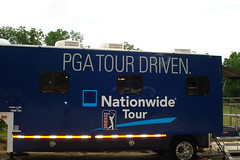
Your redneck-hippie guide to the PGA Tour!
~*~
Yes, we provide only the very best guides to American culture here at DEAD AIR!
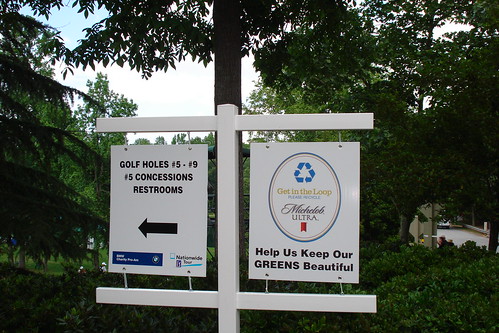
My apartment complex is about 20 feet from Thornblade, one of the premier golf courses in the south. As stated in this space last year, it is time for the annual invasion of the golfers. Of course, I speak of the BMW Charity Pro-Am Golf Tournament. It's some major hoopla, and people flock here from all 50 states and abroad. The celebrities in this year's tournament include Terry O'Quinn, Dennis Quaid and Greg Kinnear. 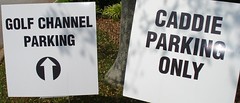
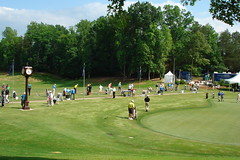
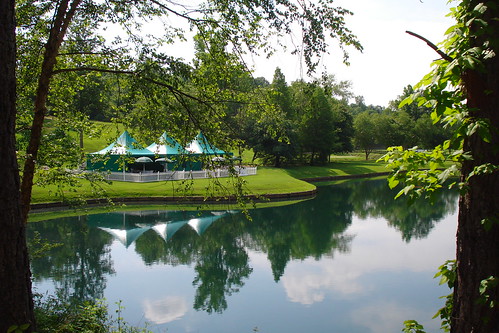
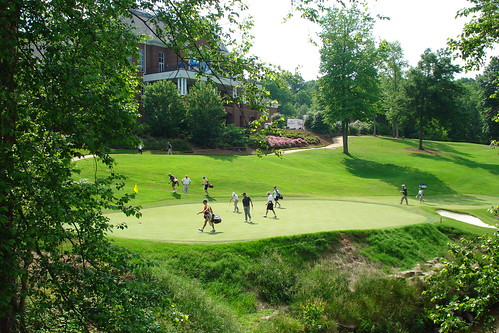
Unfortunately, I don't know from golf, so I can't explain any of these photos on a sportsman's level. But I can certainly explain them on a redneck-hippie level!
~*~ 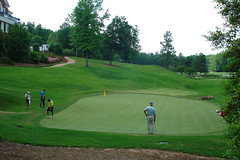
You can't see the golf ball, but it's real close!
~*~
~*~
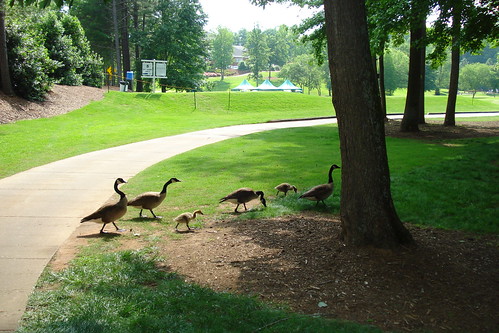
An unsuspecting geese family flees, confused and wondering what all these mega-rich people are doing in their habitat.
I know exactly how they feel.
~*~
And more photos below...





Monday, April 20, 2009
J.G. Ballard 1930-2009
 The greatest living writer of our time has passed.
There is nothing else to say.
And now he belongs to the ages.
~*~
Ballardian contains many pertinent links remembering Ballard; Simon Sellars writes:
Amen.
Ballard articulates clearly to me the implications of living in an age of total consumerism, of blanket surveillance, of enslavement designed as mass entertainment. But he also speaks to me of resistance through irony, immersion, ambivalence, imagination -- of remixing, recycling, remaking, remodelling.
His work embraces dystopian scenarios, including the archetypal non-space often characterised as a deadening feature of late capitalism. But this is not simply a call for nihilism. Ballard's characters are not disengaged from their world. Rather, they embody a sense of resistance that derives from full immersion, a therapeutic confrontation with the powers of darkness, whereby merging with dystopian alienation negates its power. This is predicated on concurrency: Ballard's writing turns objectivity into subjectivity, opens up gaps where there is room for new subjects. His scenarios are what I term 'affirmative dystopias', neither straight utopia nor straight dystopia, but an occupant of the interstitial space between them, perpetual oscillation between the poles – the 'yes or no of the borderzone', to use a phrase from his work.
Here, dystopia becomes the real utopia, and utopian ideals, typically represented as a stifling of the imagination, the true dystopia. He reinhabits the frame to present a clearinghouse in which corporate and national governance is overthrown and regoverned as a 'state of mind'.
To read and to understand Ballard, then, is to be gloriously, finally liberated.
To James Graham Ballard: thank you.
From Iain Sinclair:
One of my first addictive tastes of Ballard was The Crystal World, one of the quartet of disaster novels described here by Tim Martin:
“Everything that everybody else was bored by or appalled by, he was excited by. He wasn’t really interested in English literary parties and kept himself outside that.
“He was bored by the heritage of Central London and, unlike other writers, never wanted to talk about what he was writing. He preferred to talk about ideas, or some weird news cuttings he had brought along.
“Living out in Shepperton for so long, he was one of the first to understand that the psychosis of suburbia was a fascinating thing to pursue.
“He loved the edges of cities: shopping complexes, motorways and airports. He was very taken up with Watford because of its multi-storey car parks.
“Where other people were terrified by the consumerist culture he saw it as exciting, something he could manipulate, shredding it and making his own world out of it.”
More:
From the peerless science fiction of his stories in the Sixties, to the later dystopian satires on middle-class England, Ballard's fictions circled relentlessly around the most troublesome of modern preoccupations: tribalism, self-immolation, the fiction of belonging. Assisted by a peculiarly unliterary style that was heavy on aphorism and jargon and light on character and dialogue, Ballard created a literary microcosm all his own: a place where everyday life is a nest of competing psychopathologies, where human dreams and desires are reflected in their physical environments and where the workings of the mind become indistinguishable from external reality.
Ballard's work seized upon the vocabulary of marketing and the media, mixing them with techniques learnt from surrealism to create a new kind of fiction. His first quartet of novels told the story of four apocalypses, as the Earth was variously reclaimed by air, water, drought and a strange creeping crystallisation. In each novel, the world's changed circumstances were mirrored in the mental landscapes of Ballard's small group of characters. These complicated, troubling works, which included The Drowned World and The Burning World, began the games of repetition and identity that would resurface in all Ballard's subsequent writing, as well as giving first proof of his uncanny capacity for prediction.
Surreal though the early novels undoubtedly were, they paled beside The Atrocity Exhibition, a collection of stories and fragments that may prove to be Ballard's most influential work. Ostensibly a fever-dream taking place in the mind of a deranged psychiatrist, this was a work of violent postmodernism, drawing on the war in Vietnam, the Zapruder film of the Kennedy assassination and the world of advertising to create a terrifying and uproarious new form of satire. Prescience was everywhere at work: he noted Ronald Reagan's habit of using "the smooth, teleprompter-perfect tones of the TV auto-salesman to project a political message that was absolutely the reverse of bland and reassuring", while a frightening comic piece about focus groups analysing the "optimum sex-deaths" of female celebrities in automobile accidents not only looked forward to his later novel Crash but ensured that the newspapers besieged Ballard for comment when Diana died.
How JG Ballard cast his shadow right across the arts (Guardian)
JG Ballard remembered (Sameer Rahim, UK Telegraph)
J.G. Ballard, 'Empire of the Sun' Author, dies at 78 (Huffington Post)
J.G. Ballard (Scriptorium)
Monday, September 8, 2008
Scarlet Begonias, or ...another Wal-Mart rant


 The extended, suffocating heat of upstate South Carolina wears ever onward... exactly when the Buckeye in me expects it to GET COOLER, during the second week of September. Why does the southern autumn (or lack of one) always fake me out like that????? Every year, I am still bewildered by searing heat in Fall. It's like I just got here, when I have lived in the south 21 years now.
 This searing heat gives way to October and November (indistinguishable), in which very chilly, frosty mornings often turn into a definite, prolonged sizzle by midday. As a result of these extremes, one never knows if long or short sleeves are required or what kind of sweater or jacket to pack. I never learned how to dress young Delusional Precious properly, and she was perpetually burning up and/or freezing.
I was married on Thanksgiving Eve in November, and I still recall the bright digital temperature display on the front of a nearby bank as we drove away: 75 degrees. (I was so startled by it, I still remember it.)
~*~
Luckily by the end of the week, the remains of tropical storm Ike should cool off the place and bring some much-needed rain. But what is good for one area will likely be tragedy for someone else. Philosophical truth (heavy).
 If that seems unduly negative, I blame Wal-Mart for my unpleasant mood. Yes, my nerves are shot, my life disrupted, the huge pile of industrialized SHIT from the ENORMOUS construction site is as big as the space shuttle.
 All so people can buy CHEAPLY and make sure the people of Taiwan have jobs. I know, I watch Fox.
There is an obscene amount of noise, dust, drilling, smoke, trucks, concrete, blacktop, traffic, crap... I mean, the size of the parking-lot lights, alone? They are the height of Mount Rushmore. At least one delivery was actually made by helicopter, like something out of Apocalypse Now. It has all made me ill.
I have been unable to do much of anything except flip channels compulsively, eat ice-cream sandwiches and watch Obama's poll numbers go down.
I've also been commenting on other people's blogs, being pesky elsewhere, and sending emails, most of which are likely incoherent. Sorry about that, if you were lucky enough to get one today! I'm trying to get caught up. Doing badly!
Nonetheless, keep those cards and letters coming in, and down with Wal-Mart!
~*~
Studio version of Scarlet Begonias, with some interesting acidhead visuals!
I'm trying to concentrate on those lyrics--
Once in a while you get shown the light
In the strangest of places if you look at it right.
Wednesday, May 21, 2008
The famous golfers have departed, for now...
~*~
Golfer: Listen, what am I paying my fucking dues for? This is my golf course! If I wanna play here, I will play here. If he gets hit with my titleist, that's his fucking problem. Fore! Fore! [Hits ball]
Michael Douglas: [the ball barely misses his head; whips out shotgun] Five!
What the hell are you trying to do? Kill me with a golf ball? It's not enough you have all these beautiful acres fenced in for your little game, but you gotta kill me with a golf ball? You should have children playing here, you should have families having picnics, you should have a goddamn petting zoo! But instead you've got these stupid electric carts for you old men with nothing better to do! [Fires his shotgun at a golf cart, causing it to roll down the hill]
Michael Douglas: Now aren't you ashamed of yourself?
--from the movie FALLING DOWN (1993)
~*~
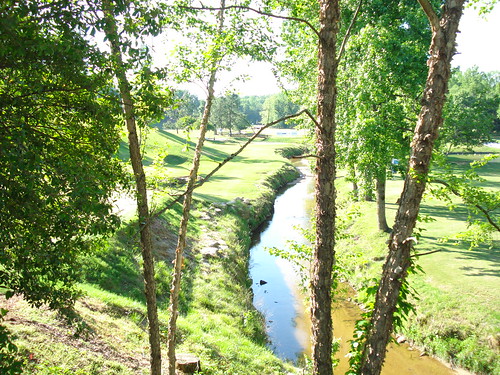
I live, quite literally, about 15-20 feet from a golf course. The horrors never end.
I can usually carry on a delightful delusion that I live next to a beautifully-landscaped park, where families are having picnics and there is a goddamn petting zoo (see quote above), but alas, it's not and there isn't. This past weekend, the point was brought forcefully home, since the BMW Charity Pro-Am Golf Tournament was going on, quite literally, right outside my bedroom window.
And so, I had drunk people in golf carts whizzing by all weekend, manically searching for celebs like Joe Pesci, Kurt Russell, Luke Wilson, Dennis Quaid, Cheech Marin and Wayne Gretzky. No parking for miles, the scent of hundreds of gallons of spilled beer, and large Hollywood-sized trailers everywhere, with various snazzy and colorful brand names emblazoned thereon. Also, lots of sports networks broadcasting on every corner, with those mobile TV-eyes poking up in the air--We're on the air, live!
One barely resists the urge to shove the talking head out of the way and STRIP, yelling: HEY YALL, WELCOME TO GREENVILLE! [moons camera]
Maybe when I was younger.
~*~
Speaking of which--my last post, written in a fit of pique, has been linked on the UK feminist blog titled The F-Word (not to be confused with Sara Anderson's F-Words, from Idaho). THANK YOU, DEAR SISTERS!
I finally enabled backlinks on my blog, but as you can see, it only picks up maybe half of all trackbacks, which is disturbing. (On my end, I have finally started leaving my own html-made trackbacks.) Harumph--Blogger needs to get with the program! Now that I have a clue, might have gone with Wordpress instead and I understand now why so many people switch over.
Hope your Wednesday is good. I tried to make that purty golf-course photo a "Wordless Wednesday" post, but as you've all undoubtedly figured out by now, wordlessness does not come easy to me.
~*~
----------------
Listening to: Grateful Dead - King Solomon's Marbles
via FoxyTunes
Monday, May 5, 2008
Money war marks Eastside council race
 Below--an article about my neighborhood. Which of these guys is the "good" guy? Consider first, it is a given that a Republican WILL win the seat, which Republican is telling the truth? (Or does that fact that both are Republicans mean that neither can possibly manage that?)
Money war marks Eastside council race
By Ben Szobody • STAFF WRITER • May 5, 2008 • GREENVILLE NEWS
A Republican money battle is taking shape in the bustling Eastside County Council district where political newcomer Brad Medcalf is challenging one-term incumbent Jim Burns on one of the county’s fundamental debates — how to handle growth.----------------
Burns’ support of a tree conservation law, a countywide growth plan and traffic impact studies for new development has drawn both the ire of some developers and the praise of emerging resident groups formed to fight what they consider ill-suited construction projects.
Medcalf said Burns hasn’t adequately dealt with growth-related problems like traffic congestion, and that he’ll make personal property rights more prominent in the growth debate. He ran unsuccessfully for the county’s independent Planning Commission last year with the support of local homebuilders.
Included in Medcalf’s first-quarter fundraising report: 39 donors in development-related businesses, contributing a third of his $22,950 total haul, according to contribution forms filed with the state Ethics Commission.
Medcalf had more than 130 donors total, which he said is a sign of diverse support from people mostly within the district. He said he’s now at more than $30,000.
Burns’ contribution list for the same period totaled $2,000 from three donors — Rescom Construction, Erwin and Nancy Maddrey and Velda Hughes — though he said this week he was just getting started and now has more than $30,000 in total contributions.
Burns said he’s not surprised at Medcalf’s totals, because he said developers have told him that they intended to fund an opponent.
"I don’t think District 21 wants another politician who’s deep in the pockets of developers," Burns said.
Medcalf said he can’t help who contributes to his campaign out frustration with the incumbent, and that Burns’ own fundraising invitations have shown a preponderance of downtown Greenville supporters from outside the district.
Burns said more than half of his contributions as well as the people on his "host committee" come from inside District 21.
At stake is the relatively small council district straddling interstates 85 and 385 and including Woodruff, Pelham and Garlington roads — all sites of recent high-profile zoning disputes pitting major developers against highly organized citizen groups.
On Medcalf’s first-quarter donor list: developers Chris Hack and Ron Johnson, builders Rick Quin and Jeff Johnson and real estate professionals Keith Schemm, Paul C. Aughtry, Gordon Seay, Johnny Flynn, E.F. Dupree Jr., Al Hagood, David Dempsey, Greg Huff, C. Dan Joyner Jr., Matthew Carter, Philip Wilson, Reggie Bell, Gordon Gibson, Reba Bahan, Jon Good and Hunter Gibson.
Lobbyist Susan Hoag, project manager Greg Garvey, contractors Stewart Watson and Tom Henderson, engineers Larry Kendall, Robbie Compton and John Rollins, architects Ron Geyer, Ed Ziegler and Jack Rincon and several real estate, development or construction firms are also listed.
Also listed are 19 retirees, 16 in finance or insurance-related businesses, 10 in the medical industry, six attorneys and six in sales, according to his report.
Listening to: The Who - Tattoo
via FoxyTunes
Monday, March 31, 2008
Ballardian quotes
 Left: James Graham Ballard, year unknown, from Ballardian.
My favorite writer, JG Ballard, is very ill. I am wishing him the very best.
Some random quotes from a recent BBC interview by James Naughtie:
...
[The post-war British] behaved like a defeated population. I wrote in The Kindness of Women that the English talked as if they had won the war, but acted as if they had lost it. They were clearly exhausted by the war and expected little of the future. Everything was rationed — food, clothing, petrol — or simply unobtainable. People moved in a herd-like way, queuing for everything. Ration books and clothing coupons were all-important, endlessly counted and fussed over, even though there was almost nothing in the shops to buy. Tracking down a few lightbulbs could take all day. Everything was poorly designed — my grandparents’ three-storey house was heated by one or two single-bar electric fires and an open coal fire. Most of the house was icy, and we slept under huge eiderdowns like marooned Arctic travellers in their survival gear, a frozen air numbing our faces, the plumes of our breath visible in the darkness.
I’d been to the United States and I’d seen that already, by the early 60s, we were getting the first supermarkets, motorways, we were getting, you know, consumer society, television and the like, we were turning into a kind of — media landscape — and I thought; this is interesting, because we’re all going to be Americanised, sooner or later, whether we like it or not, and science-fiction was above all, it was American, it described an Americanised future....
JN: To that extent it was right.
JGB: Yes it was right. It was right.
I’ve always been drawn to consumerism and Americanisation of daily life but I’ve always been aware, you know, there’s a sort of — dark side to the sun, and in the case of Kingdom Come — which describes, really, a sort of high-point reached by consumerism in this country, a year or two ago — I suggest that, you know, consumerism, could evolve into something very close to fascism....
[War brings] the sense that reality is a stage set that can be cleared at any moment; that came over very strongly, because children are very reliant on stability and convention, they take for granted that their parents are maintaining this friendly place called home. I think the experience of war is to undermine all that. I’ve always been a little sceptical about what I’m told — there’s nothing new about that nowadays — nobody trusts a politician. And I think I’m sceptical about consumerism because it’s really all we’ve got left — the main pillars of British society have always been: the monarchy, the Church of England, the class system, you know, respect for the Armed Forces, and so on. And they’ve all, these pillars have all been knocked down: politicians are distrusted, we think of them really as a collection of — many of them anyway — as a collection of rogues, the Church of England has lost a lot of its authority, so has the monarchy. So what we have: consumerism. I’m not sort of suspicious of consumerism, but the problem arises is when it’s all there is left. I mean, if you go out in the London suburbs, away from our great museums and Houses of Parliament and art galleries, theatres and the like, into a world where all you have are retail outlets, you suddenly, think my god, how can you live here? In fact I do live here. It’s that sense that there’s nothing other than a new range of digital cameras, or what have you, to sustain one’s dreams…
 In a 1996 interview with Scottish journalist Damien Love for The List magazine, he discusses his novel Cocaine Nights, which he describes as "Kafka with unlimited Chicken Kiev":
Well, I the author am not suggesting that we all go out and… burgle our neighbour’s houses, or take up drug trafficking, and the very next day we’ll all be practising our violins and forming chess clubs. But I’m saying that it’s possible that we’re too obsessed with security. Although, anyone who has just been burgled is going to think me an idiot. Quite rightly. But, it’s a matter of realising that, you know, certain things have to be bought at a price, and maybe the price is too high. Maybe, to make a pearl, you need a bit of grit in the oyster shell. I think, probably, that the proposition I’ve put forward in the novel is probably correct....
As living standards continue to rise, as they have done since the war — and, I’m sure living standards will, on the whole, continue to rise — people have got more to lose. You know, they’ve packed their homes with high-tech electronic gear. It’s worth burgling the average suburban house, now. Many of them are equipped like TV studios, not to mention things like jewellery. So, one gets this strangely interiorised style of living, where you switch off the outside world, rather like it was some threatening television programme. You do this by treble locking your front door and switching on the alarm system, and then you retreat and watch videos of the World Cup. And that’s not a good recipe for healthy society. Looked at objectively, one could say that cinema, the visual arts, the ‘entertainment’ culture generally, are in a worse state than they have ever been this century. The cinema is a shadow of what it was in the forties. There’s scarcely a novelist worth reading. There’s scarcely a painter or sculptor worth looking at. I’m too old to know if the music scene has the vitality that it had back in the 60s, but I don’t imagine that it has. And, you know, we’re in a culture of substitutes — Elizabeth Hurley. They had Marilyn Monroe, we’ve got Elizabeth Hurley. Something’s gone wrong. Is it that we’re engineering a new kind of life for ourselves that has echoes of those that I describe in this book?...
I mean, it’s silly to say this, because I’m not inviting anyone to come and steal my car or burgle my house; but one always assumes that totalitarian states will be imposed from the outside on the average citizen, that they’ll be sort of horrific and threatening. But in a way, I’ve often thought that the totalitarian systems of the future will be actually rather kind of subservient and ingratiating, and will be imposed from within. We’ll define the terms of the TV mono-culture which we now inhabit, and it’s a pretty empty place. I can imagine, 50 to 100 years from now, social-historians looking back at the closing years of the 20th century and saying, ‘My God, it opened with the flight of the Wright Brothers; halfway through they went to the moon; they discovered scientific miracle upon miracle. And then they ended with people sitting in their little fortified bungalows while the tele-surveillance cameras sweep the streets outside, and they watch reruns of The Rockford Files.’Thanks to Ballardian for these interviews.
It’s a nightmare vision.
Monday, March 24, 2008
Save the libraries!
 Left: Graphic by Aaron Louie.
From Mountain Xpress, here is Ileana Grams-Moog, discussing an ongoing, national issue--the continuous, rapid depletion of public library collections. She is describing the process in Asheville (NC) but it could just as easily have been anywhere:
From my time working as a librarian, I know that all libraries cull their collections on an ongoing basis. But what’s happening now is apparently a permanent downsizing. Nor is it only fiction that is disappearing. Science, history, biography, psychology, cooking, gardening, crafts: Every area is being depleted. Many—indeed, most—of the books being sold are out of print and therefore not easily available elsewhere, if at all. This is especially deplorable in areas where old books contain information not available in new ones. In cooking, gardening, crafts, yoga, poetry, history and even in science, in fields such as animal behavior and paleontology, old books contain detailed, lively information that’s no longer covered in more recent ones. To get rid of these books is the equivalent of deliberate, collective amnesia.The other issue is storing the books, if they are not discarded. The public appears willing to pay for libraries, but not usually willing to spend tax money to build warehouses for old books that no longer circulate. (What's to become of the thousands of old, dated books, if indeed they are kept?) There are thousands of volumes discarded every year, everywhere. Most municipalities have periodic book-sales, and if you have ever been to one of these, you know some really fantastic, unique books are culled from local collections, constantly.
I was told that the criterion used is how recently the book last circulated. I just bought, for $2, a book that I took out about a year ago (and that cost the library more than $30 when acquired).
And what about the user-atmosphere of the libraries themselves? In larger cities (and increasingly, in small ones, too) homeless people sleep in libraries during the day, use the restrooms, panhandle when security guards aren't looking, etc. Have Borders and Barnes & Noble become the new 'library'--as educated, suburban readers prefer not to deal with the riff-raff that is the general public?
For an entertaining and informative take on the library biz, check out Blogging Librarian.
And I can only add, with considerable vehemence, SAVE THE LIBRARIES!!!!!!
----------------
Listening to: The Volebeats - Radio Flyer
via FoxyTunes
Wednesday, March 12, 2008
How to survive your root canal
 Looking up ENDODONTICS brings up some horrifying reading, and just look at those DRAWINGS! (screams)
~*~
The first thing you notice when entering any specialist's office: how nice everything is. My god, the money. It radiates. My fashionable endodontist (herein known as FE) has beautiful framed jazz posters in his office, what looked to be a Keith Haring coat rack (I didn't have time to inspect it carefully), and in the ladies' loo, beveled mirrors and a solid glass washbasin. The tiles are lovely, and look like marble or stone. I helped pay for all this, I thought.
Baby boomers' bad teeth--all that Dairy Queen crap, Hostess twinkies and Coca-cola, has paid for this pricey office.
I always demand gas forthwith, shocking most dental assistants with my fortitude (pump that UP, girls! MORE!) and astounding ability to withstand copious amounts of nitrous oxide. I assume there is a notation in my file (which I am told is one of the largest in the practice--ta dum!) that specifies "She likes a lot of gas!" or something like that.
FE has weird space-age, scientific tools that he employs, one of which looks like he is in a space capsule, wearing little goggles and looking through a microscope that sits right on top of your face. Meet George Jetson! I always bring some music along, and during this particular sequence I was listening to the Delfonics' "Didn't I blow your mind this time?" ...which, along with the gas, made it somewhat otherworldly and fun, for about 10 seconds or so. It hurt like a mofo, but I really couldn't differentiate the pain of the root canal itself, from the pain I have been experiencing for the past week--all sensation tends to run together into a steady stream of pain, worthy of MARATHON MAN. (Is it safe?) Left: Fancy George Jetson space-age endodontics microscope.
The noise is positively harrowing, reminiscent of chain-saws and coffee-grinders; then you smell something burning and ... Clorox? Just close your eyes, and concentrate on the Delfonics. (Daisy's advice: nitrous and music, can usually get you through it. No strange or odd music; something familiar.) The filing of the root is where you start to feel, well, nauseated. WHAT is he doing? Oh my GOD.
Apparently, my infection had something to do with the bone (the WHAT? the BONE? Oh, holy Jesus, Mary, Joseph) and might get worse before it gets better. It could become re-infected, since the bacteria in the bone doesn't get oxygen and can multiply quickly, or somesuch thing. As FE patiently explained, I felt dazed. (Bone? Did he say BONE?) I kept thinking about how I'd like to just pull it out, but I couldn't say this to color-coordinated FE with his designer scrubs and shoes. He'd wrinkle his nose at me and make me feel low class. He'd be right, too!
~*~
This round, at least, is over.
Can anyone guess the price? The winner gets a free Daisy's Dead Air Bloglines subscription! HAHAHA!
----------------
Listening to: Yo La Tengo - Moby Octopad
via FoxyTunes
Wednesday, March 5, 2008
The dentists all love me
 Yes, the dentists, as well as their compatriots, the endodontists and the oral surgeons, all rub their hands with glee. Dollar signs light up the eyes. They clear their schedules, they work through lunch, they eagerly make follow-up appointments and call each other on the phone, consultating madly together, hemming and hawing in harmony and looking at my (very expensive) X-rays. Hmmmmm, they agree: It doesn't look good.
Not surprising. It never has.
Only two generations ago, people had all of their contrary, infected teeth pulled out--just pull them all out, said my grandmother. I used to wonder how anyone could agree to such a thing, but no longer. I totally get it. JUST PULL THEM OUT has occurred to me any number of times, but the suburban dentists I go to look shocked if you say this, and this is now apparently the equivalent of Dental Blasphemy. It's BAD for your jaw and your bite and all the rest of it. The problems just get worse. You are supposed to have teeth, after all.
I read about Chairman Mao, who had horrific, chronically infected, pus-filled teeth and endured awful pain, and I am inclined to forgive a lot. The poor man was under terrible stress.
Since this past weekend, I have throbbing pain in a tooth that already has a root-canal* and crown--never a good sign. Abscess? The tooth is, God help me, moving around a bit in my jaw (grandmother's voice: Just pull it out!) and there is what appears to be a "cloud" (what?) on the X-ray. The root is possibly infected, and the consult-a-rama has begun.
So, there they are, my dentist and and my fashionable endodontist, who wears designer scrubs to work. (At his prices, I'm surprised we don't get piped-in pharmaceutical heroin and live jams from Eric Clapton himself.) Yes, yes, they sing in well-known dental-harmony, it doesn't look good.
Follow-up appointment on Friday morning, which will make me late for work, then late for home, and a veritable chain reaction of lateness will ensue--all of which will make me significantly crabbier since I am in PAIN. Well, I thought, I possibly can at least lose weight since I can't chew anything... but no, I decided the one thing I can eat is ICE CREAM, and by God, I stopped to do some consulting of my own with Ben and Jerry on my way home.
I hope Chairman Mao at least had some ice cream to make him feel better, too.
*I've had 13 root canals in all, and I'm not sure how many crowns, since several have been replaced already.
Thursday, August 23, 2007
Old fashioned gals
Today's question: How can we make art that is truthful to the past, without being obnoxious? We need to tell the truth about the role of women with sympathy and awareness, without being anachronistic.
I am particularly interested in the AMC series MAD MEN, which I assume was inspired in part by Tom Wolfe's dead-on essay about the advertising world, The Mid-Atlantic Man, also written in the 60s.
Plain(s) Feminist commented briefly on MAD MEN:
And while we're on the topic, I don't really care that the gender "issues" brought to the fore on Mad Men are true to the era. They make me damn angry to watch. What is the point? Yes, television is supposed to make one think, but it's not supposed to make me pissed-off for no reason. I have enough sexism to deal with in daily life without needing to reach back into the sixties for a fix, thank you very much.The New York Times recently reviewed several TV shows about domesticity in an article rather cutely titled Say, Darling, Is it Frigid in Here? Here is Alessandra Stanley's description of MAD MEN:
This Madison Avenue drama, set in the advertising business at the dawn of the 1960s, recreates middle-class life in the pre-Friedan era, when graduates of Wellesley and Bryn Mawr wore girdles and aprons as they raised the children and waited for their husbands, who stayed in town late, drinking and smoking and carousing with compliant secretaries. “Mad Men” has a satiric edge, but it is a stark reminder of what the battle of the sexes looked like before women’s lib, civil rights, the Pill and legalized abortion.Dump that pesky equality, guys, and get back to basics! Wink, wink, nudge nudge.
The series also serves as a taunting rebuke to modern wedlock: Careful what you wish for.
One couple on “Tell Me You Love Me” has a happy, vigorous sex life that is undermined by the wife’s inability to get pregnant. Another has two children and no sex at all, which is undermining the family bliss. Both end up slowly and guardedly confiding in an older sex therapist, played by Jane Alexander. She has an uninhibited sex life with her loving husband, Arthur (David Selby), but even her time-weathered marriage has a few cobwebs.
Katie (Ally Walker) and David (Tim DeKay) haven’t had sex in a year, but nothing appears to be wrong. They are a loving if repressed couple deeply and equally involved in raising their children, from grocery shopping to Little League practice. David is not impotent; he masturbates with furtive relish when his wife leaves the room. Yet neither seems able to summon desire for intercourse or take the initiative. A clue to their problem spills out during a therapy session, when the mild, buttoned-up David unleashes a rant about the lust-numbing domesticity of his life.
“I guess, yeah, I should be in the mood every time I clean out the gecko cage,” he hollers, his sarcasm turning to rage. “Everybody else is, it seems. I’ll tell you what turns me on: Buying Cheerios is really hot, and then of course getting shoelaces or fantasizing about minivans, that’s sexy too.”
Those intimations of emasculation stand as a cautionary tale next to Don Draper (Jon Hamm) of “Mad Men.” Don has a wife, two kids and a freethinking mistress in Greenwich Village. He doesn’t buy Cheerios or mop the floor. He’s barely ever home. But he has enough libido to sleep with two women and chase a third.
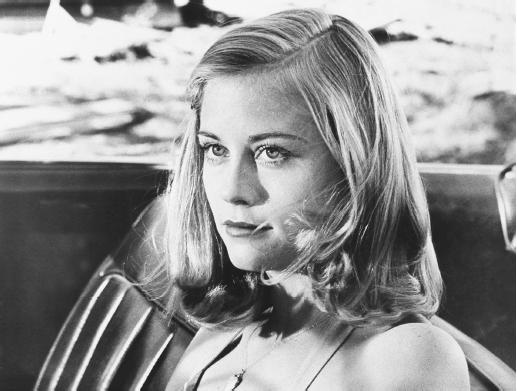
As I commented on Plain(s) Feminist's blog, one drama that succeeds in being sympathetic to women, yet totally realistic for its time (the 50s), was THE LAST PICTURE SHOW, which--not coincidentally--stars several (all?) self-identified feminists. Was it the strength of their performances and/or interpretations of their characters that made the difference? Or the stellar writing of Larry McMurtry and Peter Bogdanovich?
Which old movie makes you cringe regarding the role of women, yet you like it anyway?
And like Plain(s) Feminist, which one is impossible for you to watch without getting pissed off?
Wednesday, July 25, 2007
Walk on the Wild Side
 Courtesy of Alphabitch, here is my neighborhood's walking score: 48. Yes, that's forty-eight out of 100.
Does that suck or what?
In the days after my smash-up, I wrote about how difficult it was to walk to my job without getting mowed down. I guess I now have proof! Pretty depressing, though.
Check your walking score! And I hope you get a higher score than I did.
Friday, June 22, 2007
My daddy said son, you're gonna drive me to drinkin, if you don't stop drivin that hot rod Lincoln...
Wrecked my car Monday. Big WHAM into the Kia SUV in front of me, whilst merging off of Verdae Blvd, right in front of the Olive Garden. Big spectacle. Why, oh why, God? 98 degrees, and I sat there waiting for the tow-truck for an hour, until I was as wet as if I had just been swimming.
State Farm totaled the car. What? One little front bumper and tire-cover? Apparently. Talked to Pedro, Man of Automobiles, who said he could fix it with recycled parts, for the amount they will pay me. Now, why couldn't State Farm find a recycled bumper? Why do we have insurance companies, in that event? Must everything be spanking new?
I am now thinking of that excellent book, BOWLING ALONE, and I wonder how we all got so dependent on cars, why we all live so S-P-R-E-A-D O-U-T, in toxic suburbs (apart from community and each other) and using up oil as if it were water. I hate being part of it, but frankly, I can't seem to extricate myself.
And so, I walk to work today. Argh. Actually, it isn't so bad, except for the heat, and crossing Pelham Road, which is literally taking one's life into one's hands. (Me and the Mexicans who work on Restaurant Row are the only folks walking.) I am lucky, in one way, that I live close enough to walk to work. No one else I know could.
And when I get there, soaking wet again. Yesterday, I took a washcloth and went into the bathroom, spraying myself with Aura Cacia Orange-Patchouli mist when I was done washing. I thought to myself, if all these people walked, we'd all be sweaty.
Once upon a time, not too long ago, everyone was sweaty all the time. Was that a better world? Certainly, computers could never survive in that heat. But were we more tolerant of appearances when we traveled long distances in the heat, getting dirty and smelly? My suburbanites are antiseptic, blow-dried, made-up, botoxed, perfect, muscled with no sweat or strain, sleeveless arms all fit and sleek, but no sign of ever having used them, and no reason to.


