Thursday, July 11, 2013
Owl mythology
He flew from tree to tree about 100 yards in front of me, which is when I first noticed him. He had an enormous wing span. I was walking in his direction, so when I arrived below the tree where he was, I spoke to him. He looked right at me and seemed to be listening. I suddenly understood all the stories about owls being "wise"--they do seem to be smart and attentive, with their immense, intense eyes.
Watching him for a few minutes, I realized he was carefully watching me too, looking me up and down. Very large black eyes; a creepy feeling, as if sizing me up to determine if I could be eaten.
I stood there awhile, sort of communing with the owl. I asked him a couple of spiritually-oriented questions that I won't repeat here. As I said, he seemed to be listening, so why not? The swamp is so, so hushed and quiet. It seemed appropriate to break the silence and say hello.
I then pointed him out to the next couple of cyclists as they whizzed by; these two expensively-sports-attired young fellows ignored me as if I was a crazy old woman (uh-oh). But the next two middle-aged women cyclists stopped and cooed appreciatively at him, taking photos also. A nice Baptist-looking family of cyclists also stopped, their teenage son especially impressed, exclaiming he had never been so close to an owl that was not caged.
On my way home, I idly considered the Lakota legend concerning the sighting of owls in the daytime (portent of death) and wondered if Lakota legends 1) applied to non-Lakota, and 2) applied in Carolina. (Wouldn't Cherokee or Catawba legends apply here instead?) And then I promptly forgot about the owl... until I dreamed about him.
He was answering my questions. He answered them very clearly, but not in "language." They were answers that formed in my mind, and when I woke up, I knew what I should do and what was going to happen.
So, I realize now that the owls are magic.
I posted the owl's photo on Facebook and received a couple of warnings about bad luck. And so I looked up some of the mythology and omens connected with owls. I discovered that throughout the world, they are regarded as signs of both good and bad luck. Also, I learned that the concept of owls being "sisters" originally comes from the indigenous people of Australia (see list below), which I hadn't known. There is a national women's organization called OWL (Older Women's League), which (as far as I know) has mostly regrouped into smaller, local chapters. I always wondered why they chose that particular name; I assumed it was a reference to the wisdom of age. I realize now that the connection of owls/women is part of the world's mythology.
The Owl Pages offers everything you ever wanted to know about owls. I discovered his species: Barred Owl, although many southerners call them Rain Owls, which is certainly an interesting (and appropriate!) name, since we have had so much rain lately.
From the Owl Pages, I found a list of fascinating world-legends and mythology about owls.
Here are some of my favorites:
Africa, Central: the Owl is the familiar of wizards to the Bantu.
Africa, Southern: Zulus know the Owl as the sorcerers' bird.
Africa, West: the messenger of wizards and witches, the Owl's cry presages evil.
Algeria: place the right eye of an Eagle Owl in the hand of a sleeping woman and she will tell all.
Arabia: the Owl is a bird of ill omen, the embodiment of evil spirits that carries off children at night. According to an ancient Arabic treatise, from each female Owl supposedly came two eggs, one held the power to cause hair to fall out and one held the power to restore it. Arabs once believed that the spirit of a murdered man continues to wail and weep until his death is avenged. They believed that a bird that they called "al Sada" (or the death-owl) would continue to hoot over the grave of a slain man whose death had not been avenged. The bird would continue to hoot endlessly until the slain man's death was avenged.
Arctic Circle: a little girl was turned into a bird with a long beak by magic, but was so frightened she flapped about madly and flew into a wall, flattening her face and beak. So the Owl was created.
Australia: Aborigines believe bats represent the souls of men and Owls the souls of women. Owls are therefore sacred, because your sister is an Owl - and the Owl is your sister.
Borneo: the Supreme Being turned his wife into an Owl after she told secrets to mortals.
Brittany: an Owl seen on the way to the harvest is the sign of a good yield.
Burma: during a quarrel among the birds, the Owl was jumped upon and so his face was flattened.
Cameroon: too evil to name, the Owl is known only as "the bird that makes you afraid".
Carthage: the city was captured by Agathocles of Syracuse (Southern Italy) in 310 BC. Afterward, he released Owls over his troops and they settled on their shields and helmets, signifying victory in battle.
Celtic: the Owl was a sign of the underworld.
China: the Owl is associated with lightning (because it brightens the night) and with the drum (because it breaks the silence). Placing Owl effigies in each corner of the home protect it against lightning. The Owl is regarded as a symbol of too much Yang (positive, masculine, bright, active energy).
France: when a pregnant woman hears an Owl it is an omen that her child will be a girl.
Germany: if an Owl hoots as a child is born, the infant will have an unhappy life.
India: The Barn owl is the "vahana" (transport/vehicle/mount) of the Hindu goddess of wisdom, Lakshmi. As such, the owl is held as a symbol of wisdom and learning. The eagle owls, especially the rock eagle owl [Bubo bengalensis] and the brown fish owl [Bubo zeylonensis] are called " ullu" in Hindi and the word is also used as a synonym for "idiot" or "imbecile". The most chilling sound during the quiet and cold winter nights in the plains of Bengal is perhaps the call of the " kaal penchaa", the Brown Hawk Owl. The rhythmic "kuk - kuk - kuk" is believed to be a foreboding of impending death.
Indonesia: Around Manado, on the isle of Sulawesi, People consider Owls very wise. They call them Burung Manguni. Every time someone wants to travel, they listen to the owls. The owls make two different sounds; the first means it is safe to go, and the second means it's better to stay at home. The Minahasa, people around Manado, take those warnings very seriously.
Iran: In Farsi the Little Owl (Athene Noctua) is called "Joghde-kochek". It is said that this bird brings bad luck. In Islam, it's forbidden (Haram) to eat.
Ireland: An Owl that enters the house must be killed at once, for if it flies away it will take the luck of the house with it.
Israel: in Hebrew lore the Owl represents blindness and desolation and is unclean.
At left: the swamp itself, which is much more ominous after heavy rains. I love love love it, except for the mosquitoes, which are humongous and always-starving. It is also home to the largest snake I have EVER seen that wasn't under glass in a zoo.
~*~
Japan: Among the Ainu people the Eagle Owl is revered as a messenger of the gods or a divine ancestor. They would drink a toast to the Eagle Owl before a hunting expedition. The Screech Owl warns against danger, although they believe the Barn Owl and Horned Owl are demonic. They would nail wooden images of owls to their houses in times of famine or pestilence.
Latvia: when Christian soldiers entered his temple, the local pagan god flew away as an Owl.
Lorraine: spinsters go to the woods and call to the Owl to help them find a husband.
Madagascar: Owls join witches to dance on the graves of the dead.
Malawi: the Owl carries messages for witches.
Mexico: the Owl makes the cold North wind (the gentle South wind is made by the butterfly). The Little Owl was called "messenger of the lord of the land of the dead", and flew between the land of the living and the dead.
Newfoundland: the hoot of the Horned Owl signals the approach of bad weather.
Poland: Polish folklore links Owls with death. Girls who die unmarried turn into doves; girls who are married when they die turn into Owls. An owl cry heard in or near a home usually meant impending death, sickness, or other misfortune. An old story tells how the Owl does not come out at during the day because it is too beautiful, and would be mobbed by other, jealous birds.
Puerto Rico: The Owl is called "Mucaro". Back in the 1800s, the people from the mountain coffee plantations used to blame the little mucaro for the loss of coffee grains. The belief was that the coffee was part of the owls' diet, and many owls were killed. There are old folklore songs on the subject, one goes like this:
Poor Mucaro, you're a gentleman
you just want to eat a rat
then the rat
set up a trap
he eats the coffee grains
and people blame you.
Romania: the souls of repentant sinners flew to heaven in the guise of a Snowy Owl.
Russia: hunters carry Owl claws so that, if they are killed, their souls can use them to climb up to Heaven. It is said that Tartar shaman of Central Russia could assume Owl shapes. Kalmyks hold the Owl to be sacred because one once saved the life of Genghis Khan.
Samoa: the people are descended from an Owl.
Siberia: the Owl is a helpful spirit.
Spain: legend has it that the Owl was once the sweetest of singers, until it saw Jesus crucified. Ever since it has shunned daylight and only repeats the words 'cruz, cruz' ('cross, cross').
Sri Lanka: the Owl is married to the bat.
Sumeria: The goddess of death, Lilith, was attended by Owls.
Sweden: the Owl is associated with witches.
~*~
And so we see, Owls are often connected with women, and with spirituality... or both.
Since my dream, I choose to see my owl as a good omen. But I also realize that life IS impermanence, and what is regarded as "good" right now, may well be considered "bad" in the future.
Perhaps that is the lesson of the owl. Live completely in the present.
Posted by
Daisy Deadhead
at
3:00 PM
Labels: Africa, animals, Australia, birds, Buddhism, China, goddesses, history, India, Indigenous peoples, Japan, Mexico, New Age, Owls, Puerto Rico, recreation, Russia, South Carolina, spirituality, Swamp Rabbit Trail
Wednesday, November 2, 2011
Wordless Wednesday: Lamb's Bread
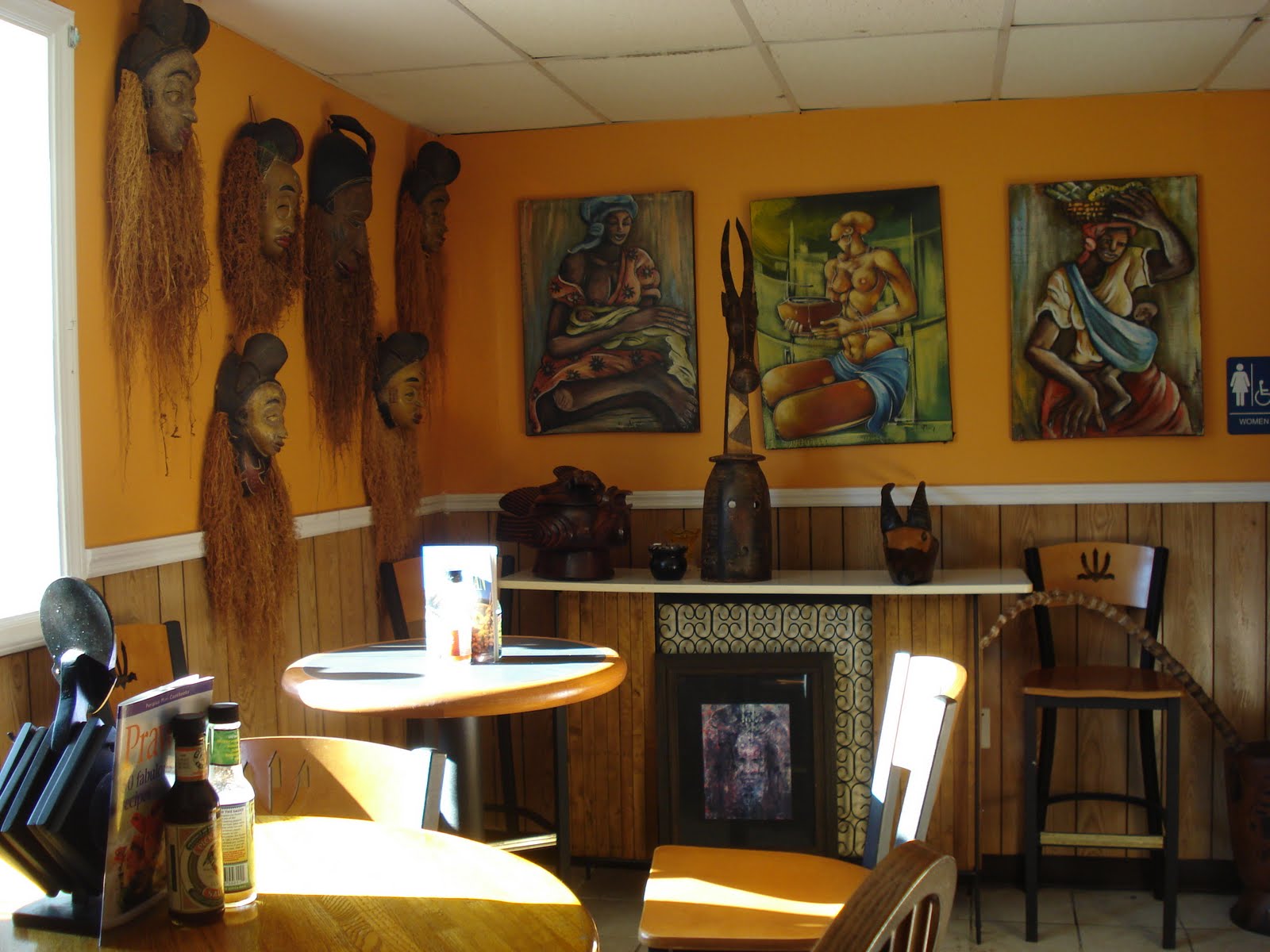
Interior of Lamb's Bread vegan restaurant in Columbia. They have all kinds of amazing African statues, artwork and sculptures. Entering the establishment is like entering another world.
They make a fabulous vegan Reuben sandwich, to die for. The restaurant is one of the great hidden treasures of our State Capitol; if you are in town, check them out.
Posted by
Daisy Deadhead
at
10:26 AM
Labels: Africa, African-Americans, art, Columbia, food, Lamb's Bread, restaurants, South Carolina, veganism, Wordless Wednesdays
Thursday, October 29, 2009
Cookbooks you should meet

The Gluten-Free Vegetarian Kitchen by Donna Klein
This is a great cookbook! Lots of people are attempting to go gluten-free these days, and Klein is a veritable pioneer in that direction:
Gluten, a combination of proteins found in various cereals, is what "gives bread its elasticity and cakes their spring," according to the author of this wonderful vegetarian resource. But for people suffering from celiac disease or wheat allergies, gluten can cause painful cramping, nausea and worse. Although gluten-free baked goods will never taste quite as supple as their refined wheat counterparts, Klein's offerings hardly taste like deprivation. Spiced Basmati Rice Pilaf with Peas is a spicy, filling supper, easy to prepare and high in fiber. Mushroom, Pea and Pearl Onion Pot Pie with Herbed Potato Topping is more involved, but worth it: slightly sweet vegetables in a creamy sauce under a thick potato crust brightened with herbs. A surprisingly well-rounded selection of breads features recipes for dense, soft Irish Potato Bread, thickened with more than a pound of potatoes and a quarter cup's worth of potato flour, and a Rice Flour Pizza Crust that's a close-enough approximation of the real thing.And check out the desserts, including Klein's famous Hawaiian Coconut Cake and Blueberry Cheesecake!
Best Quick Breads by Beth HenspergerThe author of The Bread Bible has ferreted out the quickest of her trademark bread recipes, for those of us too impatient (or busy) to wait. There are 150 bread recipes in all.
I particularly recommend her fabulous Cornmeal-Orange biscuits!
Entertaining for a Veggie Planet by Didi Emmons You haven't lived until you've tried Emmons' sweet potato soup! MMmM-MMMmmMM!
A Taste of Africa by Dorinda HafnerHafner, a native of Ghana, hosted a well-loved cooking show on Kentucky Educational Television, and this was the accompanying cookbook. This is not vegetarian, but still notable for the sheer variety of recipes and ingredients. I highly recommend the Toogber (called "poff-poff"), aka Nigerian sweet puffs, which are wonderful.
Toogber literally translates into "sheeps' balls"--don't tell your friends what they're eating! (LOL)
Serene Cuisine: Traditional Yogic Recipes for the Mind & Body by Nicky MoonaI love this cookbook! The Yogic philosophy is mirrored in these traditional recipes:
Yoga and the right foods make a deliciously healthy combination. These easy-to-prepare recipes have their roots in ancient principles, but they’ve all been revamped for the modern diet and illustrated with beautiful color photos. Every dish feeds the body and spirit as well as the mind: it’s a high fiber, high in antioxidants, vegetarian diet for people who want to eat well and be happy, and it can help manage weight, boost energy, improve concentration, strengthen the immune system, and even ease stress. Above all, these recipes taste fantastic, thanks to infusions of therapeutic spices. There’s no guilt when you dig into a rich Strawberry Lassi; Lentil Spinach Soup; Corn, Tomato, and Cucumber Salad; a variety of chutneys and curries; Green Lentil and Rice Kichdi; and Honey Fruit Delight. A bonus appendix shows yoga postures, and explains the links between the poses and the recipes.

Vegan Planet is the name of my favorite cookbook by South Carolina's own Robin Robertson, who has authored 17 ground-breaking vegetarian and vegan cookbooks. (Vegan Planet is also the name of her first blog; the second is titled Global Vegan Kitchen.) Her other books include Quick-Fix Vegetarian: Healthy Home-Cooked Meals in 30 Minutes or Less, Fresh from the Vegetarian Slow Cooker: 200 Recipes for Healthy and Hearty One-Pot Meals That Are Ready When You Are, Carb Conscious Vegetarian: 150 Delicious Recipes for a Healthy Lifestyle, and the totally indispensable and fantastic soy-bible titled The Soy Gourmet.From Robin's tasty book titled Vegan Fire and Spice: 200 Sultry and Savory Global Recipes, this is an Indian recipe for those of you who need some spice in your life!
Anshu's Red Lentil Sambar
1 cup red lentils
3 1/2 cups water
2 tablespoons cold-pressed canola oil
1 teaspoon black mustard seeds
1 onion, chopped
4 garlic cloves, minced
2 hot green chiles, seeded and minced
1 teaspoon grated ginger
1 (14.5-ounce) can diced tomatoes
2 1/2 teaspoons sambar powder
1/2 teaspoon ground coriander
1/4 teaspoon cayenne
1/4 teaspoon ground cumin
1 teaspoon salt
1 cup chopped carrots
1 cup chopped cauliflower
1 cup green beans, cut into 1-inch pieces
1 cup chopped eggplant
1 tablespoon lemon juice
1/4 cup chopped cilantro
1. Combine the lentils and water in a pot and bring to a boil. Reduce the heat to medium, cover, and simmer until soft, about 30 minutes. Set aside, but do not drain.
2. Heat the oil in a skillet over medium heat. Add the mustard seeds and when they begin to pop, add the onion, garlic, and ginger and cook until softened, about 5 minutes. Stir in the tomatoes, then add the sambar powder, coriander, cayenne, cumin, and salt. Stir in the carrots, cauliflower, green beans, and eggplant. Cover and cook for 5 minutes to soften.
3. Add the vegetable mixture to the reserved lentils, cover, and simmer until the vegetables are very soft, about 20 minutes. If the mixture becomes too thick, add more water. Stir in the lemon juice and cilantro and cook 5 minutes longer. Taste and adjust the seasonings.
Serves 6
Posted by
Daisy Deadhead
at
11:58 AM
Labels: Africa, Beth Hensperger, books, Didi Emmons, Donna Klein, Dorinda Hafner, food, health, India, Nicky Moona, Robin Robertson, veganism, vegetarianism, yoga
Tuesday, May 6, 2008
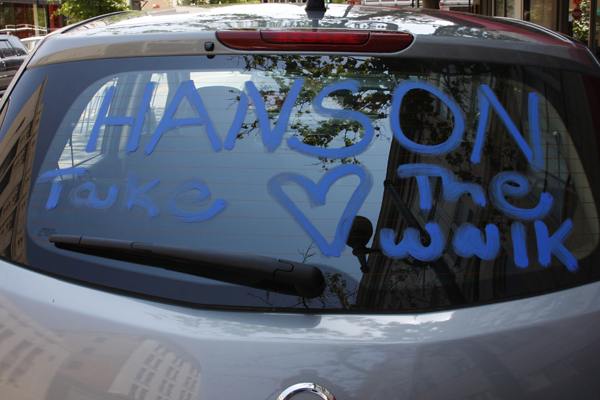
Hanson's walking tour in Asheville
Left: Photo by Jonathan Welch for Mountain Xpress.
~*~
As some of you know from my David Cassidy post, I'm fascinated with teenage idolhood in all of its multi-faceted, fun permutations. And I can't resist sharing this story:
Hanson’s big welcome
by Aiyanna Sezak-Blatt on 05/05/2008 for Mountain Xpress
Flocking to Asheville from Maine, New York, Virginia, Tennessee and across the Carolinas, Hanson fans are willing to travel great distances to see their musical idols up-close. More than 400 screaming fans — the majority being young women between the ages of 27 and 18 — gathered in front of the Orange Peel this afternoon for a chance to join the pop band Hanson on a one-mile barefoot walk through downtown Asheville. This is the band’s 66th “Walking Tour” since September of 2007, an event that aims to raise awareness on issues of poverty and AIDS in Africa, while empowering young people to stand up for a cause that they believe in.-— by Aiyanna Sezak-Blatt, Mountain Xpress.
But traveling great distances is not the only thing Hanson fans are willing to do to show their support, as Xpress learned when talking to the crowd of Hanson fans.
Michelle Brochon of Long Island and her best friend Katie Harris of Bowdoin, Maine, traveled 18 hours straight to have a front-row view of Hanson at their sold-out Asheville performance.
“It’s a special show because it’s my birthday,” said Brochon, who had been camping out at the Orange Peel since 3:30 p.m. on Saturday (two days before the concert). Brochon, despite sleeping on the streets, enthusiastically told Xpress that Hanson’s music means the world to her because, “They’re my age and they’re easy to relate too. They could have stopped making music, they could have sold out, but they didn’t and they keep making music on their own terms.”
Brochon and Harris were two of the five people who camped out for two-nights at the Orange Peel, and were joined by 60 others on Sunday night.
Along with camping gear, Hanson fans sported hand-made signs, one of which read: “We’re Walking A Mile W/ No Shoes On … What Are You Doing Today?” Other fans proudly displayed their tattoos inspired by the Hanson logo and by lyrics from their songs. One fan had the phrase: “Don’t lose yourself in your fear” tattooed on her forearm.
When the three Hanson brothers emerged from inside the Orange Peel, they were welcomed with ear-shattering screams and a cheer that seemed to ring through the city. They walked from the Orange Peel to Pritchard Park, where Taylor took out his mega-phone and began sharing stories about “The Walk” and the impact it’s made on raising awareness and energy in their generation. “We are the army of hope,” Taylor proclaimed. “We are not an underestimated generation, we have the capacity to make a difference.”
Needless to say, Hanson received a warm welcome from their local fan-base here in Asheville.
----------------
Listening to: Uncle Tupelo - Looking for a Way Out
via FoxyTunes
Posted by
Daisy Deadhead
at
4:29 PM
Labels: Africa, AIDS, Aiyanna Sezak-Blatt, Asheville, culture, Hanson, Jonathan Welch, Mountain Xpress, music, North Carolina, Orange Peel, teenage idols, young women
Sunday, April 13, 2008
Dead Air Church: Shining Star
This song is about human dignity and self-respect, and goes out this week to our newly-retired blogger Brownfemipower. I will dearly miss your spiritual writing and fierce insight. Also, to Blackamazon, who is able to bring down the wrath of feminist publishing with three little words! An amazing and powerful woman, whose words command earth-shaking responses. These are the women the world requires!
At the end of this song, unlike the recorded version, there is a "call and response" segment, which first entered mass-marketed popular music (to my knowledge) with the Isley Brothers' Shout. This is a worship style of the African-American church, that evolved from African community-debate tradition:
In Sub-Saharan African cultures, call and response is a pervasive pattern of democratic participation -- in public gatherings in the discussion of civic affairs, in religious rituals, as well as in vocal and instrumental musical expression. It is this tradition that African bondsmen and women brought with them to the New World and which has been transmitted over the centuries in various forms of cultural expression -- in religious observance; public gatherings; sporting events; even in children's rhymes; and, most notably, in African-American music in its myriad forms and descendants including: gospel, blues, rhythm and blues, jazz and jazz extensions.Not surprisingly, this song has been covered by Christian artists also, notably the pioneering Christian metal band Stryper.
And before there was Samuel L. Jackson, there was... Maurice White!!! One of the coolest guys ever; the very measure of cool even though people used to call his hair a "half-ro" since half of his hair was gone. Unfortunately, White has Parkinson's disease now and is no longer in the music business. He was quite the marvel in his day, as was Earth, Wind and Fire--inventive, fabulous funk-originators.
And yes, he popularized the sparkly-jacket-with-no-shirt look, imitated by 70s lounge lizards everywhere. Singing effortless harmony with White is multi-talented Philip Bailey.
Enjoy, and live the message!
~*~
Earth, Wind & Fire - Shining Star
[via FoxyTunes / Earth, Wind & Fire]
Posted by
Daisy Deadhead
at
8:50 AM
Labels: 70s, Africa, African-Americans, Blogdonia, call and response, Dead Air Church, Earth Wind and Fire, funk, Maurice White, music, nostalgia, Philip Bailey, religion, spirituality, Stryper