Showing posts with label Mexico. Show all posts

Tuesday, January 28, 2014

Medea Benjamin in Greenville

Peace activist Medea Benjamin, author and co-founder of CODE PINK, gave a presentation last evening at the Coffee Underground. This was in association with the Upstate Peace Network--with whom I am proudly affiliated.

An excellent discussion followed.

It was thrilling to meet her and grab a copy of her new book, DRONE WARFARE: Killing by remote control, which you should buy and commit to memory immediately.

~*~

Excerpt from the book:
Over fifty countries have the technology and many of them—including Israel, Russia, Turkey, China, India, Iran, the United Kingdom, and France—either have or are seeking weaponized drones.

Some of these countries do not just possess the technology; they are already using it.

During its 2008-2009 invasion of the Gaza Strip known as "Operation Cast Lead," the Israeli Defense Force repeatedly deployed unmanned aircraft to fire on suspected members of Hamas, the elected Palestinian government.

According to a leaked US State Department cable reported on by the Israeli newspaper Haaretz, in one incident an Israeli drone "shot at two Hamas fighters in front of the mosque and sixteen unintended casualties resulted inside the mosque due to an open door through which shrapnel entered during a time of prayer."[i] While the technology may be precise, fallible human beings are still the ones picking the targets and pulling the trigger.

Israel ostensibly ended its military occupation of the Gaza Strip in 2005. But thanks to modern drone technology, it does not need boots on the ground to dominate—and extinguish—Palestinian life.

"For us, drones mean death," said Hamdi Shaqqura of the Palestinian Center for Human Rights in an interview with the Washington Post. According to his group, Israeli drones killed at least 825 people between 2006 and 2011, the majority civilians. And that has affected almost every aspect of Palestinian life. According to one study, the majority of children living in Gaza suffer from post-traumatic stress disorder (PTSD) as a result of the constant buzzing and bombing of Israeli death machines. Palestinians even have to take drones into account when trying to do something as benign and banal as fixing a broken-down car—you really don't want a group of people lingering around for long when there's a plane armed with missiles hovering overhead. "When you hear drones," Shaqqura explained, "you hear death."

"It's continuous, watching us, especially at night," said Nabil al-Amassi, a Gaza mechanic and father of eight. "You can't sleep. You can't watch television. It frightens the kids. When they hear it, they say, 'It is going to hit us.'"

Along with Israel and the United States, Britain is the only other country to have employed weaponized drones in war as of 2011. In the 1980s, the UK developed the Phoenix, a drone that was briefly used in the Kosovo War and then in Iraq in 2003. So many were lost or crashed that British troops nicknamed the aircraft the "Bugger Off," as the planes rarely returned from a sortie. For Afghanistan, the UK bought US-made Reapers and rented Israeli Hermes drones. This was part of a stopgap measure while developing their own Watchkeeper drone in a joint venture by Israeli and UK private companies that, after many delays, was supposed to be operational by 2012.
Like their US and Israeli counterparts, the British government sees unmanned aircraft as the way of the future, with the Guardian reporting that UK officials say "almost one third of the [Royal Air Force] could be made up of remotely controlled aircraft within 20 years."
In July 2011, British drone operators made a mistake that underscores the continued fallibility of modern weapons, killing four civilians in Afghanistan with missiles fired from Reaper drones that they were piloting out of a US air base in Nevada. (The Royal Air Force has been piloting Reapers from Creech Air Force base in Nevada since late 2007.) Lest anyone believe the incident exposed flaws with the increased reliance on the almighty drone, UK military officials were quick to explain the deaths were the result of intelligence failures on the ground rather than problems with the aircraft.

That fallible human element does not harm just those on the receiving end of the West's liberating Hellfire missiles. When Iraqis were actually able to see the unencrypted video feeds that the unmanned vehicles were broadcasting back to US troops, it gave them the chance to escape and evade assassination. In 2002, Iraqis were also able to use a Soviet-era MIG-25 to shoot down a US drone. In 2006, the Syrian air force reportedly shot down an Israeli spy drone flying on the Lebanese side of the border with Syria. And in a little-reported incident in February 2011, as Yemeni police were transporting a Predator drone that had crashed in southern Yemen, Al Qaeda gunmen attacked, running off with the downed aircraft.

But the perceived enemies of the US government are doing more than just hijacking and shooting down drones: they are using their own.

During its 2006 war on Lebanon, the Israeli Defense Force claimed to have shot down several surveillance drones that Hezbollah had received from Iran. In Iraq, US troops shot down a similar Iranian drone in March 2009.

Just as US drone technology is falling into the hands of less-than-friendly regimes, the technology—like the Hummer and other military equipment before it—is finding its way back to the homeland. In a September 27, 2011 presentation at the headquarters of the US Air Force on the future of "remotely piloted aircraft," the branch's chief scientist Mark T. Maybury pointed to "homeland security" as a key future use of drones, complete with maps of the United States intended to highlight the need for "Integrating [drones] in National Airspace."

The future is here.

In 2005 Congress authorized Customs and Border Protection (CBP) to buy unarmed Predators. By the end of 2011, CBP was flying eight Predator drones along the southwestern border with Mexico and along the northern Canadian border to search for illegal immigrants and smugglers. By 2016, CBP hopes to have two dozen drones in its possession, "giving the agency the ability to deploy a drone anywhere over the continental United States within three hours," according to the Washington Post. And beyond, it seems, as the US Drug Enforcement Agency (DEA) has deployed several drones in neighboring Mexico to spy on that country's powerful drug cartels.
In June 2011, the Post reported that CBP's drone fleet had "reached a milestone...having flown 10,000 hours." But they had little to show for it. The paper flatly noted that the 4,835 undocumented immigrants and 238 drug smugglers that the Department of Homeland Security claimed to have apprehended thanks to UAVs were "not very impressive" numbers. What is impressive is the cost: $7,054 for each undocumented immigrant or smuggler who was caught.

"Congress and the taxpayers ought to demand some kind of real cost-benefit analysis of drones," said Tom Barry of the Center for International Policy, a Washington think tank. "My sense is that they would conclude these aircraft aren't worth the money."
But politicians in Washington don't seem too concerned. CBP's Michael Kostelnik told the Post he has never been pressed by a lawmaker to justify his agency's use of drones. "Instead the question is: Why can't we have more of them in my district?"

Remainder of excerpt here.

One of the most disturbing and startling new realities shared by Benjamin: Local law enforcement can't wait to get their hands on drones. It sounds just like the movie Escape from New York--law enforcement will finally be able to physically abandon the inner-cities at last. Nobody needs to get their hands dirty or their shirts bloodied (or worse). That's the plan.

It will all be handled by remote control.

You really MUST buy the book... Medea Benjamin is doing a TEDtalk later in the week, and I will try to link that here as well.

Thursday, July 11, 2013

Owl mythology

At left: On Sunday, I saw this owl on the Swamp Rabbit Trail, maybe 90 minutes before dusk.


He flew from tree to tree about 100 yards in front of me, which is when I first noticed him. He had an enormous wing span. I was walking in his direction, so when I arrived below the tree where he was, I spoke to him. He looked right at me and seemed to be listening. I suddenly understood all the stories about owls being "wise"--they do seem to be smart and attentive, with their immense, intense eyes.

Watching him for a few minutes, I realized he was carefully watching me too, looking me up and down. Very large black eyes; a creepy feeling, as if sizing me up to determine if I could be eaten.

I stood there awhile, sort of communing with the owl. I asked him a couple of spiritually-oriented questions that I won't repeat here. As I said, he seemed to be listening, so why not? The swamp is so, so hushed and quiet. It seemed appropriate to break the silence and say hello.

I then pointed him out to the next couple of cyclists as they whizzed by; these two expensively-sports-attired young fellows ignored me as if I was a crazy old woman (uh-oh). But the next two middle-aged women cyclists stopped and cooed appreciatively at him, taking photos also. A nice Baptist-looking family of cyclists also stopped, their teenage son especially impressed, exclaiming he had never been so close to an owl that was not caged.

On my way home, I idly considered the Lakota legend concerning the sighting of owls in the daytime (portent of death) and wondered if Lakota legends 1) applied to non-Lakota, and 2) applied in Carolina. (Wouldn't Cherokee or Catawba legends apply here instead?) And then I promptly forgot about the owl... until I dreamed about him.

He was answering my questions. He answered them very clearly, but not in "language." They were answers that formed in my mind, and when I woke up, I knew what I should do and what was going to happen.

So, I realize now that the owls are magic.

I posted the owl's photo on Facebook and received a couple of warnings about bad luck. And so I looked up some of the mythology and omens connected with owls. I discovered that throughout the world, they are regarded as signs of both good and bad luck. Also, I learned that the concept of owls being "sisters" originally comes from the indigenous people of Australia (see list below), which I hadn't known. There is a national women's organization called OWL (Older Women's League), which (as far as I know) has mostly regrouped into smaller, local chapters. I always wondered why they chose that particular name; I assumed it was a reference to the wisdom of age. I realize now that the connection of owls/women is part of the world's mythology.

The Owl Pages offers everything you ever wanted to know about owls. I discovered his species: Barred Owl, although many southerners call them Rain Owls, which is certainly an interesting (and appropriate!) name, since we have had so much rain lately.

From the Owl Pages, I found a list of fascinating world-legends and mythology about owls.

Here are some of my favorites:

Africa, Central: the Owl is the familiar of wizards to the Bantu.

Africa, Southern: Zulus know the Owl as the sorcerers' bird.

Africa, West: the messenger of wizards and witches, the Owl's cry presages evil.

Algeria: place the right eye of an Eagle Owl in the hand of a sleeping woman and she will tell all.

Arabia: the Owl is a bird of ill omen, the embodiment of evil spirits that carries off children at night. According to an ancient Arabic treatise, from each female Owl supposedly came two eggs, one held the power to cause hair to fall out and one held the power to restore it. Arabs once believed that the spirit of a murdered man continues to wail and weep until his death is avenged. They believed that a bird that they called "al Sada" (or the death-owl) would continue to hoot over the grave of a slain man whose death had not been avenged. The bird would continue to hoot endlessly until the slain man's death was avenged.

Arctic Circle: a little girl was turned into a bird with a long beak by magic, but was so frightened she flapped about madly and flew into a wall, flattening her face and beak. So the Owl was created.

Australia: Aborigines believe bats represent the souls of men and Owls the souls of women. Owls are therefore sacred, because your sister is an Owl - and the Owl is your sister.

Borneo: the Supreme Being turned his wife into an Owl after she told secrets to mortals.

Brittany: an Owl seen on the way to the harvest is the sign of a good yield.

Burma: during a quarrel among the birds, the Owl was jumped upon and so his face was flattened.

Cameroon: too evil to name, the Owl is known only as "the bird that makes you afraid".

Carthage: the city was captured by Agathocles of Syracuse (Southern Italy) in 310 BC. Afterward, he released Owls over his troops and they settled on their shields and helmets, signifying victory in battle.

Celtic: the Owl was a sign of the underworld.

China: the Owl is associated with lightning (because it brightens the night) and with the drum (because it breaks the silence). Placing Owl effigies in each corner of the home protect it against lightning. The Owl is regarded as a symbol of too much Yang (positive, masculine, bright, active energy).

France: when a pregnant woman hears an Owl it is an omen that her child will be a girl.

Germany: if an Owl hoots as a child is born, the infant will have an unhappy life.

India: The Barn owl is the "vahana" (transport/vehicle/mount) of the Hindu goddess of wisdom, Lakshmi. As such, the owl is held as a symbol of wisdom and learning. The eagle owls, especially the rock eagle owl [Bubo bengalensis] and the brown fish owl [Bubo zeylonensis] are called " ullu" in Hindi and the word is also used as a synonym for "idiot" or "imbecile". The most chilling sound during the quiet and cold winter nights in the plains of Bengal is perhaps the call of the " kaal penchaa", the Brown Hawk Owl. The rhythmic "kuk - kuk - kuk" is believed to be a foreboding of impending death.

Indonesia: Around Manado, on the isle of Sulawesi, People consider Owls very wise. They call them Burung Manguni. Every time someone wants to travel, they listen to the owls. The owls make two different sounds; the first means it is safe to go, and the second means it's better to stay at home. The Minahasa, people around Manado, take those warnings very seriously.

Iran: In Farsi the Little Owl (Athene Noctua) is called "Joghde-kochek". It is said that this bird brings bad luck. In Islam, it's forbidden (Haram) to eat.

Ireland: An Owl that enters the house must be killed at once, for if it flies away it will take the luck of the house with it.

Israel: in Hebrew lore the Owl represents blindness and desolation and is unclean.

At left: the swamp itself, which is much more ominous after heavy rains. I love love love it, except for the mosquitoes, which are humongous and always-starving. It is also home to the largest snake I have EVER seen that wasn't under glass in a zoo.

~*~


Japan: Among the Ainu people the Eagle Owl is revered as a messenger of the gods or a divine ancestor. They would drink a toast to the Eagle Owl before a hunting expedition. The Screech Owl warns against danger, although they believe the Barn Owl and Horned Owl are demonic. They would nail wooden images of owls to their houses in times of famine or pestilence.

Latvia: when Christian soldiers entered his temple, the local pagan god flew away as an Owl.

Lorraine: spinsters go to the woods and call to the Owl to help them find a husband.

Madagascar: Owls join witches to dance on the graves of the dead.

Malawi: the Owl carries messages for witches.

Mexico: the Owl makes the cold North wind (the gentle South wind is made by the butterfly). The Little Owl was called "messenger of the lord of the land of the dead", and flew between the land of the living and the dead.

Newfoundland: the hoot of the Horned Owl signals the approach of bad weather.

Poland: Polish folklore links Owls with death. Girls who die unmarried turn into doves; girls who are married when they die turn into Owls. An owl cry heard in or near a home usually meant impending death, sickness, or other misfortune. An old story tells how the Owl does not come out at during the day because it is too beautiful, and would be mobbed by other, jealous birds.

Puerto Rico: The Owl is called "Mucaro". Back in the 1800s, the people from the mountain coffee plantations used to blame the little mucaro for the loss of coffee grains. The belief was that the coffee was part of the owls' diet, and many owls were killed. There are old folklore songs on the subject, one goes like this:

Poor Mucaro, you're a gentleman
you just want to eat a rat
then the rat
set up a trap
he eats the coffee grains
and people blame you.


Romania: the souls of repentant sinners flew to heaven in the guise of a Snowy Owl.

Russia: hunters carry Owl claws so that, if they are killed, their souls can use them to climb up to Heaven. It is said that Tartar shaman of Central Russia could assume Owl shapes. Kalmyks hold the Owl to be sacred because one once saved the life of Genghis Khan.

Samoa: the people are descended from an Owl.

Siberia: the Owl is a helpful spirit.

Spain: legend has it that the Owl was once the sweetest of singers, until it saw Jesus crucified. Ever since it has shunned daylight and only repeats the words 'cruz, cruz' ('cross, cross').

Sri Lanka: the Owl is married to the bat.

Sumeria: The goddess of death, Lilith, was attended by Owls.

Sweden: the Owl is associated with witches.

~*~

And so we see, Owls are often connected with women, and with spirituality... or both.

Since my dream, I choose to see my owl as a good omen. But I also realize that life IS impermanence, and what is regarded as "good" right now, may well be considered "bad" in the future.

Perhaps that is the lesson of the owl. Live completely in the present.

Friday, October 15, 2010

Part Two: How white flight brought down the economy

PART TWO of my series, How did the American Left lose the working classes?


I drove down to Woodruff Road and decided to check out the Goodwill Store. (As my regular readers know, I love snooping around in the Goodwill.)

Although I had seen a plethora of DeMint and Haley bumper stickers on my drive down, it is notable I saw none in the Goodwill parking lot. I saw Our Lady of Guadalupe, of whom I am very fond. I saw her about five times, even more than usual.

Keeping this series of posts in mind, I counted. Three white people in the whole place. All three whites were at least over 40; one was a quite-ancient, wise-appearing old man perusing the used book-bin, carefully inspecting the tossed-aside Tom Clancy and Robert Ludlum thrillers. The other two had grandchildren in tow and seemed to be shopping for them, too.

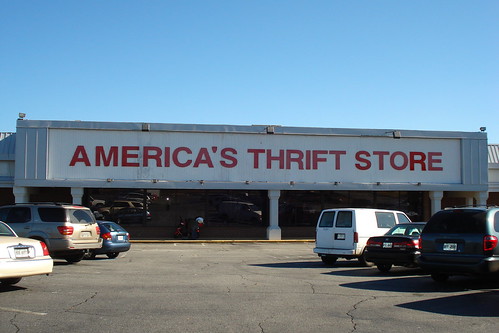
The signs are now in Spanish and English, and several announcements were made in Spanish. (The music was a neutral oldies radio station, although I imagine that will also change in the future.) I was instantly reminded of the thrift store I went to in suburban Atlanta last year (see my souvenir photo above), in which I was the only white person in the whole store, the signs only in Spanish. And this was in Newt Gingrich's old district, where some of the houses start at half-a-million dollars (or did, before the economy tanked). Where do these folks live? -- I wondered. And then I realized, they live in one of the many apartment complexes dotting Cobb County, just as I live in a similar one here in Greenville County. They work for the people who live in the half-million-dollar homes, just as I also do.

After my visit to the suburban-Atlanta thrift store, we went over to the Barnes and Noble. I was immediately struck by the fact that these businesses were not very far apart in terms of mileage, but are light-years apart in terms of culture and economics. The Barnes and Noble was practically an all-white enclave, only a few miles from the thrift store, an all-Latino enclave.

And today, after leaving the Goodwill, I drove only a mile or so to Whole Foods.

Again, the shock of leaving a heavily-Latino enclave, driving a short distance, and entering an all-white one.

Why are we segregating ourselves?

I know for a fact (see link above) that poor (and some middle-class and bohemian-type) white people love digging through second-hand cast-offs as much as I do. I have been visiting yard sales and thrift stores my whole life, and white people have always been very well-represented.

So, what's going on?

~*~

Today, I saw workers replacing the carpet in another apartment unit in my building. Latino men, speaking Spanish and hammering nails, waved to me as I left. Latino men take care of the grounds, too. (When we moved here, the grounds crew were all black men, and the fellows laying the carpet were also black.)

Me and Mr Daisy often joke we will be the last white people left in the complex. Our apartment faces the woods and golf course, as I have written before, and we like living in this little pocket of quiet that we have been lucky to find in such a busy area. Whenever we seriously consider moving, we are never satisfied with houses that are RIGHT ON THE STREET; we have gotten rather spoiled living back here in our private little spot facing the woods, away from traffic and other suburban hoopla. Even though we are only about two blocks from I-85, we hear the occasional siren or Harley-Davidson, but not much else.

When we moved here, the population of the apartment complex seemed to mirror that of South Carolina at large, which was fine with us. (One of the main reasons we moved here was that the schools were supposed to be the best, in a county where the schools historically have left quite a lot to be desired.) I'd say it was about 25-30% African-American; the state of SC is about 1/3 African-American in total.

But we have stayed, and the other white people haven't. Where'd they go? We looked around one day, and saw that the vast majority of our neighbors were black or immigrants (Asian and Latino). The white people who remain are usually older (like us), or very young and newly employed at nearby Michelin or BMW (the Asian engineers walk to Michelin from here; while the whites all drive). We hardly see any white families with children; I was stunned to see ONLY children of color getting off the school bus in front of the apartment gate recently.

Okay, where are the white people? What's going on?

They bought houses, they got divorced, they moved away, etc. But don't People of Color do all of those things, too?

We are self-segregating.

And here it is: self-segregating costs money.

As I have intently studied the local real estate market, houses-for-sale, condos-for-rent, etc etc etc, the truth hit me with considerable force:

I can tell WHO lives in a neighborhood by the price.

Whiteness runs about $200-300 a month. That is the price of whiteness. The same-size apartment in a heavily-minority apartment complex is about $200-300 LESS than in an all-white or mostly-white complex. In terms of real estate: the same-size house, in more or less the same condition, might run you as much as $50,000 more in a mostly-white neighborhood than in a black neighborhood. Fact.

Me and Mr Daisy joke that the popular real estate expression "Location, Location, Location" is code for "White location."

How much did this whole Wall Street foreclosure-crisis have to do with white flight? Are we allowed to talk about that?

Why WERE people living so far beyond their means, anyway? When we hear the Fox News stories (beware the source), we are given to understand that it's them clueless minorities who couldn't do the math and understand that their mortgage was too high. (((shakes head dismissively in haughty Fox News manner))) Tsk tsk, what do you expect?

But I am officially rewriting that version here:

The mortgage crisis was caused, in large part, by poor white people who were fleeing Mexicans and Blacks in rental properties.
I know this because they moved away from MY apartment complex, bought pricey DeMint-district McMansions, and then went financially belly-up, in short order.

Why should we bail out white people who were running away from The Bad People? I resent doing that, since I didn't run away. Why am I footing the bill for the people who did? (After the Revolution, when I am Minister of Finance, we will be checking up on the REASONS you moved in the first place, before rescuing your mathematically-challenged, now-flat-broke white ass. Ha.)

We have to face the fact that racism is killing the working classes, rendering them/us easily manipulated by real-estate hucksters and Whole Foods and every other damn thing.

And keeping us ALL (of all colors) from joining together to SEE CLEARLY what is going on.

There is a REASON the Tea Party is largely composed of angry white people; they are the ones who did as they were told. They moved away from the Bad People, they moved where they were told to move and bought what they were told to buy... and HEY! They got fucked. How'd THAT happen? No wonder they are damned pissed. But instead of examining the ideology of capitalism (a cornerstone of which is: MUST BUY HOUSE! RENTERS ARE TACKY!), they swallow it whole, and keep on swallowing.

"You know what capitalism is? Getting fucked!"--Tony Montana

~*~

The American Left, as we established in Part One, is now itself a wholly-owned subsidiary of the ruling class. It is that segment of the ruling class that is (at best) interested and involved in justice and/or (at worst) wants to FEEL GOOD (even morally superior) about themselves. And a discussion of racism in everyday life, which is what segregation IS, is not something they are eager to have, since it is also part and parcel of the life they lead.

Because affluent liberals have the money to ignore the actual market-price of whiteness I listed above, they don't readily SEE it. To the liberal ruling class, segregation is invisible. It just IS. They want to live in XYZ neighborhood/village/subdivision/condo development because it's a cool place to live and they don't see that as any sort of racist act, and how dare you suggest such a thing. It is simply what they want, the way they want a new car stereo, a new computer, a new car. And a new house. The fact that someone BUILT that house, that computer, that car, is immaterial to them. It's something they must have; their identity depends on it (more about this phenomenon, first addressed by Herbert Marcuse and Christopher Lasch, in future posts).

Thus, segregation is totally invisible to them. Certainly, they don't believe they actively participate in segregation, even if pressed to admit they live in an all-white area. It just happened that way, that's all. Economically, segregation is not something they are forced to think about, so they don't.

And to these white people (to any privileged whites), segregation means: How many People of Color to ALLOW IN. It's already understood that they are coming from an all-white perspective, an all-white neighborhood, an all-white place. They aren't running from anybody. As privileged whites, they are there already. They already occupy the protected place the non-privileged whites are TRYING TO GET TO, the safe place that is sought after and coveted.

And for this reason, the liberal classes did not see the white flight-factor in the economic collapse. If they did, they excused it. But I am of the opinion that none actually realized the impetus for the stampede of cheap mortgages, at the same time anti-immigrant fervor exponentially increased. Because: For privileged whites, immigration is about who to employ as a nanny or yard worker. For non-privileged whites, immigration is about who is going to live next door to you.

Since the American Left ignores their own racial segregation (due to the profusion of leftists from bourgeois backgrounds), they ignore everyone else's, too. They have therefore ignored one of the primary reasons (and one of the primary motivations) for the cheap mortgages.

TO sum up: A bunch of rich industrialists bring in Latinos to work on the cheap. First they bring them in by the thousands...and then, by the millions... all while abdicating responsibility and pretending that these poverty-stricken folks are just hopping fences and swimming the Rio Grande on their own. Then, they find them apartments to live in, right next to white people, while they also employ them (very cheaply) to do upkeep on the grounds and lay carpets. The buildings fill up with spicy, strange odors and Our Lady of Guadalupe on the door; lots of brown-skinned children and women cursing at the kids in Spanish.

Don't be alarmed!--the rich to the rescue again. You don't like these people and their taco-smells? We have a cheap mortgage for YOU! Like magic, you will be transported OUT of that hell-hole, and you will be among people like yourself again.

And yes, the miracle-mortgages were marketed JUST LIKE THAT, only just a tad more respectable.

For years I have received their cheapie direct-mail advertisements for basement-rate mortgages, addressed to everyone in the apartment complex... usually stunning photo-shopped postcards of glimmering white houses that look like they are in Malibu, rather than in the upstate.

These postcards ask, in large dramatic block lettering: TIRED OF APARTMENT LIVING?

Now, why would you be tired of apartment living? Owning your own home makes you far more TIRED than calling up maintenance, let me assure you.

I think they were actually asking something else. Location, location, location.

~*~

To be continued!

Monday, January 11, 2010

The Big Squeeze: Tough Times for the American Worker by Steven Greenhouse

Rarely has a book left me so thoroughly depressed.

I had planned to start writing this review over the weekend, but it was an unpleasant prospect that I kept putting off, rather like changing the kitty litter.

But I knew I had to. Rah rah the working classes, and all like that. But that's just it, I hate to catalog exactly how bad we're getting it right now, and will likely continue to get it. Whilst reading this book, I remarked offhandedly to Mr Daisy that surely it can't continue like this, and he just laughed at me. Sure it can. It can get much worse; just take a look at those exhausted seamstresses in Taiwan hurriedly sewing sewing sewing for a measly 9 cents a garment. Reading this account of working conditions in the USA right now, one comes away with the (thoroughly depressing) idea that the Labor Movement was a mere blip, a momentary pause in the long march towards turning the masses of us into automatons and work horses, not necessarily in that order.

Interestingly enough, what initially grabbed me about this book was the inclusion of a chapter about the company I used to work for. Wow, there it is! I was somewhat dazzled to read it: see, I told you it was bad. Of course, I already knew that, but how validating to see it here on the printed page; the lousy working conditions duly listed with the other shitty employers like Walmart.

The company in question runs call-centers for corporate clients, and although the client in the book-example is different, the description of the work-atmosphere and job-requirements are the same. (I have mentioned this job a few times on DEAD AIR, notably here and here.) I made pretty good money, admittedly, but I paid for it in blood. During rush-seasons, we got bonuses simply for showing up and on time, so that should tell you just how vicious and nasty the calls could get. It was not unusual for people to dramatically walk out on the job with a "take this job and shove it" flourish... or they might simply scurry away in tears. They finally had to bribe employees to stay.

Now, however, in today's economy, they don't even bother with the bribes. Wages are down; bonuses and perks largely non-existent. The layoffs and pay-decreases enumerated in this book started in 2001, which is the year I left.[1]:


They call it the script. But it's actually an arcane list of things you are supposed to say, and things you'd better not say. At the [company] call center in [Anywhere, USA], the script sometimes seems only slightly less sacred than the Bible.

If any of the 550 [my center had over 800] customer service representatives (CSRs) stray too much from the script on one call, they risk a tongue-lashing. If they are caught straying on three or four calls, they risk their job.

You must always say "Thank you for calling ____." [...] You should never call a customer sir or madam, it's always Mr. or Ms. with the last name. And you had better not mispronounce the last name, even if it's Krzyzewski. If you don't slip in the customer's name at least three times during a call, that will mean some demerits. And you'd better mention [special bargain] at least once each call. You need to sound chipper and energetic, and you shouldn't spend more than four minutes on a call [our official call time was three minutes, ten seconds, give or take]. You also need to slip in at least two "pro-actives" [instructions to customer on how to avoid calling back, things they can do themselves, but say it nicely].

[...] And when a call is about to end, you'd better not forget to ask, "Have I resolved all of your concerns today?"

[...] There are more than 60,000 call centers in the United States and an estimated 4 million call center workers. It's an industry at the heart of the American economy. Call centers are the connective tissue of modern commerce, handling airline reservations and stock sales, selling HBO subscriptions and cell phones, taking orders for LL Bean and Dell computers, troubleshooting problems with your hard drive or your credit card.

Call centers are sometimes viewed as factories that supply an invaluable product: customer service. One academic study found that "call centers introduce principles of mechanization and industrial engineering into a much wider array of service transactions than was hitherto possible"--thanks to specialized software, networked computers, sophisticated equipment that distributes calls, and recording devices that keep tabs on a CSR's every word. While call centers rely on modern technologies to maximize productivity, their techniques often seem borrowed from the "drive" principles of old.
In short, deviate from the script, take too long, mess it up, and it's your ass in a sling.

And you know, some folks in management tried to be as humane as they could be about it, but rules are rules. I once listened to myself cut off an extremely-talkative jerk (on a tape-recorded call; all are recorded, but only a random few are listened to for monthly quality-review), because he was running up my call-time drastically... After every few word-torrents, I interrupted him with, "Yeah yeah yeah yeah yeah" [2] which made my supervisors crack up so bad, they could barely write me up, they were laughing so hard. Nonetheless, I was written up. You have to keep the call short, but you can't interrupt the customer either (even if he sorely needs interrupting); obviously a no-win situation for the CSR. [3]

If you've ever wondered why it often takes two or three calls to straighten out a situation, keep in mind, the CSR answering your call might be working on a backlog of the last several calls. If you are put on hold immediately, it's because she has every window on her screen filled up, and has to clear one first to handle your call. Also, much of the new technology "auto-populates" screens with customer information that is often incorrect. So, she has to fix that, too. And a bunch of other shit besides:

[...] While on a call, perhaps answering a customer's questions about a monthly bill, the CSRs not only were supposed to slip in all the elements from the script, but were supposed to verify names and addresses and type them into the computer. And if the customer changed their cell phone plan [this was the Verizon call center in the book, mine was not] during a call, the CSRs had to type a great deal of additional information and do a credit check, all while navigating among various computer screens. [...] If while juggling all these tasks a call center rep concentrated so much on her typing or her computer screen that she didn't listen to the customer for a second or dropped a beat in the conversation, there would be consequences. "If you ever asked a customer to repeat something, the supervisors had a fit," [recalls one employee] "and you couldn't have dead air."

;) And now you know another reason for my blog name.

And now you also know why your information gets all screwed up.

~*~

As I said, I feel validated reading this account from the labor correspondent for the New York Times. Then again, note the "golly gee whiz" tone in what he has written, above. These are investigative "field studies" for him. It sounds remarkably like anthropology involving a pilgrimage to another culture that the author doesn't belong to, rather than workers in his own country. One gets the distinct impression that Steven Greenhouse doesn't actually associate with the people he is writing about. And see, although his heart is undoubtedly in the right place, I think this is part of the problem. Who is his intended audience, the workers in question? Who is he telling all of this to? NPR listeners? PBS viewers-like-you? People who attend Ivy-League schools? I can't quite figure out who is supposed to be reading this book; I didn't need to read it to know about the state of affairs described therein. I know what's in it. Who doesn't know about the current sorry state of affairs for the American worker? The educated people who will never have a job like CSR? (And are they utterly certain about that?)

Part of the problem is the class-schism of New York Times readers (wherein handbags are advertised starting at $4000 on sale) vs the rest of the country.

The problem is that he has to write this book in the first place, because people like him don't know about the call centers unless they read it in a book.

~*~

The best chapter in The Big Squeeze is (perfectly) titled "Leaner and Meaner," in which Greenhouse delineates the collapse of basic decency among management... something I first noticed during the Reagan era, when Big Business was manically fetishized as the savior of the American economy (and we see how well THAT worked, she coughed). Suddenly, bosses were given carte blanche to rip you a new one and scream stop fucking up whenever they took a notion. Before this time, such behavior was seriously uncool (have a look at MAD MEN again) and could lead to dismissal. After the 80s? The temper-tantrum-throwing supervisor was considered a real go-getter and was promoted to a fare-thee-well. Having no "sentimentality" and screaming at people the day their mother dies, well, that's a guy who CARES ABOUT THE COMPANY and will certainly go far, with hella commitment like that! The longer I have worked, the more I have seen this phenomenon in play. I have seen it increase to the point that I just assume most supervisors will be cruel--and I am pleasantly surprised when they aren't. Cruelty has become a managerial requirement; unkindness and brutality signal that you run a tight ship. A lot like the military.

Other chapters are also required reading, particularly "Outsourced and Out of Luck" and the well-documented "The Rise and Fall of the Social Contract"--chapter titles that speak for themselves. Although he offers 'solutions' at the end of the book, one can't help but think that companies and capitalists have already found their solution--and he even mentions it himself: Outsourcing. Maquiladoras. India. Mexico. If American workers complain or buckle under the pressure, do what the rich have always done: move on. Textile workers in the north start unionizing? Move the textile industry to the south. Too expensive THERE TOO? On to Mexico. Too expensive to pay call center workers a living wage in the USA? Hey, they speak English in India, and that's the new frontier for call centers.

They will just keep going until they find more people to use. And there seems to be a never-ending supply.

As I said, the book was depressing. The only thing I can think of to make me feel better is to repeat this old expression I learned years ago: Workers of the World unite, we have nothing to lose but our chains.

:)


...


[1] I left the company virtually right before 9/11... one of my first thoughts on 9/11 was how much of a mess it would be if I was still taking calls (my shift was heavily East Coast/New York), which is a terrible, self-serving thought, but one I couldn't suppress. I was so grateful to be off the phones, so that I would not hear the anguish up close.

[2] I sounded rather like the yeah-yeah's at the end of the B-52s song, "Dance this mess around" if you have ever heard it.

On another call, I got a customer named Fernando and asked him if he liked the Abba song of the same name. I nearly got written up for that too, but it turned out he loved the song and started singing it to me. (That one also made the rounds of management, and some would sing "Fernando" to me when they saw me in the hallways.)

[3] What was jarring about the call was how I didn't remember a thing about it, as if my memory banks had been wiped clean ("Did I fall asleep?")... Even now, years later, only a few calls really stand out--most are a veritable blur of meaningless capitalist verbiage in my memory.

Tuesday, April 28, 2009

Swine flu lesson: STOP BUTCHERING ANIMALS!!!!

The swine flu epidemic is all over the news. And I am wondering: how did a swine virus get into humans?

Now, why would we be associating with SWINE? Umm, let me guess.

I went to the CDC website and I am informed:


Swine flu viruses do not normally infect humans. However, sporadic human infections with swine flu have occurred. Most commonly, these cases occur in persons with direct exposure to pigs (e.g. children near pigs at a fair or workers in the swine industry). In addition, there have been documented cases of one person spreading swine flu to others. For example, an outbreak of apparent swine flu infection in pigs in Wisconsin in 1988 resulted in multiple human infections, and, although no community outbreak resulted, there was antibody evidence of virus transmission from the patient to health care workers who had close contact with the patient.
"Swine industry"--doncha love these half-assed euphemisms the pork industry employs? HA! Industry?!? You mean, the death industry?

Do you mean KILLING the swine, like, for meat?

Does this mean, none of this would be happening, if people didn't BUTCHER PIGS TO EAT?

(((pauses for dramatic effect))) (((lets this realization sink in))))

Eating meat is disgusting. Raising pigs for slaughter is GROSS. Factory farming is unnatural, filthy and horrific, and a sin before Almighty God. And when you mess with the almighty, this is the kind of thing that happens. (Will you meat-eaters learn from this, at long last?)

Why aren't news reports properly focusing on butchering animals for meat as the cause of this epidemic, rather than babbling about the Mexicans?

Ohhhh, probably because it's all carnivores reporting the news, hm?

More on the flu:

Mexican Schools Shut as Epidemic Hits 'Critical' Point (Washington Post)

Cases confirmed in Asia, Middle East as virus spreads beyond Mexico (MSNBC)

Swine Flu: Chicago's Mexican Community Prepares, School Bans Handshakes (Huffington Post)

H1N1 (Alas, a blog)

PS: Leave the pigs alone, and I bet we won't catch their nasty germs. How about it?

EDITED TO ADD (for strong stomachs only!): Swine Flu: Smithfield Foods' statement vs. the ugly truth (Cogitamus)

Friday, December 12, 2008

Feast of Our Lady of Guadalupe

Left: Dad and son arrive at this evening's Mass commemorating the Feast of Our Lady of Guadalupe.

~*~


After all of the media foofaraw over my priest, I figured it would be relatively safe to go today's Mass. The Feast of Our Lady of Guadalupe is a Latino holiday, and the Spanish-speaking priest was presiding. And I was right! I was one of extremely few gringos in attendance.

It was educational to sit through a Mass that I didn't understand. This is how many immigrants feel, living in the USA: Huh? What?

I didn't know any of the songs, not even the basic melodies. It is almost as if there is more than one Catholic church.

And then again, of course there is not: I could follow the Order of Mass fine. I knew everything that was going on; the bell rings for the consecration and the host is held aloft. I followed along okay, as Latinos follow along okay for the English Masses. It's all one church, and A follows B, predictably, comfortingly. The ritual washes over one's soul, richly reassuring and reminding.

One of the hymns seemed ineffably sorrowful, and the woman next to me wept silently. Since I didn't know the Spanish lyrics, I wondered if the sadness was in the hymn itself, or some memory called up by it. I thought the woman could be missing her homeland. I wondered if the Blessed Mother made her think of her own mother, who is probably very far away. The concept of the Communion of Saints means that we are all together; the entire Church partaking of communion together, throughout time and space, living and dead. It is an idea that has always comforted me, and whenever I seriously meditate on it, my fear of death dissolves. I felt this especially strongly as I realized so many of the immigrants at this Mass were actively praying for their kinfolk at home-- missing them so much, I could feel their intense longing through their wistful singing.


Left: Adorable little pumpkin in traditional Mexican dress, inspects the articles that have been brought for a Feast Day blessing.


Children came with baskets of flowers and vigil candles as offerings for the Blessed Mother. Some were dressed traditionally, and were just SO PRECIOUS! (I am missing my grandchild mightily, and again, I realized so many people present were also missing children, grandchildren, nephews, nieces, brothers, sisters....) Babies were brought forward for blessings. We were all ceremoniously doused with holy water.

I recognize the story of Guadalupe, even delivered in Spanish, through the use of certain words: Juan Diego, Maria, Sacramento. I love the Blessed Mother very much, and when I have asked her for comfort, she has never failed me, as she did not fail St Juan Diego.

It was a wonderful evening, and I felt greatly restored.

Sunday, August 17, 2008

Dead Air Church: Cortez the Killer

He came dancing across the water, Cortez, Cortez...

This week for Dead Air Church, I wanted to recognize the Feast of the Assumption (which was the 15th) by commemorating the victims of one Hernán Cortés de Monroy y Pizarro, 1st Marqués del Valle de Oaxaca. The Aztec Empire fell on August 13, 1521.

One account of the massacre in the Main Temple of the Aztec capital Tenochtitlan (May 1520):


Here it is told how the Spaniards killed, they murdered the Mexicas who were celebrating the Fiesta of Huitzilopochtli in the place they called The Patio of the Gods

At this time, when everyone was enjoying the fiesta, when everyone was already dancing, when everyone was already singing, when song was linked to song and the songs roared like waves, in that precise moment the Spaniards determined to kill people. They came into the patio, armed for battle.

They came to close the exits, the steps, the entrances [to the patio]: The Gate of the Eagle in the smallest palace, The Gate of the Canestalk and the Gate of the Snake of Mirrors. And when they had closed them, no one could get out anywhere.

Once they had done this, they entered the Sacred Patio to kill people. They came on foot, carrying swords and wooden and metal shields. Immediately, they surrounded those who danced, then rushed to the place where the drums were played. They attacked the man who was drumming and cut off both his arms. Then they cut off his head [with such a force] that it flew off, falling far away.

At that moment, they then attacked all the people, stabbing them, spearing them, wounding them with their swords. They struck some from behind, who fell instantly to the ground with their entrails hanging out [of their bodies]. They cut off the heads of some and smashed the heads of others into little pieces.

They struck others in the shoulders and tore their arms from their bodies. They struck some in the thighs and some in the calves. They slashed others in the abdomen and their entrails fell to the earth. There were some who even ran in vain, but their bowels spilled as they ran; they seemed to get their feet entangled with their own entrails. Eager to flee, they found nowhere to go.
~*~

He came dancing across the water
With his galleons and guns
Looking for the new world
In that palace in the sun

On the shore lay Montezuma
With his cocoa leaves and pearls
In his halls he often wondered
With the secrets of the worlds

And his subjects gathered round him
Like the leaves around a tree
In their clothes of many colors
For the angry gods to see

And the women all were beautiful
And the men stood straight and strong
They offered life in sacrifice
So that others could go on

Hate was just a legend
And war was never known
The people worked together
And they lifted many stones

They carried them to the flatlands
And they died along the way
But they built up with their bare hands
What we still can't do today

And I know she's living there
And she loves me to this day
I still can't remember when
Or how I lost my way

He came dancing across the water
Cortez, Cortez

What a killer.


~*~

Neil Young & Crazy Horse - Cortez the Killer

Friday, March 14, 2008

Martin Fierro 1942-2008

Left: Martin Fierro, photo by Robert Minkin, from Dead.net.

~*~


Music fans and Deadheads everywhere have suffered a great loss, with the passing of mighty saxophonist Martin Fierro. He died of cancer yesterday, surrounded by family and friends in Marin County, California.

Martin is known to Deadheads primarily for playing flute and saxophone on the 1973 Grateful Dead album Wake of the Flood. He also played with several of Jerry Garcia's side projects, including the Legion of Mary.

Martin was born in Mexico and moved to El Paso, Texas, at the age of 10, where he played saxophone in his high school marching band. Then he heard music by Fats Domino, Chuck Berry and others, changing and rearranging his world, as the music did for so many other young people of the era. Martin's music took him to new places and new syncretic combinations; a new musical synthesis. He was a fixture in the Bay Area jam band scene of the late 60s/early 70s, sitting in with bands like Mother Earth, Sir Douglas Quintet and Quicksilver Messenger Service.


Left: Jerry Garcia birthday concert poster, from Honest Tunes. (2006)

Dead.net reports on Martin after the breakup of The Legion of Mary:

Martin had no trouble finding work following the dissolution of the Legion of Mary; indeed his tenure with Garcia was like a springboard to an expanded fan base and many new opportunities. He continued to play on and off with Merl Saunders—a lifelong friend—and he also played often with various groups led by John Cipollina, including a marathon stint in the great Bay Area jam band Zero. His association with Zero also led to an enduring musical partnership with Steve Kimock, as well. In fact, the last time I saw Martin play was with a re-formed Zero (with Kimock) at Wavy Gravy’s birthday benefit at the Regency Ballroom in SF in 2007. Over the years Martin also sat in with many other jam bands, from String Cheese Incident to Dark Star Orchestra. “I just love to play, man,” he told me, “I’ll show up and it’s, ‘Oh, Martin, you gonna play with us, right?’ And I say, ‘Well, I do happen to have a horn with me…’” he laughed.

When we spoke, he joked about how he had cheated death on numerous occasions: “The worst was a surfing accident in Hawaii [in the late ’90s]. I broke my neck and my back, man. I was dead for close to ten minutes and they brought me back, and then they thought I was brain damaged or I’d be paralyzed. The next day I played a gig with Zero!” He laughed heartily—as he often did. And whether there was a touch of exaggeration in the tale or not doesn’t matter. (He did, in fact, carry a lot of physical pain with him, from that and other episodes) But it shows his zest for life, which he retained until his final days on earth.

Another one gone too soon.
Yes.

Our prayers and Deadhead love go out to Martin and his family.

**You can share memories and leave messages and memorials at martinfierromusic.com.

Wednesday, December 12, 2007

Feast of Our Lady of Guadalupe


Far from home, Virgin of Guadalupe comforts believers

Waukegan church celebrates 476th anniversary of first sighting

By Andrew L. Wang | Chicago Tribune

6:44 PM CST, December 12, 2007


Powerful drumbeats echoed off the sanctuary ceiling and dancers in traditional Aztec garb leaped and spun at a frenetic pace as statues of Jesus and Mary cast beatific gazes upon them.

There was a time when the performance of an indigenous ritual might have been shocking at a Roman Catholic church; not so Wednesday at Holy Family Church in Waukegan, as parishioners gathered before dawn to mark the 476th anniversary of the appearance to an indigenous Mexican peasant of a dark-skinned Virgin, now known to the world as the Virgin of Guadalupe.

"She's really the blending of the two cultures into one," said Rev. Gary Graf, pastor of the church.

The message held special resonance for Latinos in this far north suburban city after a trying year.

Many said they feel targeted by police enforcing a city ordinance to tow cars if the drivers don't have insurance or valid driver's licenses. They fear they will be caught up in an immigration sweep, like the one in August that netted nearly 100 people—some of whom were not guilty of any crime or immigration violation. And they worry that new powers sought by local police will lead to deportation for minor offenses.

"I'm asking my parents to sell the house," said Veronica Martinez, 27, of Waukegan. "It's very tough." Martinez was among hundreds who attended the standing-room-only event in the city's largest parish, at 450 Keller Ave.

Mexican Catholics turn to the Virgin for solace, comfort and for aid in their earthly troubles. But another lesson of the Virgin is particularly relevant today, Graf told his mostly Latino parishioners: The collision of cultures can create a new, more inclusive society that values the contributions of both.

The story of the Virgin, passed down over nearly five centuries, says that Mexican peasant Juan Diego was walking to morning mass Dec. 9, 1531, when he heard a woman's voice calling him to the top of Tepeyac, a hill on the outskirts of Mexico City. When he reached the top of the hill, he saw the dark-skinned Virgin with European features who spoke in Nahuatl, his language, and asked him to build a church in her name.

Juan Diego told his bishop of his vision, but the cleric was skeptical and told him to get proof that the woman he saw was the Virgin. Three days later, the story goes, the Virgin told Juan Diego to return to the hill, gather roses and bring them to the bishop as a sign. He wrapped them in his tilma, or cloak, and when he presented them the roses fell to the floor to reveal an icon of the Virgin on the fabric.

A church was built, and today the Basilica of Our Lady of Guadalupe stands on the site.

Wednesday's 4 a.m. celebration interspersed prayer with the singing of Las Mañanitas, or morning serenades, accompanied by guitars, tambourines and accordion. Graf was joined on the altar by small children, the boys wearing tilmas like Juan Diego's and sporting painted-on mustaches, girls with braided hair and brightly colored dresses.

Then came the Aztec dancers, wearing elaborate feather-covered headdresses, gold-trimmed garb and heavy anklets made of hundreds of seashells. They danced to a drum and the call of a conch shell. Fascinated parishioners pressed closer to the front of the sanctuary to see. Some snapped photos with mobile phones.

The Virgin's image has long been ubiquitous in Mexican-American neighborhoods and in recent years she has gained popularity among non-Latinos, non-Catholics and even non-Christians.

"She cares for us and comforts us," said Juan Carlos Pizano, 34, of Round Lake Beach, whose parents emigrated from Mexico. "She unites us as countrymen, as children to a mother."

Her story has many parallels to the situation of undocumented immigrants, said Elena Segura, director of the Catholic Campaign for Immigration Reform, part of the Chicago archdiocese.

At the time the Virgin appeared to him, Juan Diego faced an uncertain future, she said. He was poor and alone in the world. Spanish conquistadors had come to his land and brutally established their dominion. Indigenous peoples like his were being converted to Catholicism, their native customs and religion being subjugated.

"Then this lady showed up in the midst of all this stress," Segura said Wednesday after speaking at the service. "He represents people in despair and fear. That's like what undocumented people are feeling now, especially in this town."

Moreover, Graf told parishioners, the Virgin's mixed appearance is a message that tells believers to reach out to the non-Latino community and accept their differences.

"This is a moment in time in which we're given an opportunity to learn from the newcomer and for the newcomer to learn from those who have been here for several generations," he said. "In the process everyone's got to give a little bit . . . to become a new people, a new creation."


Queen of Peace, Blessed Mother, pray for us.