
This 53-year-old tune is somewhat spooky and weird. I heard it on late-night TV and scribbled down the title to share with you all. The verses remind me of another song (can't put my finger on which one, though, faster tempo) and the vocalized harmonies ending the chorus sound especially familiar.
I am sure both were mined for some later rock song(s), so if you can recognize the melodies, let me know. Driving me crazy.
Green Fields - Brothers Four (1960)
~*~
Early techno brilliance from the celebrated producer of the Beatles' ABBEY ROAD, as well as Pink Floyd's DARK SIDE OF THE MOON.
I Robot - Alan Parsons Project (1977)
~*~
He really needs NO introduction.
Rebel Music - Bob Marley and the Wailers (1974)
Showing posts with label 50s. Show all posts
Showing posts with label 50s. Show all posts
Tuesday, December 17, 2013
Tuesday Tunes

Monday, December 2, 2013
Monday Music
I miss my mama, who loved this song. I think she identified with the naughty girl in the song.
Warning: its PURE country, which means its pretty sexist. None of this nicey-nice American Idol-assimilated stuff!
Joe Maphis was very talented in the Chet Atkins-style, "thumb-picking guitar" that my stepfather also specialized in. (also described HERE) My parents also played this song in their band.
Nostalgic.
~*~
Dim Lights, Thick Smoke (And Loud Loud Music) - Joe Maphis (1953)
~*~
My tags tell me I've never blogged a Dire Straits song! Really?! ((shocked expression)) Corrected forthwith!
This is my favorite Dire Straits song. I love it whole bunches and have since I was 21 years old.
Water of Love - Dire Straits (1978)
Saturday, January 12, 2013
Link Wray
Rumble - Link Wray (1958)
Visuals are from The Delicate Delinquent. (1957)
~*~
I'm not sure when the following tunes were recorded.
Raunchy - Link Wray
The Earth is Crying - Link Wray
Sunday, September 23, 2012
Sam Cooke: Having a Party
I am currently watching the wonderful American Masters documentary titled Sam Cooke: Crossing Over (2010).
So much history is still unrecorded about pioneering black artists who "crossed over" into mainstream, radio pop-hit stardom. Cooke was one of the very first, achieving his first hit on the pop charts in 1957, still a very racially-incendiary time. Black artists on the mainstream charts then sounded like Johnny Mathis and Nat King Cole, not like Cooke's bluesy "You Send Me."
When Cooke performed at the Georgia State Fair, police were called in to maintain order because large integrated gatherings routinely attracted attention from racist groups like the kkk. The film clips of enthusiastic, racially-mixed southern audiences, standing up to scream and greet him, suddenly take on new significance when you keep in mind, they likely had to argue with their families for the right to be there.
The party was an act of affirmation.
Cooke's experiences made an emotional impact on him. In 1963, he joined Aretha Franklin in refusing to play for segregated audiences. When he played the Copacabana, the slicked-up patrons had never heard actual R & B before, and hardly knew what to think; they expected Sammy Davis Jr. Variety magazine wrote that Cooke "wasn't ready" for the Copa, when it's obvious it was the Copa audience that wasn't ready for him.
In late 1964, a woman named Bertha Franklin shot Sam Cooke, and nobody has ever been sure why. There is a great deal of controversy over the 'official' account of his death, which changed several times.
He had just become strongly politicized and was playing a greater role in the Civil Rights movement. Singer Etta James and others, wrote that the circumstances of his death were highly suspicious. An understatement.
When I heard "Having a Party"--I almost started to cry, it's just so beautiful.
Monday, August 20, 2012
Color Fear
 I watched an old interview of Jimmy Breslin on C-Span over the weekend, originally aired in 1991.
I just loved what he said, and decided to quote the last segment of the interview in its entirety.
It's as true now, as it was in 1991... as it was in the time he is describing, the 50s.
[C-Span CEO Brian] LAMB: You said earlier that you can't go a day without writing about and thinking about race in New York City.
[Jimmy] BRESLIN: Well, it hits you in the face in New York City. It's all there is.
LAMB: OK. Is the problem -- and I don't know whether you call it a problem or not -- but will the problem be solved?
BRESLIN: It's a very new problem, and we've got a long way to go with it.
LAMB: Why is it new?
BRESLIN: Well, it didn't start until -- when did it start in New York City? I told you a movie was made in 1950 that only had two blacks in it -- shoeshine people -- and now we're in 1991 and we're beginning to see how many are there. I found in doing the research for this book, the John Deere Company in Iowa gave me their company newspaper and a lot of old press releases from the largest train ever to carry farm equipment in the United States in whatever the year was then. It left Des Moines with 141 flatcars filled with the John Deere 99 cotton picker, and it went to the South, to Atlanta, where there was a huge civic celebration there, and it went all across the South depositing these 99 -- the first shipment, largest in the history of the nation. Each machine did the work of 90 field hands, and they went all across the South. Now, and here it came, into New York they came, these sad-faced women with their arms leaden from carrying babies and a long ride.
Day coaches from Jacksonville, buses from Spartanburg; they came from Durham, in the tidewater area of Virginia. Into New York they came and they changed the city. We were unprepared for them, the city was unprepared. The city didn't even know what was happening. Congressional people on agriculture committees didn't know what was happening. Nobody knew what was happening. It was a huge movement, and it happened without any public notice. Into New York they came.
Where else would you go if you were chased off a farm? Where else would you go -- to Knoxville or to Atlanta or to Boise, Idaho, or Casper, Wyoming? You'd go to New York! Where else would you come? And they came.
This was a city that had a reputation of feeding and clothing anybody who couldn't make his own way, but it never was prepared for this. Then at the same time you had into New York from San Juan, they came on the so-called chicory lights. It came in late night flights from San Juan, loaded to the gunwales. They landed -- the airport then was called Idlewild, not even Kennedy. The cold wind would blow across the tarmac from the Atlantic Ocean across Jamaica Bay, whip across them as they came out of these planes dressed in short-sleeved sport shirts and flowered summer dresses, the women. Somebody from the Bronx would run up and throw a coat around them. I remember there was the fellow mentioned here -- Jimmy Cannon, wrote that they were 'summer people in winter clothes,' coming into New York.
These two from San Juan and from the South together formed the greatest number of people to enter the city of New York that we ever had at one time -- greater than anything from Ireland or Eastern Europe or Southern Italy, much greater. All here, and we didn't know what to do with them because they weren't white. You could take a whole load of Jewish people from Eastern Europe who couldn't speak the language and dressed strangely with their beards and hats, and you could take them and put a statue and have songs and poems and pictures -- dramatic things. Extol them forever. You could take the Italians from Calabria and from Naples -- great. Couldn't speak English -- who cared? They were great. Any Polish that came in, great.
Here came Americans but they weren't white -- wow, here we go.
Now, that isn't that long ago that the real numbers started coming in. They were coming up in the late '40s and into the '50s, but when those trains with this farm equipment really started to come, now it was a crush and we got hit with it. Now we're in something that nobody has ever done before. We're trying to somehow survive and have economic and share economic and political power. We're not asking people to love each other. I don't think you're ever going to get anyone to love anybody anyway. Forget that. Let's just live together and see what happens. That's 100 years. When you say that's 50, 75 years easy, nothing can be done. It's going to be a long, long, long thing.
LAMB: Why do the whites and the blacks, when they don't get along, why don't they get along? What is the reason?
BRESLIN: Color fear on the part of the whites.
LAMB: Color fear?
BRESLIN: That's where it starts. Also stubborn refusal on that word "color fear" to realize it's one other thing to admit it and to do something about it.
You can tell a guy if he has a job just by looking at him. The guy walking up the street, if he's working, forget it. You can tell by a look. A glance tells you a working man, and a working man doesn't do anything but go home from his job. There's no crime if people are working. Unheard of. Nobody working at a job with any chance in life goes out and does anything wrong. They don't do it. It just doesn't happen. If they would have this color fear, if they would begin to put it in their minds that hey, you don't have to be afraid if the guy is working. The whole word is jobs. You know that. What am I telling you? You sit here every night and know it. What, am I telling you something new? That's the only political word worth discussing is jobs.
LAMB: We've only got a minute or so. If Damon Runyon were living today, would he have trouble writing?
BRESLIN: No, not at all. How could you have trouble with what's going on today? And also his style of writing going right down to the street, you'd come up with the same one word.
If the guy ain't got a job, he's not going to behave. If the guy doesn't have bread, he's going to steal it. Now, let's face it. He was writing about people who came in from Texas. Miss Temple Texas gets off a bus on a Friday, meets a guy and comes around on Monday morning with a brand-new mink coat and says, "Look what I found in the subway." Well, they were coming in from out of town and making it. Now, all you need is somebody coming in from the south end of Brooklyn, or his family that followed him, who gets ahead -- gets some bread and gets ahead in the world. There's no trouble. Jobs. He would understand that. If the guy is working, everything's all right.
I'm confident in that.
Wednesday, April 18, 2012
Dick Clark 1929-2012
In this post only nine days ago, I briefly mentioned the Rolling Stones concert in San Francisco. One thing I remember from that show is a couple dancing together (very well), and when they finished, someone shouted out, "Let's hear it for couple number 14 from Milwaukee!" and everyone standing around applauded, whistled and laughed appreciatively.
I realized that a lot of Americans would not get that joke now. And it made me sad.
His name was Dick Clark, and we grew up with him. Now he is gone, along with his black counterpart, Don Cornelius. And with them passes a whole way of life, memorialized in musicals like Grease: young people dancing on live TV to the popular songs of the day.
Upon hearing of Clark's passing, my first thought was the 'tribute song' by Barry Manilow (a remake of Les Elgart's big-band original, with updated lyrics mentioning the show and Clark by name)-- which Clark liked so much he closed out American Bandstand with it from 1977 until the show's demise.
The song sums it up.
Bandstand Boogie - Barry Manilow
(He actually starts DANCING in the middle, and then continues singing. I very much doubt he smoked!)
We're goin hoppin
we're goin happin
Where things are poppin
The Philadelphia way
Were gonna drop in
On all the music they play
On the Bandstand
Bandstand, bandstand, bandstand
Hey! I'm makin my mark
Gee, this joint is jumpin
They made such a fuss
just to see us arrive
Hey, it's Mister Dick Clark
What a place you've got here!
Swell spot, the music's hot here
Best in the east,
Give it at least
A seventy five!
And as you know, lots of the songs were worth the whole hundred percent. :)
This list gives you a partial idea of the impact of American Bandstand on mass media and pop culture.
Goodbye Dick, and thanks for the jams.
Monday, April 16, 2012
Weekend update
 At left: a fabulous vintage Chevy Bel Air, which I saw parked nearby yesterday. Any estimates on the year? I am thinking maybe 1957 or 58, which makes it as old as I am. It was bee-yoo-ti-full!
As I was taking the photos, people passed by and nodded approvingly, one announcing that it was right purty. It sure is. ((swoons)) A small consolation prize for no pink Packard, though! (I am still kicking myself for not being able to get that photo.)
~*~
Yesterday, I attended the WXMP Community Radio Meet and Greet at the Malcolm X Center for Self-Determination. (photos here) I would love for Community Radio to become a reality in the upstate. We watched a video about the Prometheus Radio Project, which was exciting and got my hopes all stoked up. In addition, we learned about the Media Access Project and the series of cases known as Prometheus Radio Project v. FCC -- which challenged radio-monopolies, making community radio a real possibility.
Efia Nwangaza, director of the Center, has the transmitter already and basically just needs to get it moved... but the costs can be staggering.
Right now, my show is on WFIS, which is commercial radio. Community radio is much more free-form, and as long as you keep the FCC rules (no cussing!), you can say any kind of crazed radical stuff you want. Then again, the wattage is not usually too high, so the listening-area isn't as large as commercial radio.
I'd love to try both, but that is likely over-extending myself.
Speaking of over-extending, just came from the dentist (ugh) and will not be making it to the meeting with Rep. Bakari Sellars; I am hoping mainstream media will cover the event halfway decently. (But if they don't, I certainly won't be surprised.) Recently, there has been a huge discussion about the various versions of Stand Your Ground laws across the USA, and I am very pleased my show was part of that. Folks are busy evaluating and re-evaluating South Carolina's Protection of Persons and Property Act (which has a "Stand Your Ground" provision included), and lots of ideas and alternatives are currently being proposed and exchanged.
I have heard from several people that our Saturday show was the best yet! You be the judge.
Thursday, December 1, 2011
News flash: People on TV live better than we do
 At left: Audrey Meadows and Jackie Gleason as Alice and Ralph in THE HONEYMOONERS.
I was looking at Ralph and Alice Kramden's tiny, dingy apartment last night, flipping channels and feeling some 50s nostalgia. And then, jarringly, I landed on some shiny new sitcom, and the same supposedly middle-class people are living in $350,000 homes.
Wait, what? How could they afford THAT? Alice and Ralph barely scraped by, and they didn't even have a car. They talked about not having a car, too. They talked about money. They talked about affording things and not affording things. I suddenly realized that modern TV characters do not talk about whether they can afford things now, unless it is something obviously expensive, like tuition to particularly-pricey colleges or spiffy sports cars or extended vacations to Paris. I also realized something else: Ralph and Alice didn't have credit cards. After all, they still bought ice for their actual ice box.
They didn't have much. No nice clothes, no nice furniture. People loved them because they identified with them.
When did that change? When did regular, just-folks TV characters turn into imitation-rich-people? Even though the characters are given simple occupations, they are clearly living way beyond their means and above their pay-grade.
I first became aware of this back in the 90s, when some wit (possibly in the Village Voice) wrote an article about the then-wildly-popular show "Friends"--suggesting that their respective apartments would cost ____ (something outlandish) that unemployed actors and waitresses (the "Friends" occupations) could never possibly afford.
This TV Trope became known as Friends Rent Control, which was the official excuse for this luxurious apartment-dwelling:Besides appealing to audience fantasy, this is usually done because large sets are easier to film in. If Monica or Chandler's apartment on Friends had been realistic, the entire apartment would be the size of an average living room, rather than the entire first floor of a house. Doing a scene with all six main characters would have been a total nightmare for the cast and crew. It's for this very reason that Angel changed its primary set from a cramped basement office in Season 1 to a spacious hotel in Season 2. In some cases, though, the reason is that the writers and producers have either forgotten or never known how normal people live; born into prosperity with parents able to afford the best universities and pampered by the entertainment industry, they actually have no clue of how the majority of people live.
Ah, we get to the heart of it.
Jackie Gleason came from Brooklyn, and actually grew up at 328 Chauncey Street, the address he used in THE HONEYMOONERS. His parents were both from Ireland. He WAS Ralph Kramden, except he didn't drive a bus (but you could certainly imagine him driving one). Jackie Gleason was poor and never even graduated from high school. He hadn't forgotten how it was to live with an ice box that used real ice.
There is a similar TV trope called Living in a Furniture Store, the title of which sums up how these TV-homes are designed and arranged.
Speaking of furniture stores, does all of this STUFF in TV shows (which we are to believe is owned by regular people like you and me), cause viewers to crave more STUFF? I think it does. I was just admiring some of the bed linens and coverings in an EVERYBODY LOVES RAYMOND rerun, and thinking idly of my tacky, ancient quilts and how I fall short. I see no reason to have new quilts when I love my old ones, but... well... they ARE old, and I am suddenly conscious of it.
In fact, these thoughts started me thinking about this post, and got me wondering how other people feel about this phenomenon.
What do you think when you see dental-hygienists and waiters and other low-income people living like kings on TV? Do you laugh at it, or does it annoy you?
Have you ever craved something you saw on a TV show? And let me clarify: I do NOT refer to commercials and advertising; it is the JOB of a TV commercial to make you crave something, but it is simply a symptom of viewing that makes you crave something you saw on EVERYBODY LOVES RAYMOND. (It is also a by-product of wanting to be like the characters, as when millions of women cut their hair like Jennifer Aniston back in the 90s.)
Your thoughts?
Friday, July 8, 2011
Let's swim to the moon

One of those things about age that makes me profoundly uncomfortable: I get sentimental very quickly.
Like, really sentimental.
It overtakes me suddenly, and there I am, shedding tears over seemingly peculiar, unrelated or odd events. Such as Ben Hall and his guitar playing. Which was just like my late stepfather's. (Note: although the outdated link claims Ben is 18, he has now reached the ripe old age of 22.)
Until I was sitting there listening to Ben, whom I hadn't heard before, I didn't realize I had unconsciously avoided the music of Chet Atkins for a reason... I was suddenly aware that the "thumb-picking" guitar-style of Ben's, was the same as my stepfather's. I have avoided it for many years, flipped radio channels and such, because it made me so emotional. And as Ben described his style of playing, I thought, oh no... because I probably would have avoided his fabulous guitar playing if I had known.
I listened, and promptly got all teary-eyed and emotional. It is so embarrassing, reminding me of a line from Colonel Kurtz in Apocalypse Now: "I cried like some grandmother." Yeah, I guess he means me. I have arrived!
Does any music do that to you?
Here is Ben's playing, the signature thumb-pickin style.
Cannonball Rag - Ben Hall
~*~
This song is as old as I am, seriously... careful, its about death, and way before the Doors made drowning at night sound sexy and existential.
I can hardly believe its taken me this long to post it!
Endless Sleep - Jody Reynolds
~*~
And speaking of the Doors, here is the 60s version of drowning for fun:
Moonlight Drive - The Doors
Let's swim to the moon
Let's climb through the tide
Penetrate the evening that the
City sleeps to hide
Let's swim out tonight, love
It's our turn to try
Parked beside the ocean
On our moonlight drive
Let's swim to the moon
Let's climb through the tide
Surrender to the waiting worlds
That lap against our side
Nothing left open
And no time to decide
We've stepped into a river
On our moonlight drive
~*~
Sorry so morbid, but its been a rather morbid week in America, yes? ;)
Sunday, September 12, 2010
Get me wardrobe!
 Over the weekend, we very much enjoyed the film Hollywoodland (2006).
Even more than fabulous Adrien Brody, even more than the presence of legendary veteran character actress Lois Smith, and even more than the entertaining, LA-Confidentialish tale based on juicy Hollywood rumors surrounding the death of George Reeves...I loved the clothes!!!!
I kept getting distracted by the continuous Hit Parade of wonderful late-50s era dresses, blouses and accessories--even the men's shirts were terrific. And every outfit was utterly perfect for the character who wore it.
The costume designer for Hollywoodland was tremendously talented JULIE WEISS, who has designed clothes for a variety of films including American Beauty, Frida and A Simple Plan. (I also loved her flamboyant showgirl costumes and sky-diving Elvises in Honeymoon in Vegas!) She could easily go into business for herself... although if she did, I doubt regular folks could afford anything so wonderful.
Throughout the movie, I just kept thinking, WOW, I'd love to wear that!
Some of my favorites of Weiss' great outfits in Hollywoodland are below, worn by cast members Robin Tunney, Caroline Dhavernas, Diane Lane, Kathleen Robertson and Ben Affleck. (At least two other incredible dresses, could not locate the movie stills.)
~*~ 


Saturday, January 9, 2010
Monday, December 7, 2009
Music Monday: It's rockabilly time!
 YES!--I said it's ROCKABILLY TIME, yall!
From the now-forgotten movie HOT ROD GANG (1958), this is the amazing Gene Vincent, who was simply too fabulous for mere words.
Apparently, "Baby Blue" was co-written by local legend Country Earl, and I never knew until last night! (He still makes a few hundred dollars a year from it, he said.) Country Earl's local restaurant in Simpsonville is colloquially known as Country Earl's Chompin and Stompin (rules: no drinking, no smoking and no cussing).
And if you are lucky enough to listen to Country Earl's classic-country radio show on WOLT-FM every Sunday night, then you already KNOW you are one of the luckiest souls on planet Earth.
~*~
Baby Blue - Gene Vincent and the Blue Caps (1958)
~*~
Race with the Devil - Gene Vincent and the Blue Caps (1956)
~*~
Be-Bop-A-Lula - Gene Vincent and the Blue Caps (1958)
Sunday, October 4, 2009
Dead Air Church: Uncle Pen
 At left, the grave of Uncle Pen in Rosine, Kentucky.
In this post, I talked about how our deeds may outlast us in ways we don't expect. And today, I salute Bill Monroe's Uncle Pendleton Vandiver, known as the legendary Uncle Pen.
When Uncle Pen instructed his nephew in his traditional, old-world ways, who knew that he would change the whole direction of American music and that someday, even New Yorkers and Europeans would know his name? I often wonder what the modest Kentucky mountain man would have said about that.
He probably taught his nephew simply because he enjoyed playing with him. He could never have known the far-reaching legacy of his teaching.
In the 60s, America-at-large was introduced to bluegrass music through Lester Flatt and Earl Scruggs and their famous TV-theme for The Beverly Hillbillies, as well as their boldly shit-kickin rendition of "Foggy Mountain Breakdown" (used nicely in the film Bonnie and Clyde).
I can still remember what it was like, as a child, when my family heard the TV-theme. Everyone went quiet, in hushed amazement: They are playing bluegrass on TV! (I imagine it was quite similar for African-Americans when they saw one of their own on TV back then, which hardly ever happened.) It felt strange to have remnants of my culture unexpectedly thrust into the mainstream, particularly regarding a type of music that we kept "to ourselves"--as bluegrass was then considered country music's poor, rural, barefoot cousin, almost an embarrassment. And there it was on prime time!
We were very ambivalent, since of course, The Beverly Hillbillies made us all look pretty stupid. Nonetheless, there we were. And suddenly, kids asked me if my stepfather (well-known country musician in the neighborhood) could play the banjo, too? I took some of my classmates home, and he played bluegrass-style banjo for them. This was way before bluegrass was widely available on records, and they were thoroughly bedazzled to hear the mysterious Flatt/Scruggs music, right in front of them. (You could hear it talk/you could hear it sing.)
And so, on this Feast of St Francis of Assisi, DEAD AIR remembers the important, pioneering work of Uncle Pen. Thank you for teaching your nephew the music of our people. The world was made so much richer by your presence.
~*~
Oh the people would come from far away
They'd dance all night till the break of day
When the caller hollered "do-se-do"
You knew Uncle Pen was ready to go
Late in the evening about sundown
High on the hill and above the town
Uncle Pen played the fiddle
Lord, how it would ring
You could hear it talk
You could hear it sing
He played an old piece he called "Soldier's Joy"
And the one called "The Boston Boy"
The greatest of all was "Jenny Lynn"
To me that's where the fiddle begins
I'll never forget that mournful day
When Uncle Pen was called away
They hung up his fiddle, they hung up his bow
They knew it was time for him to go
~*~
Uncle Pen - Bill Monroe and His Bluegrass Boys (1956)
Saturday, July 25, 2009
Instrumental oldies, pt. 1
 As some of you have undoubtedly figured out, the problem with purely-instrumental songs is: No lyrics, so you can't look them up online.
And so, I've decided to play some instrumental oldies ... chances are, you've heard these tunes your whole life and never knew the titles.
One of the most pleasant parts of aging is knowing these arcane remnants of pop-culture. Young people I work with invariably call me on the extension: What's the name of that? (I am regularly called on to identify all kinds of music, spanning decades.) I have included a couple of tunes here that I am always asked about, as well as special favorites of mine.
Presented in more or less chronological order! Enjoy!
~*~
Stephen King used this song in his horror movie Sleepwalkers (1992), which is what I once believed the title to be.
Sleepwalk - Santo and Johnny (1959)
~*~
My parents played this in their band. I can't hear the bass line without thinking of my mother...
Walk, Don't Run - The Ventures (1960)
~*~
Before you all object to the bullfighting motif, check the title! The bull has won and is now all alone in the ring... he's a lonely bull.
The Lonely Bull - Herb Alpert and the Tijuana Brass (1962)
~*~
Grab that surfboard!
Pipeline - The Chantays (1963)
~*~
You've heard this one in countless TV commercials. Fantastic vintage visuals!
Music to watch girls by - the Bob Crewe Generation (1966)
~*~
Baby-boomers who grew up with the "ABC Movie of the Week" in the 70s, will recognize this as the theme song. Burt Bacharach named the song after his daughter with actress Angie Dickinson, named Nikki, who later committed suicide.
Nikki - Burt Bacharach (1966)
~*~
A big favorite of Mr Daisy's:
The Horse - Cliff Nobles and Co. (1968)
~*~
Love is blue (L'amour est bleu) - Paul Mauriat (1968)
~*~
As star-crossed lovers Romeo and Juliet snuffed it in Franco Zeffirelli's film, they played this song... and all of us little girls sobbed our hearts out.
A Time for us (Theme from "Romeo and Juliet") (1968)
~*~
Another well-worn TV-commercial tune...you've always wanted to know the name of it!
Outa-Space - Billy Preston (1972)
~*~
Daybreaker - Electric Light Orchestra (1973)
~*~
Big finale! Originally recorded in 1968, this is a live version from 1991. I was looking for the original when I found this, and of course, I simply couldn't settle for less.
I think this might be the greatest organ riff in history. Also check out legendary session musician Steve Cropper on guitar.
Hang em High - Booker T and the MGs (live 1991)
And I hereby promise, one of these days I'll get around to pt. 2 and beyond! :)
Saturday, June 20, 2009
Fabulous Women: a diva round-up
 I figure everyone should be able to find at least one diva and song they like.
I was just listening to some old tunes and decided to share them. Enjoy these fabulous and larger-than-life women.
~*~
I don't know what the special occasion is, but I love the roar that comes up from the crowd when she starts singing in the film clip. I feel the same way when I hear it!
Rosemary Clooney - Mambo Italiano (1954)
~*~
Nobody had heard of her at this point outside of Bay Area hippies and bikers, so this performance has the added electricity of one who knows: this is my big chance. She didn't waste it, either, she burned the freakin house down.
After the Monterey Pop Festival (where this was recorded), she was virtually a household name. This clip is also famous for catching Mama Cass Elliot's unabashed "Wow!" at the end. (Well, what else could you say?)
Janis Joplin with Big Brother and the Holding Company - Ball and Chain (1967)
~*~
This song was originally recorded in 1958, but this TV appearance is quite obviously later, since there was no color TV in the 50s. I can actually remember seeing it when it was first broadcast, so I am guessing it was around 1965 or 66.
"What a lovely way to burn"...can't argue with that. :)
Peggy Lee - Fever (mid/late 60s)
~*~
Okay, somewhat melodramatic to die from not getting a phone call, but that's exactly why we loved it. This clip is from Belgian TV, and contains some rather artsy set decoration for its time. And I love the "frosted" hair, the shiny dress--this really brings back the 60s for me!
Vikki Carr was born Florencia Bisenta de Casillas Martinez Cardona, but none of us had any clue at the time. It was only when I heard her sing in Spanish, I wondered why she recorded so many songs in Spanish...
Vikki Carr - It Must be Him (1967)
~*~
I am not sure which of the back-up singers are Aretha's sisters--I am guessing from photos that Erma is on the far left and Carolyn is on the far right? (Does anyone know for sure?) This clip is from Cliff Richard's British TV-series.
Aretha Franklin - I Say A Little Prayer (1970)
~*~
Amazing to watch the very young Dolly in this one! She is too fabulous for mere words. (And Porter Wagoner's flashy get-ups never disappointed.)
Dolly Parton - My Blue Ridge Mountain Boy (1970)
~*~
My mother called this "an excellent whiskey-drinkin song." Caution: If you're going through a breakup, please avoid; turn back now!
Check out how perfectly she delivers the poignant line, "and I never drew/one response from you"--she could make you weep, people.
Linda Ronstadt - Long, Long Time (1970)
~*~
I can hardly believe this is now a staple of "lite rock"--but alas, it is.
Don't let that put you off, she is incredible.
Chaka Khan and Rufus - Sweet Thing (1976)
~*~
Patti wrote this for her husband, Fred "Sonic" Smith, guitarist for the legendary MC-5. When I heard he passed away (in 1994), the song was the first thing I thought of...
Patti Smith Group - Frederick (1979)
~*~
I've always loved the way Chrissie delivers the line, "and the veins bulged on his....brow..."
Chrissie Hynde and the Pretenders - Up the Neck (1980)
~*~
To be included with the above women, you have to record a song as good as this one:
Kathleen Edwards - Maria (2003)
Tuesday, June 9, 2009
Surfwise
 Interesting that this illustration gives Dorian a big heart and I didn't see him that way at all.
I just saw Surfwise (2007), a documentary about Dorian Paskowitz, who raised 9 children in decidedly gonzo fashion, traveling around the coasts of the Western Hemisphere and constantly surfing, surfing, surfing. Even the littlest babies surfed. They did not attend school. They lived on the barest essentials. I was amazed. From the New York Times review:
The button-down 50s did not suit Dorian, and he rebelled with a fury. The term bohemian barely covers the incredible Paskowitz family lifestyle:
There are many different ways to drop off the grid, but few dropped off with such style and urgency as Dorian Paskowitz, the paterfamilias of what is lovingly and at times enviably described as the first family of surfing. It was an intensity in part born of his passionately felt engagement with history as a Jew, which took him from Stanford Medical School in the 1940s to button-down respectability in the 1950s and, thereafter, on the road and into the blue yonder with a devoted wife, nine children, a succession of battered campers and the surfboards that were by turns the family’s cradles, playpens, lifelines and shields.
Once Doc’s origin story has been told (the movie says he introduced surfing to Israel), the story moves into its most fascinating phase, namely that stretch in the 1960s and ’70s when he and his wife, Juliette, a Mexican-American looker with an apparently sturdy constitution, raised, with next to no money, eight boys and one girl — David, Jonathan, Abraham, Israel, Moses, Adam, Salvador Daniel, Navah and Joshua — in a 24-foot camper. A few family members repeat the number 24 as if they still can’t believe it; I’m more wowed by the number 9.Indeed, Dorian ruled the family with an iron hand, and it is fairly obvious that no dissent was permitted. His treatment of Juliette enraged me. Like many hippies of the day, Dorian would drive and drive and drive until a locale "felt right"--Juliette's input was not sought or required. She was pregnant and/or breastfeeding, she said, for 10 solid years. "I've blocked a lot of it out," she reports. I would imagine so.
Doc, one of his sons explains with a mirthless laugh, was trying to repopulate the world with Jews. Certainly Doc’s sense of himself as a Jew who had escaped the Holocaust only by an accident of birth, by growing up in Southern California, hit him hard and kept hitting him. After two unhappy marriages and an unsatisfying professional stint in Hawaii, where he had settled after Stanford, Doc shed his worldly belongings and old ways, discovered the joys of sex (he’s hilariously ribald on the specifics of that joy) and dedicated himself to uncompromised, uncompromising freedom, embracing the road like Jack Kerouac, one difference being that this dharma bum had a ready-made commune. He fled the greater world, creating a smaller, manageable one in its place.
For a time, the world Doc made fit neatly into that 24-foot camper. Nut brown and slender, the Paskowitz children were beautiful, ideal subjects for an exhilarating, persuasively liberating experiment. But they were also somewhat like lab rats, given to little nips that, in time, as childish energy morphed into adolescent aggression, evolved into violence bordering on the pathological. “I loved supporting the Reich,” says David, the eldest son, who became the captain in an increasingly authoritarian regime. David’s choice of words is pretty startling, particularly given that this is an observant Jewish family.
Juliette was not an active part of the surfing fun, the whole raison d'être for the family lifestyle. Instead, she kept the whole enterprise going; the cooking, the cleaning, the continuous and non-stop settling of endless squabbling in a family of 8 boys (all intensely competitive for the attention of Dorian) and 1 girl... all huddled into the now-legendary 24-foot camper.
The children slept, apparently, stacked like cordwood. Their father and mother had sex every night and the kids saw everything (one remarks "and they weren't quiet!") Early in the movie, Dorian tells us straight-faced that his life changed when he learned how to eat pussy. He then went scouting for a woman to match his high sexual appetites, grading them as in a final exam. Juliette registered an admirable 93% and he told her, you will be the mother of my seven sons.
The kids lived on gruel, as in OLIVER TWIST, but they were mostly in excellent health, which was sheer luck. There was one nasty surfing accident that befell one son and his recovery took a whole year. (It isn't very clear from the film, but I think he was left behind while the others moved on.) And there were countless other surfing-related scrapes and nasty-knocks-on-the-head, but the kids quickly adapted and learned to roll with it.
I came away from the movie remembering various rural communes and back-to-the-land experiments I visited in my youth... always upset because it seemed to me that their much-coveted, newly found "freedom" always belonged to men, and women were more enslaved that ever before. (Washing machines, after all, helped women, not men.) Consequently, whenever I hear about men deciding to jettison 'modern conveniences'--I reach for my gun.
It's interesting that a vehicle is never one of those things they choose to do without... and they will invariably be the one driving it, too.
Check out the movie for an interesting look at a fascinating family.
~*~
Trailer--
Monday, November 17, 2008
IMITATION OF LIFE (1959)
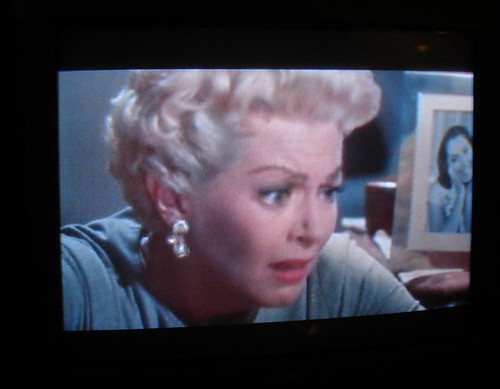
While Mr Daisy read a high-minded historical biography of Andrew Jackson, I sat there watching, yes, IMITATION OF LIFE, probably for the 100th time. I find it impossible to stop once I have started. I was one of those fan-girls who yelped with joy when John Travolta ordered the "Douglas Sirk steak" at Jack Rabbit Slim's in PULP FICTION. Douglas Sirk!
He was born Hans Detlef Sierck, which if you think about it, wouldn't sound nearly as good on the menu at Jack Rabbit Slim's:
Sirk's melodramas of the 1950s, while highly commercially successful, were generally very poorly received by reviewers. His films were considered unimportant (because they revolve around female and domestic issues), banal (because of their focus on larger-than-life feelings) and unrealistic (because of their conspicuous style).You can see the similarity to feminist blogging, she winked!
Well, I didn't need no European snobs to tell me that this is some great stuff. I was eagerly watching these movies as a kid, with the same unbridled abandon I used to read Harold Robbins novels or R. Crumb comic books, always thinking: I'm not supposed to be doing this, for some reason.
This dismissal of Sirk's films changed drastically in the 1970s when his work was re-examined by British and French critics. From around 1970 there was a considerable interest among academic film scholars for Sirk's work - especially his American melodramas. Often centering on the formerly criticized style, his films were now seen as masterpieces of irony. The plots of the films were no longer taken at face value, and the analyses instead found that the films really criticized American society underneath the banal surface plot. The criticism of the 1970s and early 1980s was dominated by an ideological take on Sirk's work, gradually changing from being Marxist-inspired in the early 1970s to being focused on gender and sexuality in the late 1970s and early 1980s.
IMITATION OF LIFE has the fascinating distinction of having been based on the 1933 novel written by Fannie Hurst:
Hurst, a white woman, was deeply involved in the Harlem Renaissance, and for a time lived with Zora Neale Hurston. Both Hurston and Langston Hughes claimed to like Imitation of Life, though both revoked their opinion after Sterling Allen Brown lambasted both the book and the first film in a review titled Imitation of Life: Once a Pancake, a reference to a line in the first film. The novel Imitation of Life continues to be highly controversial, as some read it as heavy-handed stereotyping, while others see it as a more subtle and subversive satire of and commentary on race, sex, and class in early 20th century America. Both text and films have remained deeply embedded in American consciousness, for better or worse, as evidenced by Toni Morrison's use of a character named "Pecola" in her 1970 novel The Bluest Eye.
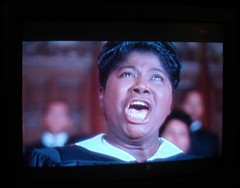 Left: Mahalia Jackson, sings at Annie's funeral in the overwrought finale.
 The first version, directed by John M. Stahl in 1934, didn't move me much, and has too many side-plots weighing the movie down. As in Hurst's original novel, the story of the racially-passing child is just too incendiary, and simply couldn't be the entire focus of a 30s movie. It was far too early and scary for racial honesty from Hollywood, and too early and scary for the (intended white) audience to absorb. By 1959, everything racial in the US was dangerously teetering and ready to go BOOM, and in Sirk's second version of the story, he goes whole hog and everything suitably bursts wide open, technicolor, bammo, in your face. (It's my opinion that only a foreign director could go this far in the 50s, having had no "direct involvement" in the ongoing American Racial Drama.) For instance, teen idol Troy Donahue (!!) [1] beats up the biracial Sarah-Jane when he discovers that she is passing, to the shock of the slack-jawed 50s audience. At the end, Mahalia Jackson sings Trouble of the World, and holy God, not a dry eye in the house.
And I should fess up. I love Lana Turner. She is almost in the same category as my Goddess Elizabeth. Unfortunately, Lana wasn't quite an actress, as was Liz, who had that uncanny born-in-cinema ability to make you believe anything. With Lana, you are periodically thinking, Oh come ON (with the steamy exception of THE POSTMAN ALWAYS RINGS TWICE). Lana's life was movie-material itself. Her daughter, Cheryl Crane, went on trial for the murder of Lana's mobster lover, Johnny Stompanato. My mother, who knew everything, told me Lana really did it. (Thus, I grew up staring at Lana in abject wonder; I figured any woman who gets away with stabbing a mobster and pinning it on her daughter must be some kind of evil genius.) [2]
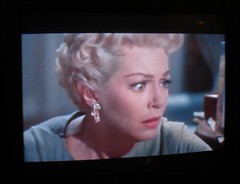 The parellel tracks of Lora and Susie (Sandra Dee) [3] in the film, and Lana and Cheryl in real life, are incredible to think about, since Lora portrays an actress in the film, as well. "Oh mama, STOP ACTING!" Susie begs her at one point, and Lora looks genuinely annoyed...did she hit a nerve? (Did Cheryl ever tell Lana that, in real life?) And this is a standard narrative (unhappy daughters) in Hollywood's "women pictures"--as it was in MILDRED PIERCE. From Stephen Handzo's article at Bright Lights Film Journal:
 If the working-class male was the presumed audience for the gangster film, one supposes the hypothetical patron of the woman's picture to have been a housewife rather than the aggressive career woman the films depicted. As in Mildred Pierce, the first half of Imitation of Life allows the housewife to experience vicariously the excitement of a career — and a glamorous one. Turner wears $1,000,000 worth of jewels in the film and a $78,000 Jean Louis wardrobe — 34 costume changes at an average cost of $2,214.13 each. (Even the film's main title is superimposed over cascading jewels that eventually clog the screen.) Although she is supposed to be a great actress, Turner is utilized to conform to her negative critical reputation as a "clothes horse."Even with the predictable chick flick baggage, IMITATION OF LIFE delivers on the big front, it's daring address of race in the 50s. Juanita Moore is prevailed upon to act like a saint in her role as Annie, which doesn't leave much room for interpretation. Perhaps if she'd been more human, 50s audiences would not have identified with her? She had to be "perfect"--but the 50s idea of perfect. Now, all of her "Miss Lora's" are like bludgeons to our (supposedly) advanced race-relations sensibilities. In my lifetime, I have gone from believing that Annie was completely honest with Lora, to realizing how careful she was in what she allowed her to see. There is a great exchange in which Lora believes Annie doesn't have any friends of her own, and Annie corrects her. She goes to the Baptist church, she tells her, and she knows lots of people. Lora says, "Annie, I never knew."
The second half of the classic woman's picture demonstrates that money does not buy happiness, which can only come from being successful in love, thereby reassuring the spectator that she was actually better off than the woman she has been encouraged to envy and enabling her to leave the film reconciled to returning to the domestic situation.
"Miss Lora," Annie says, "You never asked."
Susan Kohner, the Jewish-Mexican woman who plays angry Sarah Jane, strikes just the right notes in her performance. The scene in which she dances in her bedroom after making her decision to pass as white, is almost scary in its solipsism, as she kicks over a stuffed lamb for emphasis. She is fabulous in the role, but I think it's interesting that a racially-mixed African-American actress (such as Dorothy Dandridge or Lena Horne) [4] wasn't cast, although either would have been equally wonderful. I think the fact that nobody knew for sure WHAT Kohner was (she played a lot of Native Americans in Hollywood) worked well in the role. Everyone "knew" Dandridge and Horne were black. But the mystery of Kohner's ethnicity played well for the story, and added to the plot in a personal way. In several scenes, you can almost hear the 50s audience marveling that she could have fooled anyone! Which is the whole idea.
Handzo comments:
The scene in which Annie follows Sarah-Jane to her new apartment, is famous. Three-hanky alert! Make sure you have plenty of kleenex first, before watching:
Annie is the self-sacrificing mother dear to tearjerkers but to little purpose. Sara Jane wants something that even Mildred Pierce's money couldn't buy: white skin.
Where it is a common fault of both liberal problem pictures and soap operas to talk their issues to death, Imitation of Life excels in explicit directness. When Kohner's boyfriend (Troy Donahue) discovers that she has been passing for white, he beats her mercilessly. Instead of underplaying the melodramatic scene in the name of "good taste," Sirk intensifies it.
Kohner's escape from her racial identity takes the form of dancing in nightclubs; although the chorus lines are all white, this is a form of show business traditionally open to blacks as opposed to the "legitimate" theater of Turner's career. (Nevertheless, Lana Turner provides an indirect role model for Kohner just as Juanita Moore functions as a mother substitute to Dee.) In further contrast to the subdued colors of Turner's world, the nightclubs are a garish wonderland of reds and purples and all the gaudiness stereotypically associated with blacks merchandised to sensation-seeking whites.
Moore chases Kohner to Hollywood, where she finally agrees never to embarrass her daughter again by being seen with her.
Handzo:
This elaborate, overdone, melodramatic and beautiful soap-opera has a rock-hard truth at its core, which is what keeps some of us coming back to it again and again. What an interesting movie to show so soon after our recent election!
It is only with Annie's death that Sara Jane again acknowledges her mother. For the funeral scene, Sirk pulls out all the stops, even to Mahalia Jackson singing "Trouble of the World." Yet all the brilliant hues of the stained-glass windows and floral arrangements serve to throw into relief the most potent visual elements in this color film about color that are black and white: the white hearse requested by Annie, the white casket upon which Sara Jane flings herself hysterically when she finally realizes the emotional cost of this posthumous whiteness. As a final inversion, the white women, Turner and Dee, and Kohner, who wanted to be white, are reunited in Turner's black Chrysler limousine, temporarily equalized by the black of mourning. [5]
It's a new day, and let's hope our Sarah Janes never feel they must make such choices, ever again.
~*~
[1] During commercials, I was flipping back and forth from IMITATION OF LIFE to the GODFATHER movies, wherein Troy Donahue plays Connie Corleone's would-be husband, Merle, immortalized thusly: "Now, I don't know this Merle--I don't know what he does--I don't know what he lives on." (A shared catchphrase between me and Mr Daisy, regarding those interesting people who have no visible means of support.) Donahue's real name, in fact, was Merle Johnson. How amazing to see the arrogant teen idol morph into a middle-aged gigolo right before my eyes!
 Cover of Cheryl Crane's memoir, DETOUR.
[2] Obviously, nobody but Cheryl Crane, Lana Turner, and the deceased Johnny Stompanato, will ever know what really happened. But the standard Hollywood gossip and movie-magazine narrative was that Lana killed Johnny, and underage Cheryl took the fall for it, because she wouldn't get an adult sentence. Speaking of Harold Robbins, this was also the brazenly-stolen plot of his novel and subsequent movie Where Love Has Gone (1964), starring Susan Hayward as the Lana character (named Valerie) and Joey Heatherton as the Cheryl character (named Danielle). Heatherton, Stanley Kubrick's smoldering first choice for the role of LOLITA (Joey's dad said no), is perfect as an early-60s, juvenile delinquent-temptress, while Susan Hayward delivers one of those trademark threatening-to-boil-over performances of hers. (She's no Lana, but Joey is worth the movie.) In Cheryl Crane's biography DETOUR (yes, I just happen to have a copy of the book right HERE, she said, embarrassed), Cheryl dutifully repeats the legal version of events and I don't believe it for a minute. But the photos in the book are GREAT!
[3] Sandra Dee's delicate, wispy frame, once lauded in the coveted role of GIDGET, now causes me to wince, since I know (from reading DREAM LOVERS) that she had a harsh, world-class, Hollywood-style eating disorder. Her stage-mother had her injected with all manner of bizarre shit. (As I stated in my comments on this thread, I have long refused to watch the biopic of Bobby Darren, BEYOND THE SEA, because I heard it trashed his devoted wife Sandra Dee. And besides: KATE BOSWORTH?!? Not hardly.)
[4] Both had been considered for Elia Kazan's PINKY (1949), also about a biracial woman passing as white, but studios went with (decidedly lukewarm) Jeanne Crain, for box-office appeal. In the first IMITATION OF LIFE, Kohner's character was played by African-American actress Fredi Washington.
[5] The entire bang-up finale of IMITATION OF LIFE; Annie's death, Mahalia Jackson, the grand, over-the-top funeral, Sarah-Jane throwing herself on the casket in hysterics, is available on YouTube.
Monday, September 22, 2008
Earl Palmer 1924-2008
 Earl Palmer, by Ken Hively of the Los Angeles Times.
~*~
I have just learned that Rock and Roll Hall of Fame drummer and extraordinary talent of the 20th century, Earl Palmer, passed away on September 19th.
Some of the songs he played on--
Fats Domino: I’m Walkin, The Fat Man, Walkin to New Orleans
Little Richard: Tutti Frutti, Long Tall Sally
Lloyd Price: Lawdy Miss Clawdy
Ritchie Valens: La Bamba, Donna
Amos Milburn: Chicken Shack Boogie
Sam Cooke: You Send Me
Smiley Lewis: I Hear You Knockin, Shame Shame Shame
Jan and Dean: Dead Man's Curve, Little Old Lady from Pasadena
Palmer was also employed by Phil Spector for the bombastic Wall of Sound in the 1960s. He played on several of the Spector-era hits such as You've Lost That Lovin' Feelin by the Righteous Brothers.
Claire Noland writes in the LA Times:
Also: Tribute to Earl Palmer.
Born in New Orleans on Oct. 25, 1924, Earl Cyril Palmer was tap-dancing by age 5 on the black vaudeville circuit, touring with his mother, a singer, in Ida Cox's jazz and blues revue. He didn't learn to play drums until after serving in Europe with the Army in World War II. He returned to New Orleans and attended the Gruenwald School of Music on the GI Bill. He studied piano and percussion and learned to read, compose and arrange music.
But his childhood experiences served him well, Palmer said years later.
"I had the advantage of knowing music before I played it," he told jazz writer Zan Stewart in 1993. "Being a dancer gave me an understanding of rhythmic 'time,' and you can't teach that."
After the war, Palmer also began playing drums with the Dave Bartholomew Band and the house band at Cosimo Matassa's J&M studio in New Orleans. Jazz, blues, R&B and country music were fusing into a new, distinct genre of music, with Fats Domino, Little Richard, Lloyd Price and Smiley Lewis the frontmen laying down tracks in the early 1950s for what would become known as the beginnings of rock 'n' roll.
"What we were playing on those early records was funky in relation to jazz," Palmer told The Times in 2000. "What we were playing already had that natural New Orleans flavor about the music. I played the bass drum how they played bass drum in funeral parade bands."
In 1957 Palmer moved to Los Angeles to work for Aladdin Records but quickly became a first-call session drummer.
Besides providing the driving backbeat on many rock 'n' roll tunes, Palmer can also be heard on recordings by jazz and pop stars Frank Sinatra, Sarah Vaughan and Doris Day, as well as on the TV theme songs for "Mission: Impossible," "Green Acres" and "The Odd Couple," among others.
Resquiat In Pace.
~*~
Earl Palmer - Walkin
Subscribe to:
Posts (Atom)


