
 Photo of Van from Our Faerie Ancestors, used with tremendous gratitude!
~*~
One thing I loved about the TV show SIX FEET UNDER, was Nate's continuous apparitions of his father.
When you know someone very well, you know what they would say. You just know. Other times, you are dying to know.
I remember wishing Van a happy belated birthday, the same week as the People's Temple disaster. (He had attended the church a couple of times, pronouncing it "odd.") "Oh honey, those poor people! I can't bear it!" And those words echo, as I watch the TV shows chronicling the horrific events of 30 years ago. And I miss him, the one who couldn't bear it.
Missing my friend, one of the touchstones of my life, is almost impossible to write about. I have tried several times. What can you say about the sort of individual who is simply LARGER than life? An amazing, dynamic, theatrical personality who was a fountain of love, ferocious wit and unending generosity? I can say: he took me in when I had nowhere to go, fresh off a Greyhound bus from the midwest. He shared his home with me. He gave me the beginner's course in San Francisco 101, what to watch out for, who to trust, who not to trust. I couldn't have functioned there without him; my guide, my mentor for the city.
He was my best friend.
But I find I can't describe him accurately. He was just too big for words. His eyes were bright green, like a cat's. (If you dared ask him if they were contacts, he would mimic slapping you; they weren't.) He was 6'4" and struggled with keeping weight on his whole life. I met him when we were both 15 and he was already full-grown but weighed only 135 lbs. People gaped at him; the word gaunt barely covers it. He took me to the Chattanooga Choo-Choo restaurant in Tennessee and Glide Memorial Church and the I-Beam in San Francisco. He took me to gay bars and introduced me to the first drag queens I had ever seen in person. We danced late, late into the night at discos. He showed me porn and than ran it backward: "Watch how THIS looks!" and then hooted and squealed.
He was either the president or vice president of the official Supremes fan club. He would be mad at me for not remembering which. I have a photo of him with Mary Wilson, and on the back, his trademark scribble: "Don't I look like I'm coming?!" Yes, he did.
In short, I adored him. And I can barely write this. One of the major losses of my life, this beautiful person.
~*~
"What are THESE?" said the naive girl from the midwest, leafing through Van's wallet. There were several colorful, plastic membership cards to the popular San Francisco bath houses. "Do you take baths there?" asks naive, unaware Daisy.
"Well I suppose you could!" he winked at me. "But I don't know anyone who does!" I asked about the sexual protocol of the bath houses, and he told me everything.
~*~
 Left: Van wrote several new-age books in the 80s, and was on the staff of MAGICAL BLEND magazine. (I'm not sure if it is still publishing or not, but can't locate a decent web page.)
By the 90s, I had moved to the south, the same place he had escaped from. He tried to talk me out of it. "It's changed, Van, really," I said on the phone.
"Not nearly enough," he sniffed at me. He called it "Baptistland" and would sing made-up lyrics to the tune of Bruce Springsteen's "Jungleland"--down in BAP-TIST-LAAAAAND! Always, always, making me laugh.
I attempted to tactfully approach the subject of the bath houses, the MATH, the sheer MATH. Mathematical probabilities. I got sick when I thought of it, got a headache.
I couldn't tell him that, so I just asked: "Are you worried? Are you okay?"
"I'm fine," he said. And then he sent me a sparkly pagan greeting card assuring me that he was okay, while also informing me that he was HIV positive. "Constant changes," he added, signing his name.
Constant changes?
I wept, but composed myself before calling. "You calling to see if I'm still here?" he asked, acidly.
I shot back, "Maybe I am, what's wrong with that?"
"Don't lose that sass, sister-woman!" he ordered, laughing.
I've tried not to.
~*~
An actor (as well as writer), he liked to make phone calls 'in character'--invariably pretending to be other people. For my phone calls, it was Baptist preachers. In his best televangelist voice (which was remarkably authentic), he would shout into the phone at me: "I'm calling from Bloody Jesus Baptist Church, and would like to ask you to ATTEND THIS SUNDAY. Are you SAVED?" He changed the name of the church each time, and on at least two occasions, actually faked me out. He would chuckle, then gloriously guffaw, if he had actually fooled you. He did it to everybody. I heard him call a friend on the phone and pretend to be Laurence Olivier.
"He won't call me back, but betcha he calls LARRY!" he said to me, after hanging up.
~*~
(deep sigh) I love you, dearest Van. I missed your Scorpio birthday, because it has taken me since November 11th to write this coherently. Last year, could not manage it at all. I promised myself, this year. This year, I will write it.
Van's apparition says to me, "Don't take that stuff too seriously!" then muses, "If I'd had the internet, honey? I'd put it to some excellent uses!"
And the apparition adds, "Try not to waste your time, okay? Just don't waste it."
I won't. I promise, I won't.
~*~
When I left the Bay Area, he made me a mix tape. "This will make you think of me, and you can take it everywhere you go and think of---(((here he sang a deep baritone C)))---MEEEEEEEEEE!!!!!!"
And I did.
This was the last song on it.
Lena Horne - Believe in yourself (from "The Wiz")
Believe in yourself, as I believe in you.
Sunday, November 23, 2008
Van Robert Ault 1956-1996

Saturday, November 22, 2008
Bob Jones University issues apology about ‘racially hurtful’ policies of the past

~*~
The local news this morning is all about Pope Bubba issuing an official apology, just like the "big churches" have. Not to be outdone, he is issuing his own Papal bull, as well!
Although from the looks of it, this is not the doing of BJ3 or son Stephen Jones, current president of BJU. (As stated in my previous piece, Bob Jones VI was not considered morally fit to be University president and the gig therefore went to little brother.) This comes directly from the students and alumni! DEMOCRACY at BJU? I admit, I'm impressed. (Could be a dangerous precedent, letting people express themselves!)
Maybe someday, the apology for arresting gay people who dare to step foot on school property (see link above), will also be issued.
Bob Jones University issues apology about ‘racially hurtful’ policies of the past
By Ron Barnett • STAFF WRITER • November 22, 2008
Greenville News
Let me tell you, former (Republican) Councilman Scott Case couldn't find his butt with both hands, so this fact isn't surprising.
Bob Jones University has posted a statement on its Web site apologizing for its "racially hurtful" policies of the past, after hundreds of alumni and students signed a petition calling for an apology.
The fundamentalist Christian school on Wade Hampton Boulevard didn’t admit black students before 1971 and didn’t allow interracial dating until 2000.
"In so doing, we failed to accurately represent the Lord and to fulfill the commandment to love others as ourselves," the statement says. "For these failures we are profoundly sorry."
The statement traces the 81-year-old institution’s policies to the segregationist culture of the past rather than any theological reasons.
"Though no known antagonism toward minorities or expressions of racism on a personal level have ever been tolerated on our campus, we allowed institutional policies to remain in place that were racially hurtful," the statement says.
The university, which is not affiliated with any denomination, has students from all 50 states and nearly 50 countries, and solicits financial support for two scholarships for minority applicants, the statement says.
BJU President Stephen Jones, great-grandson of the school’s founder, is out of the country, and his father, Bob Jones III, the chancellor and past president, could not be reached for comment.
A university vice president would not comment, saying the statement speaks for the institution’s position. He did not mention the petition when asked what precipitated the apology.
The school fought a long court battle with the federal government when the IRS revoked its tax-exempt status because of its racially discriminatory policies.
A 1983 Supreme Court decision upholding the revocation notes that, "The sponsors of the university genuinely believe that the Bible forbids interracial dating and marriage." But the apology makes no mention of a biblical basis for the policies.
Instead, it says: "For almost two centuries American Christianity, including BJU in its early stages, was characterized by the segregationist ethos of American culture. Consequently, for far too long, we allowed institutional policies regarding race to be shaped more directly by that ethos than by the principals and precepts of the Scriptures.
"We conformed to the culture rather than provide a clear Christian counterpoint to it."
More than 500 students and alumni signed an online letter that was delivered to BJU’s president, board of trustees and administration on Wednesday, according to a Web site set up by the group.
"The school is widely known as segregationist, bigoted, and racist. Some of us were not aware of this reputation while we attended the university and were baffled when we encountered negative perceptions from others after we graduated," the letter, posted on the Web site www.please-reconcile.org, says.
"We see it in people’s faces and hear it in their comments and reactions upon learning where we went to school. Sometimes we encounter it in job interviews — troubling times to be confronted about racial prejudice. For some of us, employees suspect our motives as employers.
"Those of us who are ministers and spiritual leaders must explain our association with the university to minority congregants."
The apology met with skepticism from Greenville County Councilwoman Lottie Gibson, who recalls a "frightening experience" on campus in the early 1950s when she had gone to deliver food to a student and was told that "Negroes were not welcome here."
"Where I am with the Lord I want to forgive them," she said, when told of the apology. "It is just very difficult for me to give a clear forgiveness. I’m going to have to watch and see how this comes out."
County Auditor Scott Case, a white BJU graduate, said the interracial dating ban was "a non-issue" during his years at the school, 1983-87.
"I do not remember as a student ever having heard it discussed or talked about," he said.
I share Councilwoman Gibson's skepticism. We'll see.
It's interesting that BJU always seems to be a generation behind. They are finally getting with the program about race, but still offer no apologies for their open homophobia, and are in fact proud of it. As they were once quite proud of their racial policies.
Reading the statement, it sounds like an association with Bob Jones University has cost graduates a few jobs, hasn't it? On the Please Reconcile website, above, is this quote:
Dr. Bob Jones Jr. once wrote, “I try to avoid any statement for which I might have to apologize. If my enemies try to use against me something I have said, I reply, ‘I said it, I meant it, and I will now reemphasize it’” (Cornbread and Caviar, 84). He said it, he meant it, and he spends a number of pages in that chapter of Cornbread and Caviar illustrating his devotion to this dictum.And the same is happening right now, with the issue of homophobia. Bob Jones University does not allow openly GLBT students to attend, period.
What is truly unfortunate is that this statement applied not only to actual enemies, but also to Christian brothers. Friends who advised against certain statements and positions unwittingly became enemies. It was supposed that they were resisting the authority of the administrative family, even if the rebuke was carried out in private and with the intent of brotherly correction. Few issues brought as much contention as the issue of race, and exhortations to change positions met with a thunderous defense.
Back in August, I got in an argument with one of their employees about this. They obviously don't want to be called what they are: BIGOTS.
When they renounce ALL hate, I might pay attention to them and take them seriously. As it is now, they finally renounce their racism, only when a black man is about to be sworn in as President of the USA.
Better late than never, I suppose.
Wednesday, November 19, 2008
Wordless Wednesday: Bike race
 Happy Wordless Wednesday... and thanks to everyone who sent me a sympathetic email about my broken bone. YALL ARE THE BEST AND I LOVE YOU!!! (((snifff)))
Below, the St Francis Hospital bike race at Fall for Greenville, last month. As I said in that post, took me three laps before I understood that these fellas are as fast as The Flash, and I had to start clicking before the first one passes. As it was, I kept getting only the bikers at the end... the second picture is the last three bikers!
This doesn't bode well for a future in sports photography, don't think.
If you are here for Wordless Wednesday, hope you will hang around, enjoy yourself and come back!
~*~


Tuesday, November 18, 2008
Links and whining for your Tuesday

~*~
Still recovering at home, against my will. I have assorted documentation and will therefore get paid anyway, so that is something. No thanks to anti-labor Republicans!
I have debated blogging over my current disaster. But the fact is, it's embarrassing. I'll let you all guess: What is the first sign of getting old? What happens to old ladies, like clockwork? If you guess right, I'll fess up. Pretty shoddy of me, since I like to think I am Big Disability Rights Advocate Womyn!!! Ha, well, I guess not when it's ME, and some rather predictable old-lady thing. But that's how it works, yes? You don't get to choose these things yourself.
Onward, with the linkage, and your required reading/listening.
 Aunt B writes some awesomeness about country music. Pertinent quote:
My contention is and has always been that country music and urban music are the fun-house mirror reflections of each other–both share many of the same themes: deep pride in where one is from cut through with a strain of shame and anger about the circumstances one came from; a definition of manliness based in sexual prowess; a fascination with violence and guns; deep pride and anger about being outside of the mainstream; a definition of womanhood that is either based on very traditional notions of femininity or on being able to out-man the men; a love of vehicles; drinking; honoring tradition; and Mama.This kind of writing is why I am now addicted to Aunt B's blog!
And it’s no surprise to see them dancing around each other while very rarely crossing over. You can count the successful, respected white rappers on one hand, and use the other hand to count the successful, black country singers.
I bring all this up because I want to make a point about what country music means in terms of its racial focus and make-up. Country music is not usually “white” music. It’s traditionally specifically for white people who are outside of the mainstream, but who believe themselves to be some kind of bearer of Truth, some authentic experience unavailable to most folks, who are not “regular” folks.
In other words, it’s music of “regular” white people, but white folks who, in claiming regularity are claiming that in opposition to what most white folks have.
Smirking Chimp reminds us: Think U.S. is moving far left? That terrain's not even close. And he explains why, too, which is the really depressing part. Speaking of disability activism, check out Crip Chick's post on Sins Invalid, particularly the attractive and riveting Rodney Bell (first clip). Oh my! When such people exist, why do they give reality TV shows to increasingly uninteresting, boring clones? I ask you: Where is Rodney's show????
 The death of trans woman Duanna Johnson is being discussed by many bloggers, and will certainly be part of The International Transgender Day of Remembrance, November 20th.
If there is no event in your city, you could start your own. Here in the most conservative county in the USA, folks usually just meet over coffee and talk about books, blogs, and community--but that is something.
And it means, as always, passing the important knowledge on. And on.
Jill at Feministe points us to a fantastic article in THE ECONOMIST, about the dumbing down of the Republican party:Many conservatives—particularly lower-income ones—are consumed with elemental fury about everything from immigration to liberal do-gooders. They take their opinions from talk-radio hosts such as Rush Limbaugh and the deeply unsubtle Sean Hannity. And they regard Mrs Palin’s apparent ignorance not as a problem but as a badge of honour.I wondered where they got her from. CRUISES! Well, this explains plenty.
Another reason is the degeneracy of the conservative intelligentsia itself, a modern-day version of the 1970s liberals it arose to do battle with: trapped in an ideological cocoon, defined by its outer fringes, ruled by dynasties and incapable of adjusting to a changed world. The movement has little to say about today’s pressing problems, such as global warming and the debacle in Iraq, and expends too much of its energy on xenophobia, homophobia and opposing stem-cell research.
Conservative intellectuals are also engaged in their own version of what Julian Benda dubbed la trahison des clercs, the treason of the learned. They have fallen into constructing cartoon images of “real Americans”, with their “volkish” wisdom and charming habit of dropping their “g”s. Mrs Palin was invented as a national political force by Beltway journalists from the Weekly Standard and the National Review who met her when they were on luxury cruises around Alaska, and then noisily championed her cause.
And finally, POP FEMINIST gives a 70-minute interview about what it's like to grow up with a pornographer mother! Hmph! Just when you think your childhood was the weirdest of em all, someone comes along and OUTDOES you.
~*~
During my endless convalescence, my (never that solid) sanity has been saved by streaming the wonderful RadioIO. (Although hearing the late Porter Wagoner's "The Rubber Room" was a rather bizarre experience.) I was inordinately pleased to hear Robin Trower's "Too Rolling Stoned" after about 30 years. If you are up for over 7 minutes of psychedelic gee-tar, blowing your little mind (and certainly, I have nowhere else to go, dunno about yourself!)--please check it out... if you can't dig the first minute, as Queen Emily might say, you are rubbish! :P
And if you rock out to the whole thing? Go, my child, and sin no more. You've been redeemed!
Robin Trower - Too Rolling Stoned
Monday, November 17, 2008
IMITATION OF LIFE (1959)
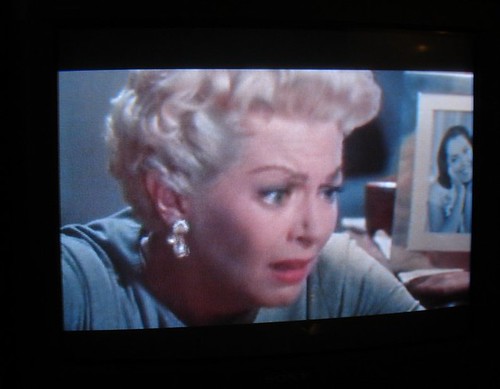
While Mr Daisy read a high-minded historical biography of Andrew Jackson, I sat there watching, yes, IMITATION OF LIFE, probably for the 100th time. I find it impossible to stop once I have started. I was one of those fan-girls who yelped with joy when John Travolta ordered the "Douglas Sirk steak" at Jack Rabbit Slim's in PULP FICTION. Douglas Sirk!
He was born Hans Detlef Sierck, which if you think about it, wouldn't sound nearly as good on the menu at Jack Rabbit Slim's:
Sirk's melodramas of the 1950s, while highly commercially successful, were generally very poorly received by reviewers. His films were considered unimportant (because they revolve around female and domestic issues), banal (because of their focus on larger-than-life feelings) and unrealistic (because of their conspicuous style).You can see the similarity to feminist blogging, she winked!
Well, I didn't need no European snobs to tell me that this is some great stuff. I was eagerly watching these movies as a kid, with the same unbridled abandon I used to read Harold Robbins novels or R. Crumb comic books, always thinking: I'm not supposed to be doing this, for some reason.
This dismissal of Sirk's films changed drastically in the 1970s when his work was re-examined by British and French critics. From around 1970 there was a considerable interest among academic film scholars for Sirk's work - especially his American melodramas. Often centering on the formerly criticized style, his films were now seen as masterpieces of irony. The plots of the films were no longer taken at face value, and the analyses instead found that the films really criticized American society underneath the banal surface plot. The criticism of the 1970s and early 1980s was dominated by an ideological take on Sirk's work, gradually changing from being Marxist-inspired in the early 1970s to being focused on gender and sexuality in the late 1970s and early 1980s.
IMITATION OF LIFE has the fascinating distinction of having been based on the 1933 novel written by Fannie Hurst:
Hurst, a white woman, was deeply involved in the Harlem Renaissance, and for a time lived with Zora Neale Hurston. Both Hurston and Langston Hughes claimed to like Imitation of Life, though both revoked their opinion after Sterling Allen Brown lambasted both the book and the first film in a review titled Imitation of Life: Once a Pancake, a reference to a line in the first film. The novel Imitation of Life continues to be highly controversial, as some read it as heavy-handed stereotyping, while others see it as a more subtle and subversive satire of and commentary on race, sex, and class in early 20th century America. Both text and films have remained deeply embedded in American consciousness, for better or worse, as evidenced by Toni Morrison's use of a character named "Pecola" in her 1970 novel The Bluest Eye.
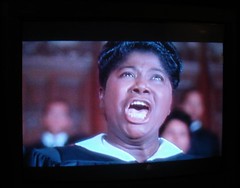 Left: Mahalia Jackson, sings at Annie's funeral in the overwrought finale.
The first version, directed by John M. Stahl in 1934, didn't move me much, and has too many side-plots weighing the movie down. As in Hurst's original novel, the story of the racially-passing child is just too incendiary, and simply couldn't be the entire focus of a 30s movie. It was far too early and scary for racial honesty from Hollywood, and too early and scary for the (intended white) audience to absorb. By 1959, everything racial in the US was dangerously teetering and ready to go BOOM, and in Sirk's second version of the story, he goes whole hog and everything suitably bursts wide open, technicolor, bammo, in your face. (It's my opinion that only a foreign director could go this far in the 50s, having had no "direct involvement" in the ongoing American Racial Drama.) For instance, teen idol Troy Donahue (!!) [1] beats up the biracial Sarah-Jane when he discovers that she is passing, to the shock of the slack-jawed 50s audience. At the end, Mahalia Jackson sings Trouble of the World, and holy God, not a dry eye in the house.
And I should fess up. I love Lana Turner. She is almost in the same category as my Goddess Elizabeth. Unfortunately, Lana wasn't quite an actress, as was Liz, who had that uncanny born-in-cinema ability to make you believe anything. With Lana, you are periodically thinking, Oh come ON (with the steamy exception of THE POSTMAN ALWAYS RINGS TWICE). Lana's life was movie-material itself. Her daughter, Cheryl Crane, went on trial for the murder of Lana's mobster lover, Johnny Stompanato. My mother, who knew everything, told me Lana really did it. (Thus, I grew up staring at Lana in abject wonder; I figured any woman who gets away with stabbing a mobster and pinning it on her daughter must be some kind of evil genius.) [2]
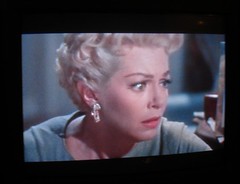 The parellel tracks of Lora and Susie (Sandra Dee) [3] in the film, and Lana and Cheryl in real life, are incredible to think about, since Lora portrays an actress in the film, as well. "Oh mama, STOP ACTING!" Susie begs her at one point, and Lora looks genuinely annoyed...did she hit a nerve? (Did Cheryl ever tell Lana that, in real life?) And this is a standard narrative (unhappy daughters) in Hollywood's "women pictures"--as it was in MILDRED PIERCE. From Stephen Handzo's article at Bright Lights Film Journal:
If the working-class male was the presumed audience for the gangster film, one supposes the hypothetical patron of the woman's picture to have been a housewife rather than the aggressive career woman the films depicted. As in Mildred Pierce, the first half of Imitation of Life allows the housewife to experience vicariously the excitement of a career — and a glamorous one. Turner wears $1,000,000 worth of jewels in the film and a $78,000 Jean Louis wardrobe — 34 costume changes at an average cost of $2,214.13 each. (Even the film's main title is superimposed over cascading jewels that eventually clog the screen.) Although she is supposed to be a great actress, Turner is utilized to conform to her negative critical reputation as a "clothes horse."Even with the predictable chick flick baggage, IMITATION OF LIFE delivers on the big front, it's daring address of race in the 50s. Juanita Moore is prevailed upon to act like a saint in her role as Annie, which doesn't leave much room for interpretation. Perhaps if she'd been more human, 50s audiences would not have identified with her? She had to be "perfect"--but the 50s idea of perfect. Now, all of her "Miss Lora's" are like bludgeons to our (supposedly) advanced race-relations sensibilities. In my lifetime, I have gone from believing that Annie was completely honest with Lora, to realizing how careful she was in what she allowed her to see. There is a great exchange in which Lora believes Annie doesn't have any friends of her own, and Annie corrects her. She goes to the Baptist church, she tells her, and she knows lots of people. Lora says, "Annie, I never knew."
The second half of the classic woman's picture demonstrates that money does not buy happiness, which can only come from being successful in love, thereby reassuring the spectator that she was actually better off than the woman she has been encouraged to envy and enabling her to leave the film reconciled to returning to the domestic situation.
"Miss Lora," Annie says, "You never asked."
Susan Kohner, the Jewish-Mexican woman who plays angry Sarah Jane, strikes just the right notes in her performance. The scene in which she dances in her bedroom after making her decision to pass as white, is almost scary in its solipsism, as she kicks over a stuffed lamb for emphasis. She is fabulous in the role, but I think it's interesting that a racially-mixed African-American actress (such as Dorothy Dandridge or Lena Horne) [4] wasn't cast, although either would have been equally wonderful. I think the fact that nobody knew for sure WHAT Kohner was (she played a lot of Native Americans in Hollywood) worked well in the role. Everyone "knew" Dandridge and Horne were black. But the mystery of Kohner's ethnicity played well for the story, and added to the plot in a personal way. In several scenes, you can almost hear the 50s audience marveling that she could have fooled anyone! Which is the whole idea.
Handzo comments:
The scene in which Annie follows Sarah-Jane to her new apartment, is famous. Three-hanky alert! Make sure you have plenty of kleenex first, before watching:
Annie is the self-sacrificing mother dear to tearjerkers but to little purpose. Sara Jane wants something that even Mildred Pierce's money couldn't buy: white skin.
Where it is a common fault of both liberal problem pictures and soap operas to talk their issues to death, Imitation of Life excels in explicit directness. When Kohner's boyfriend (Troy Donahue) discovers that she has been passing for white, he beats her mercilessly. Instead of underplaying the melodramatic scene in the name of "good taste," Sirk intensifies it.
Kohner's escape from her racial identity takes the form of dancing in nightclubs; although the chorus lines are all white, this is a form of show business traditionally open to blacks as opposed to the "legitimate" theater of Turner's career. (Nevertheless, Lana Turner provides an indirect role model for Kohner just as Juanita Moore functions as a mother substitute to Dee.) In further contrast to the subdued colors of Turner's world, the nightclubs are a garish wonderland of reds and purples and all the gaudiness stereotypically associated with blacks merchandised to sensation-seeking whites.
Moore chases Kohner to Hollywood, where she finally agrees never to embarrass her daughter again by being seen with her.
Handzo:
This elaborate, overdone, melodramatic and beautiful soap-opera has a rock-hard truth at its core, which is what keeps some of us coming back to it again and again. What an interesting movie to show so soon after our recent election!
It is only with Annie's death that Sara Jane again acknowledges her mother. For the funeral scene, Sirk pulls out all the stops, even to Mahalia Jackson singing "Trouble of the World." Yet all the brilliant hues of the stained-glass windows and floral arrangements serve to throw into relief the most potent visual elements in this color film about color that are black and white: the white hearse requested by Annie, the white casket upon which Sara Jane flings herself hysterically when she finally realizes the emotional cost of this posthumous whiteness. As a final inversion, the white women, Turner and Dee, and Kohner, who wanted to be white, are reunited in Turner's black Chrysler limousine, temporarily equalized by the black of mourning. [5]
It's a new day, and let's hope our Sarah Janes never feel they must make such choices, ever again.
~*~
[1] During commercials, I was flipping back and forth from IMITATION OF LIFE to the GODFATHER movies, wherein Troy Donahue plays Connie Corleone's would-be husband, Merle, immortalized thusly: "Now, I don't know this Merle--I don't know what he does--I don't know what he lives on." (A shared catchphrase between me and Mr Daisy, regarding those interesting people who have no visible means of support.) Donahue's real name, in fact, was Merle Johnson. How amazing to see the arrogant teen idol morph into a middle-aged gigolo right before my eyes!
 Cover of Cheryl Crane's memoir, DETOUR.
[2] Obviously, nobody but Cheryl Crane, Lana Turner, and the deceased Johnny Stompanato, will ever know what really happened. But the standard Hollywood gossip and movie-magazine narrative was that Lana killed Johnny, and underage Cheryl took the fall for it, because she wouldn't get an adult sentence. Speaking of Harold Robbins, this was also the brazenly-stolen plot of his novel and subsequent movie Where Love Has Gone (1964), starring Susan Hayward as the Lana character (named Valerie) and Joey Heatherton as the Cheryl character (named Danielle). Heatherton, Stanley Kubrick's smoldering first choice for the role of LOLITA (Joey's dad said no), is perfect as an early-60s, juvenile delinquent-temptress, while Susan Hayward delivers one of those trademark threatening-to-boil-over performances of hers. (She's no Lana, but Joey is worth the movie.) In Cheryl Crane's biography DETOUR (yes, I just happen to have a copy of the book right HERE, she said, embarrassed), Cheryl dutifully repeats the legal version of events and I don't believe it for a minute. But the photos in the book are GREAT!
[3] Sandra Dee's delicate, wispy frame, once lauded in the coveted role of GIDGET, now causes me to wince, since I know (from reading DREAM LOVERS) that she had a harsh, world-class, Hollywood-style eating disorder. Her stage-mother had her injected with all manner of bizarre shit. (As I stated in my comments on this thread, I have long refused to watch the biopic of Bobby Darren, BEYOND THE SEA, because I heard it trashed his devoted wife Sandra Dee. And besides: KATE BOSWORTH?!? Not hardly.)
[4] Both had been considered for Elia Kazan's PINKY (1949), also about a biracial woman passing as white, but studios went with (decidedly lukewarm) Jeanne Crain, for box-office appeal. In the first IMITATION OF LIFE, Kohner's character was played by African-American actress Fredi Washington.
[5] The entire bang-up finale of IMITATION OF LIFE; Annie's death, Mahalia Jackson, the grand, over-the-top funeral, Sarah-Jane throwing herself on the casket in hysterics, is available on YouTube.


